These words aren't interchangeable. Understanding what each one actually means can change how you protect your health.
You've probably seen "sanitizing," "sterilizing," and "disinfecting" used interchangeably on product labels, in marketing, and in everyday conversation. Even during the pandemic, these terms were thrown around as if they meant the same thing.
They don't.
Each word represents a different level of germ-killing effectiveness, and choosing the wrong approach for your situation can leave you less protected than you think - or cause you to use harsh chemicals when you don't need to.
Here's what you actually need to know.
The Germ-Killing Hierarchy
Think of cleaning, sanitizing, disinfecting, and sterilizing as a ladder. Each rung represents a higher level of microbial elimination:
Cleaning → Sanitizing → Disinfecting → Sterilizing
The higher you go, the more germs you kill - but the more effort, time, or specialized equipment required. Most situations don't require climbing to the top of the ladder. Understanding where you need to be saves you time, money, and exposure to unnecessary chemicals.
Cleaning: The Foundation
Before we talk about killing germs, we need to talk about removing them.
Cleaning is the physical removal of dirt, dust, debris, and germs from surfaces using soap (or detergent) and water. The mechanical action of scrubbing loosens contaminants and washes them away.
Here's the critical point: cleaning doesn't kill germs - it removes them.
When you wash your hands with soap and water, you're not killing the bacteria and viruses. You're physically removing them from your skin and rinsing them down the drain. The soap breaks down the oils and organic matter that germs cling to, and the friction of rubbing dislodges them.
Cleaning is always the first step. You cannot effectively sanitize, disinfect, or sterilize a dirty surface. The dirt and organic matter shield microorganisms from whatever germ-killing method you're using.
When cleaning is enough: Most everyday situations. Regular cleaning of surfaces, dishes, laundry, and hands keeps germ levels manageable for healthy individuals in normal circumstances.
Sanitizing: Reducing Germs to Safe Levels
Sanitizing reduces the number of germs on a surface to a level considered safe by public health standards.
The key word here is "reduces." Sanitizing doesn't eliminate all germs - it brings the population down to an acceptable threshold where the risk of infection transmission is low.
According to EPA standards, a sanitizer must reduce a specific test bacterium by 99.999% (a 5-log reduction) within 30 seconds. That sounds impressive, but remember: this is reduction, not elimination. Some germs survive. And importantly, this standard is tested against specific bacteria, not all possible pathogens.
Sanitizing is strongly associated with the food industry. Health codes require food-contact surfaces (cutting boards, counters, utensils) to be sanitized after use. The logic is simple: you're preparing food on these surfaces, and while you want to reduce bacterial contamination, you also don't want chemical residue that could transfer to food.
Common sanitizing methods include:
- Dilute bleach solutions (weaker than disinfecting concentrations)
- Quaternary ammonium compounds ("quats")
- Heat (like hot water in commercial dishwashers)
- UV light devices
When sanitizing is enough: Food preparation surfaces, dishes, areas where chemical residue is a concern, situations where you need to reduce germs quickly without harsh chemicals.
Disinfecting: Killing the Germs
Disinfecting goes a step further than sanitizing by actually killing pathogenic microorganisms on surfaces.
According to the CDC, disinfection "eliminates many or all pathogenic microorganisms, except bacterial spores, on inanimate objects." The EPA requires disinfectants to kill 99.999% of germs - but with a broader range of pathogens than sanitizers, including bacteria, viruses, and fungi.
Notice that phrase: "except bacterial spores." This is the key difference between disinfecting and sterilizing. Bacterial spores are extremely hardy dormant forms that some bacteria create to survive harsh conditions. They're incredibly difficult to kill and can survive most disinfection processes.
Disinfecting uses stronger chemical solutions than sanitizing:
- Higher-concentration bleach solutions
- Alcohol-based products (typically 60-90%)
- Hydrogen peroxide
- Phenolic compounds
- EPA-registered disinfectant sprays and wipes
The CDC recommends disinfecting (rather than just sanitizing) when someone in your household is sick or immunocompromised, or when surfaces may have been contaminated with pathogens of concern.
Important note: Contact time matters enormously with disinfectants. The product label will specify how long the surface must remain wet with the disinfectant to achieve the claimed kill rate. This "dwell time" or "contact time" can range from 30 seconds to 10 minutes or more. If you spray and immediately wipe, you're not getting the full disinfecting effect.
When disinfecting is necessary: High-touch surfaces during illness, bathroom surfaces, areas contaminated with bodily fluids, situations where known pathogens are present, healthcare-adjacent environments.
Sterilizing: Complete Elimination
Sterilizing is the nuclear option. It destroys all microorganisms - including those hardy bacterial spores that survive disinfection - and renders a surface or object completely free of microbial life.
Sterilization is the standard in medical settings. Surgical instruments are sterilized before procedures. Dental tools are sterilized between patients. Laboratory equipment is sterilized to prevent contamination of experiments.
Common sterilization methods include:
- Autoclaving: Using pressurized steam at 121°C (250°F) for 15-30 minutes
- Dry heat: Extended exposure to temperatures of 160-180°C
- Ethylene oxide gas: For heat-sensitive equipment
- Hydrogen peroxide gas plasma: Another option for heat-sensitive items
- Gamma radiation: Used in industrial settings
Notice something? These are all professional-grade methods requiring specialized equipment. You're not sterilizing anything in your home kitchen.
Here's a crucial point from infection control experts: Sterilization is neither necessary nor desirable for everyday household surfaces.
Why? Because the normal population of harmless microbes living on surfaces actually helps keep harmful ones at bay through competition. Creating a sterile environment in your home would disrupt this microbial ecology - and it's impossible to maintain anyway.
When sterilizing is necessary: Medical instruments before invasive procedures, laboratory equipment, pharmaceutical manufacturing, situations where absolute absence of microbial life is required.
Where Does UV-C Fit In?
Here's where things get interesting for everyday consumers.
UV-C light (ultraviolet light in the germicidal wavelength range of 200-280 nanometers) represents a different approach to killing germs. Instead of using chemicals, UV-C damages the DNA and RNA of microorganisms, preventing them from reproducing and rendering them inactive.
UV-C is classified as a disinfection technology. It kills bacteria, viruses, and fungi on surfaces exposed to adequate dosage. In healthcare settings, UV-C devices are used for high-level disinfection of rooms and equipment.
The advantages of UV-C over chemical disinfection are significant:
No chemicals: UV-C leaves no residue, produces no fumes, and doesn't require rinsing. This makes it safe for electronics, delicate items, and situations where chemical exposure is undesirable.
Speed: Chemical disinfectants require extended contact times (often 10+ minutes). UV-C can achieve significant germ reduction in seconds to minutes, depending on the device and distance.
Broad-spectrum effectiveness: UV-C doesn't discriminate between types of germs. Bacteria, viruses, and fungi are all vulnerable to UV-C damage. This contrasts with some chemical disinfectants that are more effective against certain pathogen types.
No resistance: Unlike antibiotics and some chemical disinfectants, microorganisms cannot develop resistance to UV-C. The physical mechanism of DNA damage works regardless of bacterial evolution.
The limitations of UV-C are also important to understand:
Line-of-sight only: UV-C only disinfects surfaces it directly reaches. Shadows, crevices, and covered areas won't be disinfected.
Surface condition matters: Dirt and debris can shield microorganisms from UV-C exposure. Cleaning before UV-C disinfection improves effectiveness.
Dosage matters: Different organisms require different UV-C doses for inactivation. The intensity of the light and the exposure time both factor into effectiveness.
The UVCeed Approach
This is why UVCeed was designed the way it was.
UVCeed provides consumer-accessible UV-C disinfection - bringing technology previously limited to hospitals and laboratories into your everyday life. In independent testing, UVCeed demonstrated:
- 99.9% reduction of Staphylococcus aureus in 15 seconds
- 99.99% reduction of E. coli in 24 seconds
- 99.9% reduction of SARS-CoV-2 in 32 seconds*
That's disinfection-level germ reduction, achieved in seconds, without chemicals.
The UVCeed system is designed for flexibility:
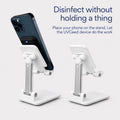
Handheld device: Disinfect any surface by passing the UVCeed device over it. Hotel remotes, airplane tray tables, shopping cart handles, gym equipment - anything you can reach.
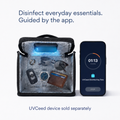
Bag Adapter: Create an enclosed disinfection chamber for your everyday items. Keys, wallet, phone, earbuds, sunglasses, baby items - place them in the bag, zip it closed, and let UV-C do its work.
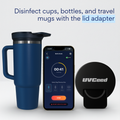
Lid Adapter: Disinfect the interior of travel mugs and tumblers (Stanley, Yeti, etc.) that can harbor bacteria and mold in their hard-to-clean interior surfaces.
One device, multiple adapters, comprehensive protection.
Choosing the Right Level for Your Situation
Here's a practical guide for everyday decisions:
| Situation | Level Needed | Best Approach |
|---|---|---|
| Everyday kitchen surfaces | Cleaning | Soap and water |
| Food prep surfaces | Sanitizing | Dilute bleach or sanitizing spray |
| Bathroom surfaces | Disinfecting | EPA-registered disinfectant |
| During household illness | Disinfecting | Disinfectant or UV-C |
| High-touch items (phone, keys) | Disinfecting | UV-C (no chemicals on electronics) |
| Travel (hotel, plane) | Disinfecting | UV-C (portable, no liquids) |
| Medical instruments | Sterilizing | Professional autoclave |
For most consumer situations, you're choosing between sanitizing and disinfecting. Sterilizing is overkill (and impractical), while cleaning alone may not be enough when pathogens are present.
Common Misconceptions
"Hand sanitizer sterilizes your hands."
No. Hand sanitizer (typically 60%+ alcohol) sanitizes your hands by reducing germ populations. It doesn't sterilize, and it doesn't work as well as soap and water for many pathogens - including norovirus, which causes stomach flu.
"If I use more disinfectant, it works better."
Not necessarily. Chemical disinfectants are formulated for specific concentrations. Using more doesn't speed up the process or increase effectiveness - it just wastes product and may leave residue. Follow label directions.
"Antibacterial soap is better than regular soap."
The FDA found no evidence that antibacterial soaps work better than regular soap and water. The mechanical action of washing is what removes germs. Some antibacterial ingredients may actually contribute to antibiotic resistance.
"UV-C can sterilize surfaces."
Technically possible but impractical for consumer use. True sterilization requires very high UV-C doses and controlled conditions. Consumer UV-C devices provide disinfection, which is appropriate for everyday use.
"Natural products clean and disinfect."
Cleaning? Yes - many natural products can clean effectively. Disinfecting? Usually no. Vinegar, essential oils, and similar products don't meet EPA standards for disinfection. They may reduce some microbes, but they're not proven disinfectants.
The Bottom Line
Understanding the difference between sanitizing, sterilizing, and disinfecting isn't academic - it directly impacts how effectively you protect yourself and your family.
For everyday household use:
- Clean regularly with soap and water
- Sanitize food-contact surfaces
- Disinfect when illness is present or contamination is suspected
- Sterilize is almost never necessary outside medical settings
For portable, chemical-free disinfection of the items you touch every day, UV-C technology like UVCeed brings hospital-grade germ-killing to your pocket.
No chemicals. No wait times. No guessing.
Just proven disinfection in seconds.
Ready to upgrade from sanitizing to true disinfection? Explore the UVCeed system and see how UV-C technology can fit into your daily routine.
Want More Articles Like This?
Get research on UV-C treatment and product updates delivered to your inbox.