TL;DR
The CDC and FDA confirm a 1,947-person cyclospora outbreak across 9 states, tied to shredded iceberg lettuce from Taylor Farms de Mexico served at some Taco Bell locations. 98 people have been hospitalized. No deaths reported. Taylor Farms voluntarily pulled all iceberg lettuce sourced from central Mexico from the U.S. market on July 17, 2026. If your kid ate at Taco Bell in June or July, know the symptoms. And know that in your own kitchen, 254 nm UV-C inactivates bacteria on food surfaces and prep surfaces in an app-guided session. FDA rules mean we can't cite a specific reduction percentage on food, but UV-C is a real tool, and UVCeed puts it in your hand.
What happened
The CDC's official investigation update reports:
- 1,947 people infected with cyclospora with reported Taco Bell exposure
- 98 hospitalizations
- 9 states affected: Illinois, Indiana, Kansas, Kentucky, Michigan, Ohio, Oklahoma, Pennsylvania, West Virginia
- Onset dates: June 22, 2026 through July 20, 2026
- Source: shredded iceberg lettuce from Taylor Farms de Mexico, sourced from central Mexico
- Corrective action: Taylor Farms voluntarily removed the implicated lettuce from the U.S. market on July 17, 2026
Sources:
- Investigation Update: Cyclospora Outbreak, July 2026 - CDC
- Shredded iceberg lettuce served at Taco Bell locations is source of cyclosporiasis infections - CDC Newsroom
- Investigation of 9-State Outbreak of Cyclospora Illnesses: Iceberg Lettuce (July 2026) - FDA
- Taylor Farms pulling iceberg lettuce after tie to cyclospora outbreak - CNN, July 16, 2026
What cyclospora does to a kid
Cyclosporiasis is caused by Cyclospora cayetanensis, a microscopic parasite spread through contaminated food or water. It is not spread person-to-person the way norovirus is; it needs an incubation period in the environment.
Symptoms in a child typically start 7 days after exposure and include:
- Watery diarrhea, often severe and prolonged
- Loss of appetite and weight loss
- Cramping, bloating, gas
- Nausea, occasional vomiting
- Low-grade fever
- Fatigue
The tricky part for parents: if your child ate at Taco Bell in mid-July and had a "stomach thing" a week later that seemed to resolve, cyclospora can relapse. Symptoms come and go for weeks without treatment. It requires a specific antibiotic (usually trimethoprim-sulfamethoxazole) prescribed by a doctor.
If you suspect it, call your pediatrician and specifically request a stool test for Cyclospora cayetanensis. Standard stool panels don't always catch it.
Source: Cyclosporiasis - CDC
Why this keeps happening (and why "wash your greens" isn't enough)
Cyclospora oocysts are spectacularly hard to kill on produce:
- They are resistant to chlorine at standard sanitation levels
- They survive standard produce washing
- They are too small to reliably remove by rinsing alone
- Cooking to over 160°F does kill them, but that defeats the purpose of a salad
This is why the FDA doesn't recommend home rinsing as a sufficient defense against cyclospora. The safest defenses are supply-chain interventions upstream and, at home, thorough cooking for produce that has been implicated.
But cooking your salad is not a plan.
Where UV-C fits, at home
254 nm UV-C inactivates bacteria and parasites by damaging the nucleic acids they need to replicate. Municipal water systems use UV-C to inactivate cryptosporidium and giardia. See: Ultraviolet Disinfection - EPA drinking water guidance.
At home, UVCeed's 254 nm UV-C can be used on:
- Kitchen countertop and prep surfaces where produce is chopped
- Cutting boards after washing
- Sink faucet handles (frequent recontamination point)
- Refrigerator handle, drawer, and shelves where produce sits
- The lunchbox your kid carries the salad in
- The produce itself. 254 nm UV-C inactivates bacteria on food surfaces including leafy greens. FDA rules prevent us from citing a specific reduction percentage on food, so we don't. UV-C is a supplement to washing and, when relevant, cooking, not a substitute.
Where UVCeed fits
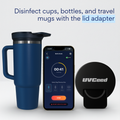
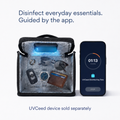
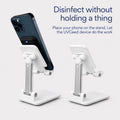
UVCeed is a smartphone-mounted 254 nm UV-C device that runs an app-guided session. You aim at the surface, hold it steady, and the app confirms when that section has received a full germicidal dose. For larger surfaces (like a full countertop), you move to the next section and run another session.
Family kitchen features:
- 254 nm UV-C, the germicidal wavelength
- App-guided sessions, so you know each section is complete
- Tilt-safety shutoff, so it will not fire if pointed at a person or pet
- USB-C charging
- Pocket-sized, works over the kitchen counter, in a lunchbox, or on a family road trip
Kitchen session checklist for the next 7 days
Post this on the fridge. Run one session per surface:
- Countertop (each section)
- Cutting board (after washing and drying)
- Sink faucet handles (hot and cold, both sides)
- Refrigerator handle
- Refrigerator interior handle
- Refrigerator produce drawer handles
- The bagged salad exterior before you open it
- Kids' lunchbox interior and exterior
- Kids' reusable water bottle exterior
- Highchair tray and armrests
- Silicone lids and containers before use
FAQ
My kid ate at Taco Bell in July. What should I watch for? Watery diarrhea starting 5 to 14 days after the meal, especially if it's prolonged or waxes and wanes. Call your pediatrician and specifically request testing for Cyclospora cayetanensis.
Does UV-C kill cyclospora? 254 nm UV-C damages nucleic acids in bacteria, viruses, and protozoa. Municipal water systems rely on UV-C to inactivate protozoan oocysts including cryptosporidium. On food surfaces, FDA rules prevent us from citing a specific reduction percentage, so we don't.
Can I use UVCeed on the produce itself? Yes. 254 nm UV-C inactivates bacteria on food surfaces including leafy greens. FDA rules prevent us from citing a specific reduction percentage on food. Rinse first, then run a session on the produce and the prep zone.
Is UV-C safe around kids? UVCeed's tilt-safety shutoff means the beam stops if it's not pointed at a surface. Run sessions when kids are not directly in the beam path.
How long does a session take? 30 to 60 seconds per section. The app confirms.
Can I use it on baby bottles or pacifiers? Yes, on the exterior hard surfaces. For sterilizing bottle interiors before feeding a newborn, standard steam sterilizers remain the gold standard.
The bottom line
The Taco Bell cyclospora outbreak is a reminder that supply-chain contamination reaches the family kitchen, and that "just rinse it" doesn't stop parasites this stubborn. UVCeed puts 254 nm UV-C in your hand for the surfaces where produce is prepped, stored, and served. App-guided sessions mean you know each section is done.
Want More Articles Like This?
Get research on UV-C treatment and product updates delivered to your inbox.