TL;DR
On July 22, 2026, Midwest Poultry Services L.P. voluntarily recalled 1,589,577 dozen eggs (roughly 19 million eggs) sold under the Kroger, Simple Truth, and Brookshire's brands after being linked to a multistate Salmonella Enteritidis outbreak. As of the FDA's most recent update, 98 people across 17 states have been infected and 26 have been hospitalized. The eggs shipped from farms in Texas between June 6 and July 3, 2026, with sell-by dates through August 17, 2026. If you bought them, throw them out or return them. Then disinfect every surface those eggs touched: your fridge shelf, your egg carton area, your kitchen sink, your countertops, and any bowl or utensil that made contact. 254 nm UV-C is an effective, chemical-free way to close that loop.
What Actually Happened
Midwest Poultry Services, headquartered in Mentone, Indiana, but operating farms in Texas, initiated the recall after FDA sampling and CDC epidemiological data connected their eggs to an active Salmonella Enteritidis outbreak. The FDA recall notice covers:
- Roughly 19 million eggs (1,589,577 dozen)
- Sold under Kroger, Simple Truth, and Brookshire's brand names
- Sell-by / best-by dates: July 20 through August 17, 2026
- Distributed to Kroger stores in Texas and Louisiana and to Brookshire Grocery stores in Arkansas, Louisiana, Mississippi, New Mexico, Oklahoma, and Texas, per TODAY's summary
The FDA outbreak investigation page reports 98 illnesses across 17 states, 26 hospitalizations, and no deaths so far.
Why Egg Salmonella Is a Whole-Kitchen Problem, Not Just a Food Problem
Salmonella Enteritidis is the strain most commonly associated with eggs, and it is dangerous specifically because it can be inside the intact egg before the shell is even cracked, per CDC background. This is different from most produce contamination, where the pathogen sits on the outside.
Practically, that means once a contaminated egg enters your kitchen:
- The shell may carry Salmonella from the hen or the packing plant
- The inside may already contain Salmonella before you crack it
- The carton absorbs and transfers cells from shell to shelf
- The fridge shelf the carton sat on picks up whatever was on the carton
- Your hands touch the shell, then the sink handle, then the counter, then the pan handle
- The countertop and sink carry cells until they are properly cleaned
The CDC estimates Salmonella causes about 1.35 million infections in the US every year, with 26,500 hospitalizations and 420 deaths. Eggs are one of the top three food vehicles, along with poultry and produce.
What To Do If You Bought the Recalled Eggs
- Do not eat them. Return to the store for a refund or throw them away in a sealed bag.
- Wash your hands with soap and hot water for at least 20 seconds after handling the carton, per CDC hand-washing guidance.
- Empty the fridge shelf the eggs sat on. Wipe with hot soapy water first, then a disinfectant that is EPA-registered for Salmonella, then allow to air-dry.
- Wipe every surface the carton, the eggs, or your egg-handling hands touched: the sink handle, the fridge door handle, the counter, the bowl, the whisk, the pan handle.
- Watch for symptoms for the next 6 days: diarrhea, fever above 102°F, bloody stools, dehydration. Kids under 5, adults over 65, and immunocompromised people should call a doctor sooner rather than later.
The FDA reminder is to also clean high-touch handles that get missed in a normal wipe-down: cabinet pulls, oven handle, refrigerator handle.
Where UV-C Fits In a Kitchen Cleanup
UV-C at 254 nm is well-documented for inactivating Salmonella on hard, non-porous surfaces. A study indexed on PubMed demonstrated significant Salmonella reduction on food-contact surfaces after direct UV-C exposure. UV-C works by damaging the pathogen's DNA and preventing it from reproducing, with no chemical residue left on food-prep surfaces.
Where UV-C helps after an egg recall:
- The fridge shelf, drawer edges, and door handle
- The countertop where you cracked the eggs
- The sink handle and faucet
- Utensils, bowls, and cutting boards (after normal washing)
- The refrigerator handle, oven door handle, and cabinet pulls that got touched during cooking
Where UV-C does not help:
- Inside a raw egg that is already contaminated
- Under debris, in cracks, or in porous grout (line-of-sight limit)
- On absorbent materials like sponges, where organisms sit inside the material rather than on the surface (the NSF has documented sponges as the single dirtiest object in the average kitchen)
Where UVCeed Fits
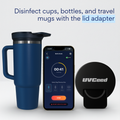
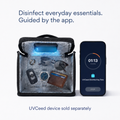
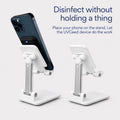
UVCeed is a 254 nm UV-C device that pairs with your phone and uses your camera plus the app to guide you through a session on the exact surface you are treating. You aim UVCeed at one section of the fridge shelf or countertop, hold it steady until the app confirms the section is complete, then move to the next section if the surface is larger than the coverage area. The app tracks coverage in real time and the tilt-safety shutoff kills the lamp if the device rotates away from the target.
Practical UVCeed sessions after this recall:
- Fridge shelf and door handle: run a session on the shelf where the carton sat, then on the fridge door handle and sink handle
- Countertop: run a session on the section where eggs were cracked
- Bowls and utensils: after normal wash, run a session on high-contact edges
- Fridge egg tray/drawer: often overlooked, high risk after any egg recall
FAQ
Can UV-C sanitize the eggs themselves? 254 nm UV-C inactivates bacteria on food surfaces including eggshells. FDA rules prevent us from citing a specific reduction percentage on food, so we do not. But with this recall, the FDA says do not eat these eggs. UV-C is not a way to salvage recalled product; it is a way to reduce cross-contamination on the surfaces the eggs touched.
How long can Salmonella survive on a fridge shelf? The CDC notes Salmonella can persist for hours to weeks on hard surfaces, depending on temperature and humidity. Refrigerator conditions slow bacterial replication but do not kill Salmonella; the pathogen simply waits.
Does cooking make recalled eggs safe? The CDC advises cooking eggs to an internal temperature of 160°F to kill Salmonella. But this recall is about a confirmed contamination event with 98 illnesses and 26 hospitalizations. The FDA recommendation is: do not use them. Cooking eliminates the pathogen in the egg but does not solve cross-contamination that already happened on your counter and hands.
Are cage-free eggs safer? No. The recalled brands include Kroger Simple Truth cage-free eggs. Salmonella Enteritidis is not solved by housing type; it is solved by farm-level biosecurity, testing, and the cook temperature at your stove.
Is UV-C safer than bleach on my kitchen? Both work if used correctly. Bleach is EPA-registered for Salmonella and works well when diluted properly, but it corrodes stainless steel, damages some countertop finishes, and creates fumes. Quaternary ammonium sprays leave residue that a 2021 study in Environmental Science and Technology found in the blood of 80% of tested adults. UV-C leaves no residue and no fumes. The tradeoff is line-of-sight: UV-C does not reach into grout or under items.
The Bottom Line
An egg recall is not really about the eggs. By the time you learn about it, the surfaces in your kitchen have already been touched. The Midwest Poultry recall covers 19 million eggs, sold in seven states, over a 4-week distribution window. If any of those eggs came home with you, the follow-up is a full disinfection of every surface they touched. UVCeed makes that a chemical-free, 60-second-per-section routine.
Want More Articles Like This?
Get research on UV-C treatment and product updates delivered to your inbox.