TL;DR
A multistate Salmonella outbreak linked to pet turtles has grown to 20 confirmed cases across 12 states as of the CDC's September 18, 2026 update, with 5 hospitalizations. Half of the people sick are children younger than 5, and the outbreak investigation remains open, meaning the case count is likely to keep climbing. The strain, Salmonella Paratyphi B Variant L(+) Tartrate+, spreads through direct contact with turtles or anything in their habitat, and small, cute turtles that look perfectly clean are exactly the ones the CDC has been warning about for years.
What actually happened
According to the CDC's outbreak investigation page, public health officials are tracking a multistate Salmonella outbreak tied to contact with pet turtles, caused by Salmonella Paratyphi B Variant L(+) Tartrate+. The outbreak was first announced on August 5, 2026 with 8 sick children across 6 states. By the most recent update on September 18, that had more than doubled: 20 people sick across 12 states, with 5 hospitalizations, according to the CDC's investigation update. Illness onset dates range from June 6 to July 4, 2026, and Marler Blog's coverage of the case notes that the case count has continued to climb as more illnesses get linked to the outbreak retroactively, a common pattern with Salmonella investigations because it can take weeks for a case to get reported and matched to an outbreak strain.
All of the people sick are children younger than 10, and about half are younger than 5, according to the CDC. That age skew is not a coincidence. Toddlers and young children are more likely to put their hands in their mouths after handling a pet or touching a surface near its habitat, and they are also more vulnerable to severe Salmonella infection than older children or healthy adults.
Why "small and cute" is the actual risk factor
Turtles do not need to look sick, or even look dirty, to carry Salmonella. The bacteria live naturally in a healthy turtle's gut and get shed in its droppings, which contaminate the tank water, the basking rocks, the feeding dishes, and anything else in or near the habitat, even the outside of the tank itself if hands touch it and then touch a doorknob or a countertop. The CDC has specifically flagged turtles with shells shorter than 4 inches as historically the biggest source of illness, which is exactly why federal regulation has banned the sale of turtles under 4 inches as pets since 1975, a rule that still gets routinely ignored at flea markets, roadside stands, and informal online sales.
What to actually do if there is a turtle in your house
- Only buy turtles with shells longer than 4 inches, and only from a reputable pet store, not an informal seller.
- Wash your hands thoroughly with soap and water immediately after touching a turtle, its tank, or anything in its habitat, and make sure kids do the same.
- Keep turtles and their supplies away from the kitchen. Clean tanks, dishes, and decorations outdoors or in a utility sink, never in a kitchen sink where food gets prepared.
- Set up the enclosure somewhere out of reach of crawling infants and toddlers, not on a low shelf or the floor of a shared living space.
- Skip the kissing, snuggling, and letting a turtle roam free near where kids eat or play. It is a habitat animal, not a lap pet.
Where UVCeed fits
UVCeed is not a substitute for the CDC's core recommendation here, which is handwashing after every contact with a turtle or its habitat, and it is not designed to go into the tank water itself. Where it does fit is the dry, hard surfaces around the enclosure that get touched constantly and rarely get cleaned with the same discipline as a kitchen counter: the tank lid, the exterior glass and frame, the light hood, feeding tongs, and the shelf or stand the tank sits on. Those are exactly the surfaces a curious toddler is most likely to touch right before putting a hand in their mouth.
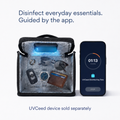
With UVCeed, you aim the device at one section, the tank lid, the stand, the feeding tools, and hold it steady until the app confirms that section is complete, then move to the next section. No chemical spray near an enclosure that a reptile, and potentially a child's hands minutes later, will come into contact with.
FAQ
Is this pet turtle Salmonella outbreak still growing? Yes. As of the CDC's September 18, 2026 update, the investigation remains open, and the case count has already more than doubled since the outbreak was first announced in early August.
Can a turtle carry Salmonella and look completely healthy? Yes. Salmonella lives naturally in a turtle's intestinal tract and gets shed in its droppings regardless of whether the turtle looks or acts sick, which is why habitat surfaces matter as much as the animal itself.
Why are small turtles specifically banned as pets? Turtles with shells under 4 inches have historically been the biggest source of Salmonella illness linked to turtles, largely because they are more likely to be handled by young children and kept in close, casual contact. Federal law has banned their sale as pets since 1975.
What should I do if my child has been near a pet turtle and develops diarrhea or fever? Contact your pediatrician and mention the turtle exposure specifically, since Salmonella symptoms, diarrhea, fever, and stomach cramps, typically appear within 6 hours to 6 days of exposure and doctors can test for it directly.
Can UV-C be used inside a turtle's tank or on the turtle itself? No. UVCeed is designed for hard, dry, non-porous surfaces with direct line of sight, like the tank exterior, lid, and surrounding stand, not for submerged aquatic environments or directly on an animal.
Want More Articles Like This?
Get research on UV-C treatment and product updates delivered to your inbox.