By UVCeed Health & Wellness | May 2026
Right now, 147 passengers and crew are trapped aboard the M/V Hondius, a polar expedition vessel anchored off the coast of Cape Verde, West Africa. Three passengers are dead. Seven total cases have been reported - two confirmed hantavirus, five suspected. One passenger was evacuated to intensive care in South Africa. Two crew members are currently ill. The World Health Organization is investigating what may be the first documented case of human-to-human hantavirus transmission on a cruise ship.
The ship left Argentina on April 1 for a weeks-long voyage through Antarctica and the South Atlantic. The first illness and death occurred just ten days later, on April 11. By the time the ship reached Saint Helena on April 22, the situation was already a full-blown crisis.
Travel blogger Jake Rosmarin, one of the trapped passengers, shared a tearful video from the ship this week. His message was simple: "All we want right now is to feel safe, to have clarity and to get home."
He cannot get home. None of them can. And this is the part of cruise ship outbreaks that most people never think about until it is too late: when a disease event happens at sea, you are confined to the vessel. There is no leaving. There is no hospital down the street. There is no option to isolate in your own home. You eat where you eat, you sleep where you sleep, and you share the same air handling system, the same corridors, the same surfaces, and the same enclosed spaces as every other person on board - including the sick ones.
Cruise Ships Are Floating Incubators for Disease Outbreaks
The M/V Hondius outbreak is not an anomaly. It is the latest in a long and well-documented history of disease events on cruise ships - and the underlying problem is structural.
Cruise ships concentrate thousands of people (or in the case of expedition vessels like the Hondius, over a hundred) into a confined, enclosed environment where they share dining areas, restrooms, corridors, railings, elevators, entertainment spaces, and cabin air systems. Every surface is a shared surface. Every handrail has been touched by dozens or hundreds of hands. Every dining table, every door handle, every elevator button is a potential transmission point.
The CDC's Vessel Sanitation Program conducts unannounced inspections of cruise ships, and even ships that pass those inspections are not free of pathogen risk. The inspections assess sanitation protocols and food handling procedures - they do not certify that every surface passengers touch is free of disease-causing organisms at the moment of contact.
Norovirus outbreaks are the most common cruise ship disease events, with hundreds of passengers sickened in a single voyage on a regular basis. But the list of pathogens that have caused cruise ship outbreaks extends far beyond norovirus: influenza, Legionnaire's disease, COVID-19, gastrointestinal illness, and now hantavirus.
The Hondius outbreak is particularly alarming because hantavirus has historically been considered a rodent-to-human disease with extremely limited human-to-human transmission potential. The fact that WHO is now investigating possible human-to-human spread aboard the ship suggests that the confined, high-contact environment of a vessel at sea may facilitate transmission patterns that do not occur on land.
The Ship Is "Clean" - but Clean Is Not Disinfected
Passenger Jake Rosmarin, defending the Hondius crew, stated that the vessel operates with "strict protocols and a strong emphasis on cleanliness" and that "suggestions that it is unclean are not accurate."
He is almost certainly right. Expedition vessels that operate in environmentally sensitive polar regions do maintain rigorous biosecurity and cleaning standards. The crew of the Hondius has reportedly implemented social distancing, masking requirements, cabin meal delivery, restrictions on indoor common areas, and access to outdoor decks for fresh air.
But here is the critical distinction that most travelers do not understand: "clean" and "disinfected" are not the same thing. A surface can be wiped, mopped, scrubbed, and visually spotless while still carrying a full pathogenic load. Cleaning removes visible dirt and debris. Disinfection eliminates the microorganisms that cause disease. These are two fundamentally different processes.
Standard cruise ship cleaning protocols use chemical disinfectants - typically quaternary ammonium compounds or bleach-based solutions - applied by housekeeping staff with cloths and mops. These protocols face the same limitations in a ship corridor that they face in a hotel room or a kitchen:
Contact time. Chemical disinfectants require the surface to remain visibly wet for 4 to 10 minutes to achieve the stated kill rate. In high-traffic ship environments where surfaces are wiped and walked on within seconds, this standard is almost never met.
Coverage gaps. Cloths and mops treat flat, accessible surfaces. They do not reach inside crevices, around door hardware, underneath railings, or into the textured surfaces of elevator buttons, remote controls, cabin fixtures, and bathroom hardware where pathogens accumulate.
Cross-contamination. Unless cloths are changed between every individual surface, the cleaning process itself redistributes pathogens from contaminated surfaces to previously clean ones. Studies have documented this effect in hospital housekeeping - and cruise ship housekeeping faces the same challenge with fewer resources and tighter turnaround times.
Chemical residue. Quat-based disinfectants leave an invisible chemical film on every surface they contact. In a cruise cabin where you eat, sleep, and touch every surface repeatedly, you accumulate chemical exposure over the entire duration of the voyage.
When passengers say a ship is "clean," what they mean is that it looks clean and it smells clean. What they do not know - and have no way of verifying - is whether the surfaces they are touching are actually free of viable pathogens.
You Cannot Control the Ship's Protocols. You Can Control Your Own.
This is the uncomfortable truth about cruise ship travel in 2026: no matter how rigorous the vessel's cleaning program is, you are relying entirely on other people to protect you from surface-borne pathogens. You have no way to verify what was done, when it was done, how it was done, or whether it was effective.
The passengers on the Hondius did everything right. They booked a reputable expedition with a well-regarded operator. They traveled on a vessel that maintains high biosecurity standards. They had no reason to believe they were at unusual risk.
And now three of their fellow passengers are dead and the rest are trapped at sea, waiting to find out if the virus is still spreading.
The lesson is not that cruise travel is inherently dangerous. The lesson is that relying exclusively on institutional cleaning protocols - on any ship, in any hotel, in any shared environment - leaves a gap between what you assume is happening and what is actually happening on the surfaces you touch.
The only way to close that gap is to carry your own disinfection capability.
UVCeed: Personal, Verified Surface Disinfection You Carry With You
UVCeed is a pocket-sized, medical-grade UV-C disinfection device that uses the 265nm wavelength trusted by healthcare facilities to eliminate up to 99.99% of harmful bacteria and viruses in 30 seconds. No chemicals. No residue. No reliance on anyone else's cleaning schedule.
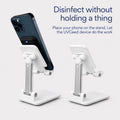
It clips to your iPhone via MagSafe and uses a patented AI-powered app to guide you through the disinfection process in real time - showing you exactly what is being treated, ensuring proper distance and coverage, and confirming when the surface reaches verified disinfection levels.
For cruise ship passengers and travelers, UVCeed eliminates the guesswork:
Cabin surfaces on check-in. The moment you enter your cabin, you can disinfect every high-touch surface yourself - light switches, remote controls, door handles, bathroom fixtures, faucet knobs, phone handsets, desk surfaces, and the minibar handle. A full cabin sweep takes minutes, and you know it was done because you watched it happen through the app.
Dining areas before every meal. Table surfaces, chair armrests, utensils, and glassware - disinfected in seconds before you sit down. No waiting for chemical contact time. No residue on surfaces your food contacts.
Shared ship surfaces throughout the day. Elevator buttons, stairway railings, lounge seating, library books, pool deck chairs, excursion gear, and tender boat railings. Every shared surface you encounter during the day is a surface you can treat before touching.
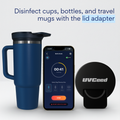
Water bottles and drinkware. The Universal Fit Lid Adapter positions UVCeed over any bottle or cup opening from 0.5 to 4.5 inches. Interior disinfection of your water bottle, travel mug, or the cabin glassware provided by the ship - without chemicals entering your drinking water.
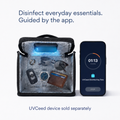
Personal items. Your phone, room key card, wallet, camera, binoculars, earbuds, and sunglasses all move between your cabin, shared spaces, and your face and hands all day. The Disinfecting Tote creates an enclosed UV-C chamber for small personal items - a 30-second reset for everything you carry.
Excursion gear. Expedition cruises involve shared equipment - life jackets, zodiac boat handles, walking poles, snorkeling gear, and binoculars. UVCeed lets you treat shared gear before you use it, regardless of who handled it last.
UVCeed is TSA-compliant, weighs under 2 ounces, recharges via USB-C, and delivers approximately 60-80 disinfection cycles per charge. It fits in a jacket pocket or a daypack side pouch. It is the only portable UV-C device that provides real-time visual verification that disinfection is actually working.
Why UV-C Instead of Wipes or Sprays?
UV-C germicidal irradiation destroys pathogens by physically breaking apart their DNA and RNA with ultraviolet light. It is a purely physical mechanism - no chemical reaction, no molecular binding, no residue left behind. It has been the gold standard in hospital disinfection for decades, and no pathogen has developed resistance to it in over 100 years of use.
Compared to chemical wipes on a cruise ship:
- UV-C works in 30 seconds versus 4-10 minutes of required chemical contact time
- UV-C leaves zero residue on the surfaces you eat off of, drink from, and touch all day
- UV-C reaches into crevices and textured surfaces that cloths and wipes miss
- UV-C does not cross-contaminate between surfaces
- UV-C does not contribute to antibiotic resistance
- UV-C provides verified disinfection through the UVCeed app - you see it working, not just hope it worked
There is a reason hospitals do not rely on wipes alone for high-stakes disinfection. They use UV-C. And when you are confined to a vessel at sea with a deadly pathogen circulating among passengers and crew, that is exactly the kind of high-stakes environment you are in.
The Complete Protection Kit for Travelers
The UVCeed Complete Protection Kit includes everything a cruise passenger or traveler needs:
- UVCeed Device - portable, hospital-grade 265nm UV-C disinfection that clips to your iPhone via MagSafe
- Universal Fit Lid Adapter - disinfects the inside of any water bottle, cup, glass, or ship-provided drinkware
- Disinfecting Tote - enclosed UV-C chamber for phones, key cards, wallets, cameras, earbuds, and personal items
Developed by Bonutti Technologies - a medical device incubator founded by orthopedic surgeon Dr. Peter M. Bonutti, with over 400 patents and 30+ years of medical innovation. Backed by 8+ U.S. patents. Named one of Fast Company's Next Big Things in Tech. Currently deployed in healthcare facilities including Sarah Bush Lincoln Hospital.
Built-in machine vision safety technology detects humans and pets, automatically disabling UV-C output to prevent accidental exposure. The device operates exclusively through the smartphone app, providing continuous safety monitoring throughout every session.
The Bottom Line
The passengers on the M/V Hondius did not expect to be quarantined off the coast of Africa with a deadly virus. No one who boards a cruise ship expects that. But outbreaks on ships are not rare events - they are a recurring feature of confined, high-density travel environments where hundreds of people share the same surfaces, the same air, and the same spaces for days or weeks at a time.
You cannot control the ship's cleaning protocols. You cannot verify what was disinfected, when, or how. You cannot know whether the chemical wipe-down of your dining table actually achieved a pathogen kill or just moved organisms from one surface to another.
What you can control is the 30 seconds it takes to disinfect a surface yourself, with a verified, hospital-grade UV-C device that fits in your pocket and shows you the results in real time.
The next outbreak will happen. The only question is whether you will be prepared for it.
UVCeed is manufactured by UVCeed, LLC. UV-C disinfection is intended for use on hard non-porous surfaces and objects. It is not a medical treatment and does not prevent airborne transmission of respiratory illness. UVCeed does not claim efficacy against hantavirus specifically; stated kill rates are based on independent laboratory testing of Staphylococcus aureus (99.9% in 15 seconds), E. coli (99.99% in 24 seconds), and SARS-CoV-2 (99.9% in 32 seconds) on hard non-porous surfaces at 12.7 cm. See uvceed.com for full testing details and disclaimers.
Want More Articles Like This?
Get research on UV-C treatment and product updates delivered to your inbox.