TL;DR
The CDC has confirmed a multistate Salmonella outbreak tied to jalapeño peppers served at Chipotle Mexican Grill and QDOBA. As of August 5, 2026, there are 345 confirmed cases across 27 states, 36 hospitalizations, and 93% of interviewed patients reported eating at a Mexican-style restaurant before getting sick. Both chains have pulled the affected peppers. If you eat out often, this is a reminder that restaurant food safety is not something you can inspect from your seat, and that the surfaces you touch in a restaurant (menus, POS screens, table condiments, tray handles) carry their own bacterial load. UV-C at 254 nm inactivates Salmonella on the surfaces you can actually control, including the phone you hand back to the server and the water bottle you carry in.
What Actually Happened
On August 5, 2026, the CDC issued a public warning about a Salmonella outbreak traced to fresh jalapeño peppers imported from Sinaloa, Mexico by Coast Citrus Distributors and served at Chipotle and QDOBA restaurants nationwide. The scale, from the CDC's own release:
- 345 confirmed illnesses across 27 states
- 36 hospitalizations, zero deaths so far
- Illness onset dates from June 19 to July 20, 2026
- Of 191 people interviewed, 177 (93%) reported eating at a Mexican-style restaurant in the week before getting sick
- Minnesota and Colorado each have 110 reported cases, the two hardest-hit states
Chipotle switched its jalapeño supplier on July 20, 2026, and QDOBA stopped serving jalapeños entirely on July 28, per NBC News reporting. The CDC and FDA say there is no ongoing risk from those two chains today, but the recalled peppers were also distributed to other wholesalers, so exposure is not necessarily over.
Why Restaurant Salmonella Is a Different Problem Than Home Kitchen Salmonella
At home you control the source, the cutting board, the wash, and the cook temperature. At a restaurant you control none of that. The CDC estimates Salmonella causes about 1.35 million infections in the US every year, with about 26,500 hospitalizations and 420 deaths. Restaurants are a recurring vector because a single contaminated ingredient in a shared prep line can seed dozens of tickets in a single lunch service.
Symptoms typically show up 6 hours to 6 days after exposure and include diarrhea, fever, and stomach cramps that last 4 to 7 days. Most people recover without treatment. Kids under 5, adults over 65, and anyone immunocompromised are at highest risk for severe illness, again per CDC guidance.
What You Can Actually Control When Eating Out
You cannot audit a supplier. You can control what happens after you sit down. The realistic risk-reduction checklist:
- Wash or sanitize your hands before eating, after touching menus, and after signing the check. The FDA's food code treats hand hygiene as the single most important control for foodborne illness, and it applies to guests too.
- Do not put your phone on the table where food will land. Restaurant tables and phones are two of the highest-touch surfaces in your day.
- Wipe or disinfect your water bottle spout if you take it into a restaurant and set it down.
- When you get home, disinfect what came with you: your phone, keys, wallet, and reusable water bottle. Salmonella can survive on hard surfaces for hours to days.
- If you feel symptoms in the next week, save any receipts and report the illness to your state health department. That is how outbreaks like this one get identified in the first place.
Where UV-C Fits (and Where It Does Not)
UV-C at 254 nm is a well-documented method for inactivating Salmonella on hard, non-porous surfaces. A peer-reviewed study indexed on PubMed documented significant Salmonella reduction on food-contact surfaces after direct UV-C exposure. UV-C damages the pathogen's DNA and prevents it from reproducing, which is how it stops the infection cycle without any chemical residue.
Where UV-C helps in a restaurant-going scenario:
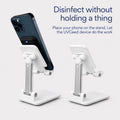
- Your phone after you handled a menu, a check, or a card reader
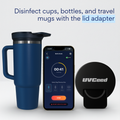
- Your reusable water bottle after it sat on a table
- Your keys and car door handle after a to-go pickup
- Your kitchen counter and reusable grocery bag after bringing home takeout containers
Where UV-C does not help:
- Inside a sealed jalapeño or a dish that has already been served to you
- Inside cooked food that is already contaminated at the source
- On produce that has folds, crevices, or waxy coatings where UV light cannot reach directly (shadowing is a real limit, and the FDA's guidance for cookable produce is to heat to 158°F / 70°C)
Where UVCeed Fits
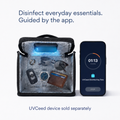
UVCeed is a 254 nm UV-C device that connects to your phone and uses your camera plus the app to guide you through a session on the exact surface you are treating. You aim UVCeed at one section of the surface, hold it steady while the app confirms the section is complete, then move to the next section if the surface is larger than the coverage area. The tilt-safety shutoff turns the lamp off automatically if the device rotates away from the target so nothing shines at your eyes or skin.
For a restaurant-goer, the useful sessions are quick and specific: your phone (case removed), your water bottle spout and threads, your keys, and your reusable bag. No chemicals, no wipes to dispose of, no perfume left behind on the surface. When you get home, run a session on the phone before you put it on your bedside table.
FAQ
Is Chipotle safe to eat at right now? The CDC and FDA say the affected jalapeños have been removed from Chipotle and QDOBA and there is no current ongoing risk from those restaurants, per the CDC newsroom release. Coast Citrus Distributors peppers were also sold to other wholesalers, so risk at other restaurants and small grocers is not zero.
Can UV-C kill Salmonella on the jalapeños themselves? 254 nm UV-C inactivates bacteria on food surfaces including produce. FDA rules prevent us from citing a specific reduction percentage on food, so we do not. On a pepper's smooth outer skin UV-C reaches the surface directly; inside seed pockets or under stems it cannot, because UV light does not bend around corners. Wash first, then cook to a safe temperature.
How long does Salmonella survive on hard surfaces? CDC surface-persistence data shows Salmonella can survive for hours to days on hard, non-porous surfaces at room temperature. That is why the phone and keys you carry into a restaurant matter as much as the meal itself.
Do I need to worry if I ate at Chipotle in May? The outbreak's confirmed illness onset window is June 19 to July 20, per the CDC release above. If you ate at Chipotle or QDOBA in that window and had diarrhea, fever, or cramps in the 6 days after, contact your doctor and your state health department.
Is UV-C safer than a chemical wipe on my phone? Both work if used correctly. Wipes leave residue, can damage phone coatings over time, and expose you to quaternary ammonium compounds, which a 2021 study in Environmental Science and Technology found in the blood of 80% of tested adults. UV-C leaves no residue and no chemical exposure. The tradeoff is that UV-C only works on line-of-sight surfaces, so folds and creases are not treated.
The Bottom Line
You cannot verify a restaurant's supply chain from your seat, and outbreaks like this one prove that even large, well-run chains have blind spots. What you can do is control the surfaces that travel with you, in and out of restaurants: your phone, your keys, your water bottle, your reusable bag. UVCeed makes that a 60-second habit instead of a 60-second chore.
Want More Articles Like This?
Get research on UV-C treatment and product updates delivered to your inbox.