TL;DR
Between 2020 and 2024, researchers repeatedly found quaternary ammonium compounds (QACs) in the blood of tested adults. The most-cited paper, published in Environmental Science and Technology, detected QACs in 80% of tested adults before the pandemic and documented that concentrations nearly doubled during the pandemic as disinfectant use surged. QACs are the active ingredient in most spray disinfectants, most disinfecting wipes, and most hospital-grade cleaners. In cell and animal studies they trigger inflammation, mitochondrial dysfunction, and lipid metabolism changes, and a 2026 paper flagged them as substantially more toxic when inhaled than when contacted on skin. This is why chemical-free 254 nm UV-C is not a wellness gimmick; it is a rational alternative for daily surface disinfection.
What the Research Actually Shows
The foundational data comes from the peer-reviewed paper Quaternary Ammonium Compounds: Bioaccumulation Potentials in Humans and Levels in Blood before and during the COVID-19 Pandemic published in Environmental Science and Technology (Hrubec et al.). Findings that matter:
- QACs were detected in the blood of 80% of tested adults in pre-pandemic samples
- Pandemic-era samples averaged 6.04 ng/mL, up from 3.41 ng/mL pre-pandemic (a 77% increase, statistically significant per the paper)
- Higher blood concentrations of ADBAC and DDAC (the two most common QACs) correlated with increased inflammatory markers, reduced mitochondrial function, and unbalanced lipid metabolism in the same subjects
The same research group has since published follow-on work documenting that QACs are widespread in dust, food, and household air, and that everyday disinfectant use is the dominant exposure route in most homes.
A separate 2024 paper, Quaternary Ammonium Compounds in Paired Samples of Blood and Indoor Dust from the United States, confirmed the correlation: households with higher QAC dust concentrations produced adults with higher QAC blood concentrations.
The ACS review Quaternary Ammonium Compounds: A Chemical Class of Emerging Concern synthesizes the toxicology across studies and lists reproductive toxicity, respiratory sensitization, and antimicrobial resistance selection as the three primary concerns.
Where QACs Are (Almost Everywhere)
If you look at the active ingredient labels on the disinfectants under most American sinks, you will see one or more of these:
- Alkyl dimethyl benzyl ammonium chloride (ADBAC): the most common
- Didecyl dimethyl ammonium chloride (DDAC): the second most common
- Benzalkonium chloride (BAC): hand sanitizer and wipe active
- Cetylpyridinium chloride (CPC): in some mouthwashes and wipes
QACs are the active ingredient in:
- Most Lysol and Clorox spray disinfectants
- Most disinfecting wipes sold at big-box retailers
- Most hospital-grade surface cleaners
- Many liquid hand soaps labeled "antibacterial"
- Many daycare-grade sanitizers
The EPA's List N (COVID-19 registered disinfectants) is dominated by QAC-based products; a plurality of the ~600 products on the list use ADBAC or DDAC as the active.
The Health Signal in the Data
The observational studies are the most credible, because they measure what is actually in people's bodies, not just what happens in a petri dish:
- 80% of adults tested carry QACs in their blood (Hrubec et al., ES&T 2021)
- Blood levels correlated with inflammatory cytokines in the same subjects (same paper)
- QAC levels in dust predicted QAC levels in blood (Zheng et al., ES&T Letters 2024)
- A 2026 Medical Xpress-covered paper found QACs are far more toxic when inhaled than when applied to skin, per Medical Xpress reporting on the study
The StatPearls Quaternary Ammonium Compound Toxicity chapter also documents QACs as a recognized cause of asthma exacerbation, occupational asthma in cleaning-industry workers, and skin sensitization. QACs are one of the most-reported causes of poison-control disinfectant exposures.
Why This Matters for a Family Making Daily Choices
The counterargument is straightforward: "these compounds are approved by the EPA, they kill germs, so what's the problem?" A few honest answers:
- EPA registration means efficacy, not safety over long-term biological exposure. The registration standard is that the product kills pathogens on a label surface, not that the residues are inert once absorbed.
- Residue on surfaces is inhaled and ingested. The 2026 Medical Xpress-covered paper flagged inhalation as the higher-risk exposure route.
- QACs drive antimicrobial resistance. The ACS review flagged QAC exposure as a selection pressure for bacterial resistance to both QACs and, in some cases, cross-resistance to clinical antibiotics.
- The dose is chronic, not acute. The bioaccumulation study measured pre-pandemic exposure; the pandemic doubled it, and habits have not fully reversed.
For most families, none of this argues for abandoning disinfection. It argues for using QAC-based products where they are actually needed (a serious contamination event, a sick household member) and using chemical-free alternatives for the daily routine.
Where UV-C Fits
254 nm UV-C is a physical disinfection method: photons damage pathogen DNA, preventing reproduction. There is no chemical residue on the surface, no vapor to inhale, no compound to accumulate in blood. CDC infection-control guidance recognizes UV-C as an adjunct for surface disinfection, and a 2020 review in the Journal of Hospital Infection confirmed UV-C efficacy against SARS-CoV-2 and other respiratory pathogens on hard, non-porous surfaces.
Where UV-C beats a QAC spray:
- Anything you eat off (cutting boards, plate rims, water bottle spouts)
- Anything a child handles (toys, water bottles, phones)
- Anything sensitive to residue (screens, glasses, jewelry)
- Anything you cannot risk fumes on (bedside table, kitchen counter next to food prep)
Where a QAC-based product still has a role:
- A large-area outbreak cleanup (spilled bodily fluids, a stomach-flu bathroom)
- Institutional and hospital-grade contexts where labeled residual efficacy is required
- Fabric and porous surfaces (UV-C is line-of-sight, chemicals soak in)
Where UVCeed Fits
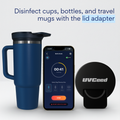
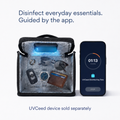
UVCeed is a 254 nm UV-C device that pairs with your phone and uses the camera plus the app to guide you through a session on the exact surface you are treating. You aim UVCeed at one section, hold it steady while the app confirms the section is complete, then move to the next section for larger surfaces. There is no chemical to inhale, no residue on the surface, and no waste to throw out. Tilt-safety shutoff protects skin and eyes if the device rotates off-target.
The realistic use case: replace the daily wipe habit on phones, water bottles, keys, TV remotes, kitchen counters, cutting boards after washing, cutting-board handles, faucet handles, and door handles with a 60-second UV-C session per section. Reserve chemical disinfectants for the actual mess.
FAQ
Is UV-C actually as effective as a QAC spray? On hard, non-porous, line-of-sight surfaces: yes. A Journal of Hospital Infection review documented UV-C efficacy against SARS-CoV-2 and other respiratory viruses on surfaces at appropriate dose. QAC sprays reach into pores and folds; UV-C does not. For daily counter, phone, and water-bottle use, UV-C is more than sufficient. For a norovirus vomit event, use bleach (which is EPA-registered as sporicidal against C. difficile and effective against norovirus).
Are all household disinfectants QAC-based? No. Bleach, hydrogen peroxide, and alcohol products are common non-QAC options. Bleach is corrosive and produces fumes; hydrogen peroxide is milder but still an oxidizer; alcohol works but evaporates fast. UV-C is the only method that leaves no residue and no fumes at all.
Should I stop using Clorox wipes? Not necessarily. The Hrubec et al. paper is not saying wipes are dangerous at label-directed use. It is documenting that residue accumulates in the body over years of daily use. A rational split: wipes for actual messes, UV-C for the daily maintenance passes on high-touch items.
Does UV-C generate ozone? 254 nm UV-C does not generate meaningful ozone. Ozone generation is associated with 185 nm UV, which is a different wavelength used in some water-treatment applications. UVCeed operates at 254 nm.
Is the QAC-in-blood research controversial? The core observation (QACs detected in most tested adults) is not controversial and has been replicated across multiple labs. What is still under active investigation is the exact dose-response relationship between blood levels and long-term health outcomes. The ACS Chemical Class of Emerging Concern review is the most cautious synthesis, and it recommends reduced exposure where practical.
The Bottom Line
The research is not saying disinfectants are bad. It is saying we've been carpet-bombing our surfaces with a chemical class that persists in dust, air, and blood, and that the long-term biological signal is real enough to act on. The rational move for most families is to shift the daily routine (phones, bottles, counters, remotes, door handles) to a chemical-free method, and reserve QAC-based products for actual outbreaks. UVCeed makes the chemical-free routine practical.
Want More Articles Like This?
Get research on UV-C treatment and product updates delivered to your inbox.