TL;DR
Lindblad Expeditions' National Geographic Sea Bird just reported its third gastrointestinal outbreak in two months. On the July 10-15 voyage, 18 of 62 passengers got sick with vomiting and abdominal cramps. The CDC's Vessel Sanitation Program is remotely monitoring. Norovirus is the suspected pathogen, though samples are still being tested. Norovirus does not respond to standard alcohol hand sanitizers the way most travelers assume. What does work on the hard surfaces where norovirus survives for days: 254 nm UV-C, delivered in an app-guided session on your cabin door handle, remote, and bathroom fixtures the moment you board.
What happened on the Sea Bird
The National Geographic Sea Bird is a 152-foot expedition vessel with a capacity of 62 guests. On the July 10-15, 2026 voyage:
- 18 passengers (nearly one-third of the ship) reported vomiting and abdominal cramps
- Crew isolated ill passengers per outbreak-response protocol
- Enhanced cleaning and disinfection was implemented onboard
- CDC's Vessel Sanitation Program issued a report on July 15 and is remotely monitoring
- Pathogen is not yet confirmed; norovirus is suspected based on symptom presentation
This is the third outbreak on the same ship since late May 2026.
Sources:
- Cruise ship hit with third stomach illness outbreak in two months; review underway - Fox News, July 20, 2026
- CDC Vessel Sanitation Program
CDC quote from the reporting: "Finding the agent that caused an outbreak can take time. When an outbreak occurs, people whose symptoms [meet] the case definition are asked to provide stool or vomitus samples."
Why cruise-ship outbreaks keep repeating on the same ships
Cruise ships are, from an infection-control standpoint, a nightmare geometry:
- High-density shared space (dining rooms, buffets, elevators, theaters)
- Continuously changing populations of guests boarding and disembarking every 5 to 14 days
- Enclosed HVAC systems
- Shared high-touch surfaces in every cabin: door handle, remote, thermostat, closet handle, safe keypad, bathroom fixtures
Norovirus, the most common cruise-ship GI pathogen, is what epidemiologists call environmentally hardy. It survives on hard surfaces for up to two weeks, requires a very small infectious dose (as few as 18 viral particles), and is not effectively killed by ethanol-based hand sanitizers at standard concentrations. See: Norovirus - CDC and Norovirus Environmental Cleaning - CDC.
That's why once norovirus is on a ship, "enhanced cleaning" often just means catching up. New passengers board, someone touches a door handle or a remote a housekeeping team didn't disinfect for the required contact time, and the cycle restarts.
What actually works on norovirus
The CDC's own guidance for norovirus environmental cleaning recommends:
- Chlorine bleach at 1,000 to 5,000 ppm on hard surfaces
- EPA List G-registered disinfectants (specifically tested against norovirus)
- UV-C radiation as a supplemental disinfection method for surfaces where chemical use is impractical
Bleach damages electronics and fabric and requires 5 minutes of wet contact time. EPA List G disinfectants require label-specified contact times, usually 3 to 10 minutes wet. Neither is realistic for your cabin's TV remote or your child's tablet.
254 nm UV-C is realistic. It's a physical process (photonic damage to microbial DNA and RNA), it works in seconds when delivered with a controlled dose, and it does not damage electronics, fabric, or skin (with the shutoff safety in the device).
Where UVCeed fits
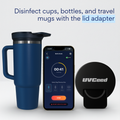
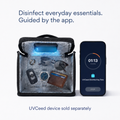
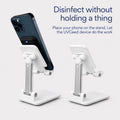
UVCeed is a smartphone-mounted 254 nm UV-C device that runs an app-guided session. You aim at the surface, hold it steady, and the app confirms when that section has received a full germicidal dose. If the surface is bigger than the beam's coverage area (like a cabin desktop or a cruise stateroom nightstand), you move to the next section and run another session.
Cruise-specific features:
- Pocket-sized, USB-C charging, TSA-friendly
- 254 nm UV-C, the wavelength recognized as germicidal
- Tilt-safety shutoff, so the beam stops if pointed away from a surface
- App-guided sessions so you know exactly when each section is complete
Your first-hour cruise session checklist
The moment your bags arrive in your cabin, before you unpack, before you go to the buffet, before you touch anything else:
Cabin door and entry:
- Cabin door handle (interior and exterior)
- Deadbolt
- Light switch by the door
- Thermostat
Sleeping area:
- TV remote (front, back, buttons)
- Bedside lamp switch
- Nightstand surface
- Safe keypad
Bathroom:
- Faucet handles (hot and cold)
- Toilet flush lever
- Shower knob
- Light switch
Balcony (if applicable):
- Sliding door handle
- Chair armrests if fabric-free
For the rest of the voyage, run a session on the remote and the door handle each morning. Two minutes total. The cheapest insurance policy on the ship.
FAQ
Do cruise lines actually use UV-C themselves? Yes, many mainstream cruise lines now use UV-C robots or wands during turnaround days between voyages. That's turnaround-day disinfection. It does not help you on day 3 of your cruise when a fellow passenger's cabin has been quarantined for GI illness.
Won't the ship's crew disinfect if there's an outbreak? They will. But the CDC quote above is important: it takes time to identify the pathogen and implement targeted response. In the interim, your cabin's high-touch surfaces are your responsibility.
Is UV-C safe onboard, with kids in the cabin? Yes. UVCeed's tilt-safety shutoff means the beam stops if it's not pointed at a surface. Run sessions when your kids are on deck or at the pool, or teach them to look away during a 30-60 second session on a shared item.
What if I'm on a smaller expedition ship like the Sea Bird? Small expedition vessels have higher attack rates in outbreaks (as this one shows) because the passenger-to-surface ratio is more concentrated. Your cabin session routine matters more, not less.
Does UVCeed replace hand hygiene? No. Wash hands with soap and water for 20 seconds after using the restroom and before eating. UV-C is for the surfaces. Handwashing is for you.
The bottom line
Three outbreaks in two months on the same ship is a signal, not a coincidence. The CDC's Vessel Sanitation Program does what it can, but cabin-level disinfection between the cleaning staff's turnaround and your dinner reservation is on you. UVCeed puts hospital-grade 254 nm UV-C in your carry-on, with app-guided sessions so you know each section is done.
Want More Articles Like This?
Get research on UV-C treatment and product updates delivered to your inbox.