Human metapneumovirus (HMPV) is spreading rapidly through Northern California and beyond, causing over 650,000 hospitalizations worldwide each year. There's no vaccine. There's no antiviral treatment. And the CDC says it spreads through contaminated surfaces. So what actually works to protect your family?
If you've been hit with a coughing, wheezing respiratory illness this winter or spring that wasn't the flu and wasn't COVID - you may have had a virus most people have never heard of.
It's called human metapneumovirus, or HMPV, and according to wastewater surveillance data reported by Fox News in early March 2026, it's surging across Northern California. Elevated levels have been detected in San Francisco, Sacramento, Davis, Vallejo, Napa, Novato, Santa Rosa, and Marin County. And it's not staying on the West Coast - CDC wastewater data show HMPV is also rising sharply in the Midwest and Northeast.
What makes HMPV particularly concerning isn't how it compares to the flu or COVID. It's what it doesn't have: no vaccine exists. No antiviral treatment exists. And the CDC explicitly states there is no cure.
The only defenses available are behavioral: hand hygiene, avoiding contact with sick people, and - critically - cleaning contaminated surfaces.
That last recommendation is where most people are failing without realizing it. And it's where a new technology is making a measurable difference.
What Is HMPV - and Why Is It Surging Now?
Human metapneumovirus was first identified in the Netherlands in 2001, but retrospective studies suggest it has been circulating in human populations for at least 50 years. It belongs to the Pneumoviridae family - the same viral family as RSV (respiratory syncytial virus) - and is now recognized as one of the most common causes of acute respiratory illness worldwide.
HMPV is seasonal, typically surging from late winter through spring. It peaked sharply in January 2026 and remains elevated across the U.S. as of early March.
The virus causes over 650,000 hospitalizations per year globally, according to Fox News senior medical analyst Dr. Marc Siegel, who called attention to the current surge. And while it typically causes cold-like symptoms in healthy adults - cough, fever, congestion, shortness of breath - it can escalate to bronchitis, pneumonia, and dangerous respiratory complications in vulnerable populations.
Those at highest risk include children under 5, adults over 65, anyone with a weakened immune system, and people with chronic lung conditions like COPD and asthma. For these groups, HMPV isn't a nuisance cold - it can be a medical emergency.
And here's the part most people don't know: virtually everyone gets HMPV at least once before age 5, according to the Cleveland Clinic. You can be reinfected throughout your lifetime. There is no lasting immunity.
The Surface Problem Nobody Talks About
HMPV spreads through three primary pathways: respiratory droplets from coughing and sneezing, close personal contact, and touching contaminated surfaces (what scientists call fomite transmission).
The CDC, Mayo Clinic, American Lung Association, and Cleveland Clinic all specifically list contaminated surfaces - phones, door handles, keyboards, toys, tables - as a transmission route for HMPV.
According to a 2025 peer-reviewed analysis published in PMC, HMPV can survive on nonporous surfaces like plastic and stainless steel for 24 to 48 hours at room temperature with moderate humidity. That means a conference table, a restaurant high chair, a gym bench, or a hotel room door handle can harbor live, infectious HMPV virus for up to two full days after an infected person touches it.
Meanwhile, HMPV is spreading through the exact environments where surface contact is constant and unavoidable: daycare centers and preschools (children under 5 are most affected), office buildings and shared workspaces, restaurants and cafeterias, gyms and fitness studios, public transit, airports and hotels, and hospital waiting rooms.
For a virus with no vaccine and no treatment, surface transmission is the exposure pathway you can actually do something about. The question is whether the tools most people are using actually work.
Why "Wiping Down Surfaces" Isn't What You Think It Is
When the CDC says "clean frequently touched surfaces," most people picture grabbing a Clorox wipe, giving the table a quick swipe, and moving on. They assume the surface is now safe.
It isn't.
Here's what the fine print on most commercial disinfectant wipes actually says: the surface must remain visibly wet with the chemical solution for 4 full minutes to achieve the kill claims on the label. This is called "contact time," and it's the single most important factor in chemical disinfection. If the surface dries before the contact time is reached - which happens almost immediately with a typical wipe - he disinfection is incomplete.
How many parents wiping down a restaurant high chair wait 4 minutes? How many gym-goers leave the bench soaking wet for 4 minutes between sets? How many office workers hold a wet wipe against their keyboard for 4 minutes?
The answer, of course, is almost nobody. A 2020 study by the CDC found that in real-world practice, surface disinfection procedures in healthcare settings - where compliance is highest - still failed to achieve adequate contact time in the majority of observed cases. In homes, schools, restaurants, and gyms, the failure rate is far worse.
The result is a nationwide illusion of protection: people believe they've disinfected surfaces that are, in practice, still contaminated.
For a virus like HMPV - which spreads through surface contact, has no vaccine to provide a safety net, and has no treatment if you get infected - that illusion has real consequences.
What Actually Works: The Technology Hospitals Already Use
There is one disinfection method that doesn't depend on contact time, doesn't leave chemical residue, and doesn't require guessing whether the surface is "wet enough for long enough": ultraviolet-C (UV-C) light.
UV-C light at the 265nm wavelength - the peak absorption wavelength for genetic material - destroys pathogens by directly fragmenting their DNA and RNA, rendering them unable to replicate. This is a physical mechanism, not a chemical reaction. It works in seconds, not minutes. It requires no liquid, no residue, and no compliance with timing protocols that nobody follows.
Hospitals have used industrial UV-C systems to sterilize operating rooms, patient areas, and medical equipment for decades. It's the gold standard for surface disinfection in environments where failure means patient death. The reason it works: UV-C doesn't care what kind of pathogen it's fighting. Bacteria, enveloped viruses (like flu and COVID), non-enveloped viruses (like norovirus), and paramyxoviruses like RSV and HMPV - all of them have genetic material, and all of them are destroyed when that genetic material is hit with sufficient UV-C energy.
Until recently, this technology was locked behind institutional price tags and building-sized equipment.
That's no longer the case.
UVCeed: Hospital-Grade UV-C That Goes Where You Go
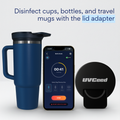
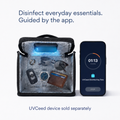
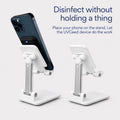
UVCeed is a compact, rechargeable UV-C LED disinfection device designed by Dr. Peter Bonutti, a practicing orthopedic surgeon with over 400 patents and decades of experience in infection prevention. It attaches to your smartphone and delivers 265nm UV-C light that eliminates 99.99%* of bacteria and viruses on any surface in 30 seconds.
What separates UVCeed from the wave of cheap UV gadgets flooding the market:
AI-powered dosage control calculates the exact UV-C energy required for complete pathogen kill on each surface. This eliminates underdosing - the silent failure mode that renders most consumer UV products ineffective. You don't "hope" it worked. The system ensures it worked.
Augmented reality real-time verification shows treated versus untreated areas on your phone screen via the UVCeed app (iOS and Android). Surfaces turn green when disinfection is complete. For the first time, you can literally see that the surface is safe - no guessing, no trusting a timer, no wondering if you held the wipe down long enough.
Patented machine vision safety detects humans and pets in the treatment area and automatically shuts off the UV-C output. This is the feature that no other consumer UV-C device has, and it's the reason UVCeed can be safely used around children.
Peer-reviewed, lab-verified results - UVCeed's pathogen kill claims are backed by independent studies published on PubMed Central, confirming elimination of Staphylococcus aureus, E. coli, Klebsiella pneumoniae, and SARS-CoV-2.
The device is EPA-registered, CE-certified, and mercury-free (LED-based, not mercury vapor). It was named a Fast Company 2023 Next Big Things in Tech award winner and is used in professional healthcare settings, including by staff at Sarah Bush Lincoln Hospital.
Who Needs This Most Right Now
With HMPV surging and no medical intervention available, certain groups face disproportionate risk from contaminated surfaces:
Parents of children under 5 - HMPV hospitalizations peak between ages 6 and 12 months. Children in daycare touch everything, and everything they touch goes in their mouths. Wiping down high chairs, play tables, and toys with a chemical wipe that requires 4 minutes of contact time isn't realistic. Treating them with UV-C in 30 seconds is.
Adults over 65 - HMPV can cause pneumonia in older adults, and immune response declines with age. Grocery cart handles, restaurant tables, doctor's office waiting room chairs - all of these are potential exposure points that a UVCeed can address in seconds.
People with asthma or COPD - HMPV can trigger severe asthma attacks and dangerous COPD complications. For these individuals, a single surface-contact exposure can lead to an emergency room visit. Meanwhile, the chemical fumes from conventional disinfectant wipes can themselves trigger respiratory symptoms - a cruel irony for people who need surface disinfection the most.
Immunocompromised individuals - Transplant recipients, cancer patients undergoing treatment, and people with autoimmune conditions face the highest risk of severe HMPV illness. Their immune systems cannot fight off what a healthy adult would recover from in a week.
Travelers - Hotel rooms, airplane tray tables, rental car steering wheels, and public restrooms are cleaned on schedules and with methods you cannot verify. UV-C verification takes the guesswork out entirely.
The Math of Prevention
With HMPV, there's no fallback plan. No vaccine if you're exposed. No antiviral if you get infected. No treatment beyond rest and fluids while your body fights it alone.
The entire burden falls on prevention. And prevention, according to every major health authority, rests on three pillars: hand hygiene, avoiding sick people, and cleaning contaminated surfaces.
Two of those three are entirely within your control. But only one of them - surface disinfection - can be done proactively before exposure occurs. You can't wash your hands before you've already touched the contaminated door handle. You can't avoid a sick person you don't know is sick.
But you can disinfect the surface before you touch it. And you can do it in 30 seconds with verified, visual proof that the job is done - without chemicals, without waiting, without hoping.
That's what UVCeed provides. It's what the CDC recommends in principle - cleaning contaminated surfaces - delivered with the technology hospitals trust, in a form factor that fits in your pocket.
For a virus with no other defense, having a real one matters.
Take the guesswork out of surface safety.
Free shipping. 30-day money-back guarantee. Also available on Amazon.
Sources
- Fox News. "Highly contagious virus with no treatment spreading rapidly through western state." March 6, 2026.
- Centers for Disease Control and Prevention. "About Human Metapneumovirus (HMPV)." Updated February 10, 2026.
- Mayo Clinic. "Human Metapneumovirus (HMPV): Symptoms and Prevention." 2025.
- Cleveland Clinic. "Human Metapneumovirus (HMPV): Symptoms & Treatment." 2025.
- American Lung Association. "Learn About Human Metapneumovirus (HMPV)."
- UC Davis Health. "A little-known respiratory virus, human metapneumovirus, surging in Northern California." March 2026.
- PMC. "Human metapneumovirus (hMPV) in 2025: emerging trends and insights." Surface survival data: 24–48 hours on nonporous surfaces at room temperature.
- Williams, J.V. et al. "Studies of culture conditions and environmental stability of human metapneumovirus." PMC, 2010.
- Bonutti, P. et al. "In Vitro Evaluation of the UVCeed Mobile Disinfection Device." PubMed Central, 2024.
- Bonutti, P. et al. "UVCeed: Leveraging Augmented Reality, Artificial Intelligence, and Gamification for Enhanced Ultraviolet C Disinfection." PubMed Central, 2024.
UVCeed is a surface disinfection device and is not a medical device. It does not treat, cure, or prevent disease in humans. Effectiveness is based on independent laboratory testing under controlled conditions; actual results may vary. UVCeed has been tested against specific pathogens as documented in peer-reviewed publications; testing against HMPV specifically has not been conducted. UV-C at 265nm is effective against single-stranded RNA viruses as a class. This article is for informational purposes and does not constitute medical advice. Consult your healthcare provider regarding infection prevention strategies appropriate for your individual circumstances. Follow all CDC-recommended prevention measures including handwashing and avoiding contact with sick individuals.
Want More Articles Like This?
Get research on UV-C treatment and product updates delivered to your inbox.