TL;DR
A University of Utah School of Medicine study found that families with school-age kids have viral infections 87% of the year (UAB News, back-to-school health; UTMB Health blog, July 2026). Adding one child to a household drives that up to 18 weeks of infection per year - 35% of the year. Adding a second child pushes it to 29 weeks. Classroom desks and shared keyboards host more bacteria than a toilet seat, and research on 4th-6th grade classrooms identified the pencil sharpener as the single germiest surface (Water Quality and Health Council). More than 40% of American school-age kids have a chronic condition like asthma that turns a routine classroom bug into a serious event (WTVY, July 29 2026). Here is a parent's protocol that reflects that reality.
The numbers you probably do not want to know
- 87% of the year with a viral infection in the house is not a typo. It is what University of Utah researchers documented using PCR testing across a full year of family samples (UAB News).
- Kids get 8-12 colds a year on average during school years (American Academy of Pediatrics - Common Cold).
- Norovirus, RSV, influenza, strep, hand-foot-and-mouth, and pinkeye all peak during the school year. So does gastroenteritis, which is the third-most common reason for school absence (CDC - Norovirus in Schools).
- 40%+ of school-age kids have a chronic health condition. For a kid with asthma, a classroom cold means a potential ER visit (WTVY, July 29 2026).
The classroom surfaces actually spreading the bugs
Research from multiple classroom microbiology studies consistently identifies the same worst offenders:
- Pencil sharpener - the single germiest object in 4th-6th grade classrooms per Water Quality and Health Council-cited research (WQHC).
- Desk surface - documented as hosting more colony-forming units than a toilet seat in NSF-referenced classroom studies (NSF International - Classroom Germs).
- Shared keyboards, tablets, and Chromebooks - saliva and food particles from every prior user, rarely cleaned.
- Water fountain spouts and refill station handles.
- Bathroom faucet handles, stall latches, and paper towel dispenser levers.
- Cafeteria table surfaces - wiped between lunches, not disinfected.
- Backpack straps and lunch box handles - your kid picks up all of the above and then carries it home.
The Tulsa Health Department's back-to-school guidance specifically calls out that classroom desks and shared keyboards "can host more germs than a toilet seat," which is a phrase that lands differently when you realize your kid touches both without washing their hands in between (Tulsa Health Department).
What your kid actually needs
- A reusable water bottle they refill themselves - avoids the fountain spout.
- Personal supplies over shared ones - a personal pencil sharpener beats the classroom one every time.
- Their own headphones for the class Chromebook.
- Alcohol-based hand sanitizer in the backpack for between-class use, plus soap-and-water handwashing at school for at least 20 seconds (CDC Handwashing).
- A clean lunch box every day, not "we'll wash it Friday."
- Age-appropriate reminders to not share water bottles, not eat off other kids' snacks, and to keep hands away from face.
Then there is the piece parents can actually control: what happens when the backpack, lunch box, and Chromebook come home.
What to session at home after school
Every school day, in a routine that takes about three minutes total:
- Backpack straps and handle. These carry every surface your kid leaned against.
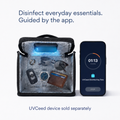
- Lunch box handle and interior. After you empty it and wipe with soap and water, run a UV-C session on the interior.
- The Chromebook or tablet if it comes home. Both sides of the case, the keyboard, and the screen edge.
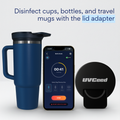
- Water bottle exterior. The inside gets soap and water. The exterior - which they hold with the same hand that just came out of a school bathroom - gets a session.
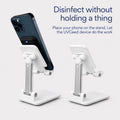
- Their phone, if they have one. Both sides. Every day.
- Weekly: the kitchen counter where the backpack lands, the family iPad or shared laptop, the TV remote, the pantry door handle.
Where UVCeed fits
UVCeed is a 254 nm UV-C device with an app that guides you through sessions: you aim at one section (backpack strap, lunch box interior, phone), hold steady while the app confirms the section is complete, then move to the next section for surfaces larger than the coverage area.
254 nm UV-C is documented to inactivate the respiratory viruses and enteric pathogens that circulate in classrooms - influenza, RSV, coronaviruses, and norovirus surrogates on hard surfaces (EPA UV Disinfection Guidance; NIH PMC - UV inactivation of respiratory viruses).
UVCeed is USB-C rechargeable, has a tilt-based safety shutoff (which matters when curious kids are around), and stores easily in a kitchen drawer where the after-school routine happens. It replaces the daily bleach-wipe habit for objects you do not want to bleach - the backpack fabric, the Chromebook screen, your kid's phone.
FAQ
Is UV-C safe to use around kids? When used correctly, yes. The rule is simple: aim at surfaces, not at skin or eyes. UVCeed has a tilt-based safety shutoff that stops emission if the device is not aimed properly. Do the sessions when the kids are not directly in the immediate area.
Can UVCeed sanitize their lunch box? Yes, on the interior and exterior surfaces. 254 nm UV-C inactivates bacteria on food-contact surfaces. If there is residual food, wash it out first, then run a session.
Can I use UVCeed on the food in the lunch box? 254 nm UV-C inactivates bacteria on food surfaces. FDA rules prevent us from citing a specific reduction percentage on food. For most family use, the higher-value application is the container and the utensils, not the food itself.
How long does a session take? Depends on surface size. For a phone or a lunch box interior, generally under a minute per section. For a backpack strap or Chromebook, a few sessions to cover the full object.
What about the classroom itself? That is not your surface. What you can control is what comes home. A three-minute after-school session on backpack, lunch box, phone, and Chromebook is where UV-C actually earns its keep for parents.
The bottom line
87% of the year with a virus in the house is the current baseline for families with school-age kids. You cannot session the classroom. But every surface that comes home from that classroom - and every surface those come into contact with once they are in your kitchen - is under your control.
Build the after-school session into the same three minutes as unpacking the backpack. That is where the transmission chain actually breaks.
Want More Articles Like This?
Get research on UV-C treatment and product updates delivered to your inbox.