TL;DR
The 2026-2027 school year is starting under a forecast from pediatric health systems for an early and robust rhinovirus season, with a notable bump in classroom pink eye (conjunctivitis) outbreaks and the usual RSV, flu, and COVID waves following in October and November. Rhinovirus is the reason your kid gets sick in the first week of school every year: it is the most efficient surface-transmitted virus circulating, it survives for days on hard, non-porous items (desks, water bottles, Chromebooks), and it triggers wheezing and croup in the youngest kids. The surfaces you can actually treat at home are the ones that come home in the backpack: water bottle, phone, Chromebook, lunchbox, keys, and the backpack's hard exterior.
What the Pediatric Forecast Says
The Michigan Medicine Department of Pediatrics back-to-school outlook and the AdventHealth pediatric team's back-to-school briefing both point to the same pattern:
- Rhinovirus first, usually within the first two weeks of classes reopening
- RSV, flu, and COVID variants ramping up in October and November
- Pink eye (viral and bacterial conjunctivitis) bump specific to the 2026 season, driven by adenovirus circulating widely
- Ongoing measles concerns in states with the largest 2025-2026 outbreaks, per CDC measles surveillance
The PPE Medical viral forecast adds enterovirus and adenovirus to the watch list, both of which spread readily via classroom surfaces.
Why Rhinovirus Is a Surface Problem, Not Just an Air Problem
Rhinovirus is the classic school virus for a reason: it survives on hard, non-porous surfaces for up to 48 hours or more under typical classroom conditions, per longstanding CDC and NIH literature. A kid touches a doorknob or a shared Chromebook, then touches their nose or eyes, and the transmission chain closes in seconds.
The University of Arizona germ studies documented that a single contaminated door handle can seed detectable virus on more than half the surfaces in a classroom within four hours. School environments amplify this because:
- Class sizes put 20-30 kids in a room designed for shared touch (desks, whiteboards, shared bins)
- Shared devices (Chromebooks, iPads, calculators) carry every hand that touched them
- Water fountains are touched by every kid, several times per day
- Bathroom door handles are the last surface between hand-washing and the classroom
- Lunchroom trays and condiment stations are handled during peak transmission windows
Pink Eye at School Deserves Its Own Section
Adenovirus is the leading cause of viral conjunctivitis, and the American Academy of Ophthalmology has documented outbreaks in classroom settings as a recurring issue. The virus survives for weeks on hard surfaces (much longer than rhinovirus) and can transfer through shared towels, pencils, keyboards, and personal items. A single infected kid can seed a classroom outbreak within days.
The CDC's guidance on conjunctivitis singles out shared surfaces, towels, and eye makeup as the most common vectors, and recommends surface disinfection alongside handwashing.
The Backpack Reality: What Comes Home Every Day
Once the school day ends, the risk transfers home through the backpack. A typical grade-schooler's backpack contains:
- A water bottle that lived on their desk and their lunch tray
- A phone or Chromebook touched by dozens of hands
- A lunchbox that sat on a shared table
- A folder or pencil case handled during group work
- The backpack's own hard exterior, which sat on the floor of the classroom, bus, and bathroom
The NSF has documented lunchboxes and reusable water bottles as top-tier household germ reservoirs, often carrying more bacteria per square inch than a toilet seat.
The At-Home Chain-Break Routine
You cannot disinfect the classroom. You can disinfect what comes home. Realistic, sustainable, 5-minute routine:
- Backpack drop zone: designate one spot near the door, not the kitchen counter
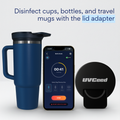
- Water bottle: rinse, air-dry, then run a UV-C session on the spout and threads before refilling
- Chromebook or tablet: wipe screen with a microfiber cloth, then a UV-C session on the keyboard, hinge, and edges
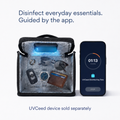
- Lunchbox: empty, wipe, and UV-C the inside surface where wrappers and containers touched
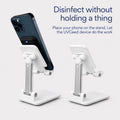
- Phone: UV-C session before it goes on the nightstand
- Backpack exterior: UV-C session on the handle, zipper pulls, and bottom (where it sat on the floor)
- Hand-washing at the door: still the highest-leverage habit; UV-C is a supplement, not a substitute
Where UV-C Fits (and Where It Does Not)
254 nm UV-C is well-documented against the pediatric viruses in play this fall. Peer-reviewed literature indexed on PubMed confirms UV-C efficacy against enveloped and non-enveloped respiratory viruses on hard surfaces, and CDC infection control guidance supports UV-C as an adjunct for surface disinfection.
Where UV-C helps for a family with school-age kids:
- Hard surfaces of anything that comes home: bottles, cases, devices
- Kitchen counters, sink handles, and door handles after unloading a backpack
- Toys that go in and out of the house
- Car door handles, seat belt buckles, and steering wheel after school pickup
Where UV-C does not help:
- Cloth backpacks (fabric folds block UV light)
- Inside a body once a virus has already entered the respiratory tract
- Deep grooves in a keyboard or a case (line-of-sight limit)
- On skin (UV-C is not a hand-sanitizer replacement; wash with soap and water)
Where UVCeed Fits
UVCeed is a 254 nm UV-C device that pairs with a parent's phone and uses the camera plus the app to guide a session on the exact surface being treated. You aim UVCeed at one section (Chromebook keyboard, water bottle spout, phone back), hold it steady while the app confirms the section is complete, then move to the next section. For a lunchbox interior or a backpack handle, you cover each section one at a time.
Safety features designed for family use:
- Tilt-shutoff: the lamp kills automatically if the device rotates away from the target
- App-guided coverage: the app tells you when a section is fully treated, so kids and parents cannot short-cycle
- USB-C charging: lives on the counter with the kitchen chargers, always ready
The routine most families settle into: bottles and devices right after school (parent-run), phones before bed (self-serve for older kids).
FAQ
Is UVCeed safe to use around kids? Yes, with adult supervision. UV-C at 254 nm is a skin and eye hazard if used incorrectly, which is why UVCeed has an app-guided session, an aim-required camera lock, and a tilt-shutoff that kills the lamp automatically if the device rotates away from the target. It is not a toy; treat it like the hair straightener or a paring knife.
Should I disinfect my kid's Chromebook every day? Yes if it is a shared classroom device. Rhinovirus and adenovirus both survive on plastic keyboards for 24-48+ hours, and the classroom Chromebook has been touched by every kid who used it that day. A 60-second session on the keyboard, screen, and hinge is warranted.
What about the backpack itself? The exterior fabric folds block UV-C, so a UV-C session works best on the hard components: handle, zipper pulls, plastic bottom pads, and the buckle. For the fabric interior, air it out weekly and run a session on any hard surfaces inside.
Does UV-C prevent pink eye? Not by itself. Pink eye is transmitted mostly through contact: hand to eye, or shared items to eye. UV-C helps by lowering surface load on the items your kid handles (Chromebook, water bottle, phone), which reduces the odds of a hand-to-eye transfer. Handwashing and not sharing towels are still the primary defense per CDC guidance.
Is UV-C safer than a Clorox wipe on a water bottle? For daily use, yes. Wipes work well but leave chemical residue that can end up in your kid's water; quaternary ammonium compounds were detected in the blood of 80% of tested adults in a 2021 study in Environmental Science and Technology. UV-C leaves no residue and does not touch the drinking water. For the outside of a bottle, either works.
The Bottom Line
Every parent knows the first two weeks of school produce a wave of colds. It is not bad luck; it is rhinovirus efficiently spreading on the hard plastic and metal surfaces that get shared in a classroom. You cannot fix the classroom. You can break the chain at the front door: bottles, devices, lunchboxes, and phones get a 60-second session and then join the family without the whole day's contact load riding along. UVCeed makes that a routine, not a chore.
Want More Articles Like This?
Get research on UV-C treatment and product updates delivered to your inbox.