TL;DR
The drug-resistant fungus Candida auris has been confirmed in 23 states in 2026, with nearly half of U.S. states now reporting cases to the CDC (The Hill, July 2026; CDC - Candida auris Tracking). Texas has logged more than 700 cases as of mid-July; Michigan is close behind with 503 (The Hill, July 2026). This fungus is different from the ones you have heard of before: it is resistant to all three major classes of antifungal medications, it survives on surfaces for weeks, and CDC lab testing shows it shrugs off the quaternary ammonium disinfectants used in most consumer wipes (CDC - Infection Control for C. auris). This is a real superbug in the strict sense of the word, and 254 nm UV-C is one of the tools CDC recommends for it.
What is actually happening
Candida auris first appeared in the U.S. in 2016. Case counts have roughly doubled year over year since then. As of the 2026 update:
- 23 states with confirmed 2026 cases.
- Texas leads with 700+ known cases.
- Michigan at 503 cases.
- 88% of clinical cases occur in patients over age 45 (CDC - C. auris General Information).
- Majority of patients are in acute care settings - hospitals, long-term care, and specialty units.
- Mortality among invasive infections is estimated at 30-60%, though it varies by patient population and site of infection (CDC - C. auris General Information).
The WHO added C. auris to its critical priority fungal pathogens list in 2022 (WHO Fungal Priority Pathogens List). The CDC classified it as an urgent threat in its 2019 Antibiotic Resistance Threats Report and has escalated messaging every year since (CDC AR Threats Report 2019).
Why C. auris is not like other yeasts
Ordinary Candida species are common commensal fungi. Most healthy people carry them without issue, and treatment options are effective. Candida auris breaks every one of those rules:
- Multi-drug resistance is the norm. Roughly 90% of U.S. clinical isolates are resistant to fluconazole, 30% resistant to amphotericin B, and a growing percentage resistant to echinocandins - which is the entire third pillar of antifungal treatment (CDC - C. auris Antifungal Resistance).
- Surface persistence for weeks. Unlike most yeasts, C. auris forms biofilms and survives on healthcare surfaces (bed rails, IV poles, blood pressure cuffs, thermometers, mobile phones) for weeks under real-world conditions (CDC - Infection Control for C. auris).
- Skin colonization without symptoms. Patients can carry it on their skin and shed it into their environment without ever developing an infection themselves.
- Resistance to common disinfectants. CDC guidance explicitly notes that quaternary ammonium compounds (the "quats" in most consumer disinfectant wipes) show reduced efficacy against C. auris, and recommends EPA List P disinfectants specifically (CDC - Infection Control for C. auris; EPA List P).
What does work against C. auris
Two categories of disinfection are validated:
- Sporicidal chemical disinfectants (EPA List P). These include hydrogen peroxide-based products, hypochlorite (bleach) at appropriate concentration, and peracetic acid. The list is public and searchable (EPA List P).
- UV-C disinfection. Peer-reviewed studies show 254 nm UV-C is effective against Candida auris on hard surfaces at germicidal doses. Full inactivation of C. auris has been documented at approximately 500-1000 mJ/cm² in benchtop and clinical-simulation studies (de Groot et al., American Journal of Infection Control, 2019; NIH PMC - UV-C efficacy against C. auris review).
Fungi generally require higher UV-C doses than bacteria. Early work at 250 mJ/cm² documented killing of Pseudomonas, Streptococcus, Acanthamoeba, Candida, and Aspergillus niger within 22 minutes of exposure. Yeast forms are the easiest fungal target - one enclosed-booth UV-C study needed 30 minutes to achieve 99.999% killing of fungal spores, notably longer than the same test's bacteria and virus kill times (NIH PMC - UV-C spectrum review).
A worthwhile scientific note: 254 nm outperforms 222 nm for fungi. At doses up to 1000 mJ/cm², 222 nm UV-C could not disinfect Aspergillus niger hyphae in benchtop testing, while 254 nm handled it. For fungal control specifically - including C. auris - 254 nm is the right wavelength choice. That is the wavelength UVCeed uses.
Where consumers should actually worry
Most people are not going to encounter Candida auris at home in 2026. The vast majority of cases are acute-care healthcare-associated: ICUs, long-term acute care hospitals, ventilator-dependent skilled nursing facilities.
But there are specific real-world scenarios worth acting on:
- You or a family member was recently hospitalized. Especially in a facility that has reported C. auris cases, and especially with an ICU stay, invasive devices (central line, catheter, ventilator), or a wound that was managed at the facility.
- You are a home caregiver for a discharged patient. Their skin may be colonized. Their belongings, wheelchair, medical devices, and personal electronics carry that colonization home.
- You work in healthcare and carry a work phone, badge lanyard, stethoscope, or scrubs home.
- You are visiting or supporting someone in long-term care and want to reduce your own transmission risk in both directions.
In each of these scenarios, the transmission surfaces are the same objects everyone touches constantly: phones, keys, wallets, badge lanyards, blood pressure cuffs, thermometers, wheelchair armrests, walker handles, remote controls, door handles.
What to actually do
- Wash hands with soap and water frequently. For high-risk scenarios, alcohol-based hand sanitizer is a useful supplement but should not be your only measure.
- Wipe hard surfaces with EPA List P disinfectant for the highest-risk items. The list is publicly maintained at EPA List P.
- Session hard non-porous items with 254 nm UV-C for objects where liquid disinfectant is impractical or damaging - phones, tablets, keys, remotes, badge lanyards, personal medical equipment. Aim, hold steady until the app confirms the section is complete, move to the next section for surfaces larger than the coverage area.
- Do not rely on standard "sanitizing" wipes. Most consumer wipes are quaternary ammonium-based, which CDC data shows are not fully effective against C. auris.
- If you are a caregiver: talk to the discharging hospital's infection prevention team about home cleaning recommendations. They will give you facility-specific guidance that reflects the actual pathogens the patient was exposed to.
Where UVCeed fits
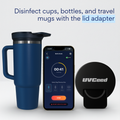
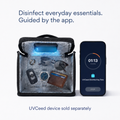
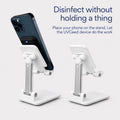
UVCeed is a 254 nm UV-C device with an app that guides you through sessions: aim at one section (a phone, a badge lanyard, a wheelchair armrest), hold steady while the app confirms the section is complete, then move to the next section for surfaces larger than the coverage area.
For Candida auris specifically, 254 nm is the right wavelength (222 nm underperforms on fungi, and UVCeed is 254 nm). Session-based application matters more here than it does for bacteria, because fungal cells generally need higher UV doses and longer dwell times - which is exactly what the session-guided protocol enforces. You are not sweeping across the surface. You are giving each section the dose fungi actually need.
The trade-off with UV-C for fungi is real: cycle-time claims should be species-specific, and dense biofilms may require repeat sessions. But for the shared-object transmission surfaces most home caregivers and healthcare workers actually worry about, UV-C fills the gap that quat-based wipes leave open.
FAQ
Does UV-C kill Candida auris? Peer-reviewed data shows 254 nm UV-C inactivates C. auris on hard surfaces at germicidal doses (approximately 500-1000 mJ/cm² for full inactivation) (de Groot et al., 2019). Fungi generally require higher UV doses than bacteria, which is why session dwell time matters.
Is C. auris something I need to worry about at home? For most healthy people going about normal life, no. If you or a family member was recently hospitalized in an affected facility, or you work in healthcare, the answer changes.
Why does hand sanitizer not fix this? Alcohol-based hand sanitizer has documented activity against C. auris on skin. The problem is not hands so much as it is surfaces - which sanitizer does not address, and which quaternary ammonium wipes do not fully address either.
Is 254 nm safer or more effective than 222 nm for fungi? 254 nm is more effective. Benchtop studies show 222 nm UV-C failed to disinfect Aspergillus niger hyphae even at 1000 mJ/cm², while 254 nm handled it. For Candida auris and other fungi, 254 nm is the right choice - which is what UVCeed uses.
Can UVCeed replace hospital cleaning protocols? No. It is a personal device for personal items and household use. Hospital environmental cleaning uses higher-output whole-room UV-C systems in addition to EPA List P chemical disinfection. UVCeed is designed for the phones, badges, keys, and personal equipment that live in the gap between those protocols.
The bottom line
Candida auris is exactly what the phrase "antimicrobial resistance" was invented to describe. Standard antifungals fail. Standard wipes underperform. It survives on surfaces for weeks. It is now in 23 states and climbing.
For most people this is a story about healthcare policy and hospital infection control. For a subset of people - recent hospital discharges, caregivers, healthcare workers - it is a concrete personal-hygiene problem that 254 nm UV-C is well-suited to help with.
Want More Articles Like This?
Get research on UV-C treatment and product updates delivered to your inbox.