TL;DR
The CDC has issued interim guidance for state, tribal, local, and territorial health departments to assess and manage travelers arriving from countries affected by the 2026 Ebola outbreak, which involves the Democratic Republic of the Congo, South Sudan, and Uganda. This is a public health monitoring measure, not a signal of domestic transmission risk. This piece explains what the guidance actually covers, why Ebola is treated differently from more common domestic outbreaks, and what a reasonable layered hygiene routine looks like for travelers moving through international airports during any active outbreak.
What the CDC Guidance Actually Says
The CDC's interim guidance for post-arrival public health assessment directs health departments to evaluate and, where appropriate, monitor travelers arriving from countries affected by the ongoing 2026 outbreak. The guidance is procedural: it tells health departments how to assess risk level based on a traveler's specific activities and exposure history in the affected region, not a blanket alert for the general public.
This distinction matters. Ebola outbreaks are almost always contained to the region where they originate through case isolation, contact tracing, and targeted vaccination campaigns, and the CDC's guidance here is the same kind of standard preparedness measure it issues during most international outbreaks, allowing US health departments to catch and respond to imported cases early rather than reactively.
Why Ebola Gets This Level of Attention With So Few Cases
Ebola virus disease has a case fatality rate that has historically ranged from 25% to 90% in past outbreaks depending on strain and access to supportive care, which is why public health agencies treat even a small, geographically contained outbreak with a high level of monitoring rigor. It spreads through direct contact with the blood, body fluids, or contaminated materials of an infected symptomatic person, not through casual airborne contact, which is a key difference from measles or influenza.
That transmission profile is exactly why international travel monitoring, rather than general public precautions, is the appropriate response. The risk to the average domestic traveler who has not been in the affected region is effectively negligible, and the CDC's guidance reflects that by focusing entirely on travelers arriving from the specific affected countries.
What a Reasonable Traveler Routine Looks Like
For the overwhelming majority of travelers with no connection to the affected region, there is no specific action needed beyond normal travel hygiene. For anyone who has been in or has connections to the Democratic Republic of the Congo, South Sudan, or Uganda:
- Follow CDC and airline guidance on arrival, including any health screening questions or monitoring requests from health department staff.
- Monitor for symptoms (fever, fatigue, muscle pain, headache, sore throat, followed by vomiting, diarrhea, and rash) for 21 days after potential exposure, and seek care immediately if they appear, per CDC clinical guidance.
- For general international travel hygiene regardless of destination, treat airport and in-flight high-touch surfaces (tray tables, armrests, lavatory handles, kiosk touchscreens) as you would for any respiratory or contact-spread illness, since airports concentrate travelers from many origin points simultaneously.
- Wash hands frequently during and after travel, which remains the highest-yield intervention against the broad range of pathogens that circulate through international travel hubs, independent of any single outbreak.
- Disinfect what travels with you: your phone, passport case, and luggage handles, all of which pass through the same high-contact checkpoints as everyone else's.
Where UV-C Fits (and Where It Does Not)
UV-C at 254 nm is broadly documented in disinfection literature as effective against a wide range of bacteria and many viruses on hard, non-porous surfaces by damaging genetic material on contact. It is a reasonable tool for the surfaces a traveler actually controls: a phone, a passport case, a tray table.
We want to be direct about a limit here: we are not aware of a published, Ebola-specific UV-C efficacy study, and Ebola's primary transmission route (direct contact with bodily fluids of a symptomatic person) is not the kind of casual surface exposure that UV-C is positioned to address for the general traveling public. We are not making an Ebola-specific claim. The value of a UV-C routine for international travelers is general layered hygiene against the much more common pathogens (rhinovirus, norovirus, common bacteria) that circulate through every airport regardless of any single outbreak in the news.
Where UVCeed Fits
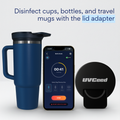
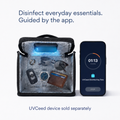
UVCeed is a portable 254 nm UV-C device that uses your phone camera and app to guide a session across a hard surface. You aim UVCeed at one section, hold it steady while the app confirms the section is complete, then move to the next section if the surface is larger than the coverage area.
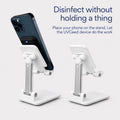
For international travel generally, the practical routine is the tray table, armrest, and your own phone and passport case after passing through security and immigration checkpoints, where thousands of hands touch the same surfaces daily. This is general travel hygiene, not an outbreak-specific claim.
FAQ
Does this guidance mean Ebola is spreading in the US? No. The guidance is a standard preparedness measure for assessing travelers arriving from the specifically affected countries, per the CDC's interim guidance. There is no indication of domestic transmission.
How does Ebola actually spread? Through direct contact with the blood, body fluids, or contaminated materials of a person who is symptomatic with the disease. It does not spread through casual contact, air, water, or food in the way respiratory viruses do.
Should I cancel travel plans because of this outbreak? Check the CDC's Travelers' Health notices for the specific destination you are planning to visit. Guidance is destination-specific and changes as outbreak status changes.
Can UV-C kill the Ebola virus? We are not aware of a published, Ebola-specific UV-C study, so we do not make that claim. UV-C's documented value for a general traveler is against the much more common pathogens found throughout airports and in-flight cabins, not as an Ebola-specific intervention.
What is the actual case fatality rate for Ebola? It has historically ranged from 25% to 90% depending on the outbreak, strain, and access to supportive medical care, which is part of why public health agencies apply a high level of monitoring rigor even to geographically contained outbreaks.
The Bottom Line
This is a standard CDC preparedness measure targeted at travelers from specific affected countries, not a signal of general domestic risk. For everyday international travelers, the practical takeaway is the same layered hygiene habit that protects against the far more common pathogens moving through airports every day.
Want More Articles Like This?
Get research on UV-C treatment and product updates delivered to your inbox.