TL;DR
On September 24, 2026, the CDC closed its investigation into a nationwide backyard poultry Salmonella outbreak with a final tally of 1,253 people sick across 46 states plus Puerto Rico, 256 hospitalizations, and 2 deaths, making it the second-worst year on record for this specific outbreak category behind the pandemic-era spike in 2020. Eight hatcheries were identified as sources of the outbreak strains. None of them were publicly named. If your household added chicks or ducklings this year, or you kept a backyard flock through the spring hatchery rush, this outbreak likely touched closer to home than it feels like it did.
What actually happened
Backyard poultry keeping has grown steadily for years, driven by interest in fresh eggs, homesteading, and pandemic-era hobbies that stuck. According to reporting on the CDC's closed investigation, 2026 turned into one of the worst years on record for Salmonella linked to live poultry contact, with cases spread across 46 states and Puerto Rico. Chicks and ducklings can carry Salmonella on their feathers, feet, and in their droppings without showing any signs of illness themselves, which is exactly what makes this outbreak category so persistent. A perfectly healthy-looking chick can shed the bacteria into a coop, a feed dish, or a child's hands during an ordinary afternoon of chores.
What stands out about this year's closure notice is what is missing from it. CDC investigators traced the outbreak strains back to eight separate hatcheries, but none were named publicly, which means households that bought chicks from any hatchery this year have no way to know whether their specific flock was one of the traced sources. That is a meaningfully different situation than a grocery store recall, where a shopper can check a lot number. Here, the exposure pathway is ongoing contact with live birds in a backyard coop, not a single product that can be pulled off a shelf.
The mail-order chick pipeline nobody thinks about
Most backyard flocks do not start at a local farm store. They start with a hatchery shipping day-old chicks or ducklings through the mail, often in bulk orders of 15 or more since chicks need each other's body heat to survive shipping. Those birds arrive at a post office or a farm store pickup counter, get handled by staff and customers, and go home in a box that a family, often with kids present for the exciting part, opens on the kitchen table or the living room floor before the coop is even fully set up. That first 24 to 48 hours, unboxing, cuddling, naming, photographing, is also the highest-contact window with a bird that may already be shedding Salmonella, well before anyone has established the handwashing routine a permanent coop setup would normally enforce.
This is also not a new problem, just a worsening one. CDC has tracked backyard poultry-linked Salmonella outbreaks as a distinct surveillance category for over a decade, and case counts have trended generally upward alongside the backyard chicken-keeping boom that accelerated during the pandemic and never fully receded. Multiple hatcheries being linked to a single year's outbreak strains, as happened here with eight separate sources, is consistent with an industry where mail-order hatcheries source breeding stock and eggs from overlapping supply chains, meaning a contamination issue at one link can surface across nominally unrelated hatchery brands within the same season.
Why this outbreak is harder to contain than a food recall
Live poultry outbreaks do not resolve the way food recalls do, because the "product" is a living animal that keeps shedding bacteria for as long as it is in the flock, and because the primary exposure route is direct contact and shared surfaces rather than something a household eats once. Kids are especially at risk here for two reasons: they are more likely to kiss or snuggle chicks, and they are less likely to wash their hands thoroughly afterward. CDC data across backyard poultry outbreaks consistently shows a disproportionate share of cases in children under 5, which tracks with this year's pattern of hospitalizations running high relative to total case count.
What to actually do if you keep backyard poultry
- Wash hands thoroughly with soap and water immediately after handling birds, eggs, feed, or anything in the coop, every time, not just when hands look dirty.
- Do not let children under 5 handle chicks or ducklings without direct adult supervision and an immediate handwashing follow-up.
- Keep coop shoes, tools, and feed scoops separate from anything that enters the house, and designate a specific mudroom or entryway zone for coop gear.
- Collect eggs regularly and wash them before storing, since eggshells can carry Salmonella from contact with droppings or a contaminated nesting box.
- Never bring live poultry, even briefly, into the kitchen or any food prep area, no matter how tame the bird seems.
Where UVCeed fits
254 nm UV-C inactivates bacteria on food surfaces. FDA rules prevent us from citing a specific reduction percentage on food, so we do not. UVCeed does not replace handwashing, which remains the single most important control for this specific outbreak category, since live birds continuously shed bacteria that no surface treatment addresses at the source. Where it fits is the household surfaces downstream of the coop: the mudroom entry, the egg basket, the counter where eggs get set down before washing, and the feed scoop handle, all hard, non-porous points where bacteria can transfer from coop to kitchen if hands and surfaces are not both accounted for.
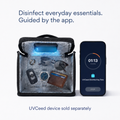
With UVCeed, you aim the device at the entry surface or egg basket, hold steady until the app confirms that section is complete, then move to the next section. A useful second layer in the chain, not a substitute for the handwashing step that actually breaks it.
FAQ
How do I know if my hatchery was one of the 8 linked to this outbreak? CDC did not publicly name the eight hatcheries, so there is no way to check a specific source directly. The safest approach is to follow standard poultry-handling hygiene practices regardless of where your flock came from.
Can chickens carry Salmonella without looking sick? Yes. Chicks, ducklings, and adult birds can carry and shed Salmonella on their feathers, feet, and in droppings while appearing completely healthy, which is why hygiene practices matter every time, not just when a bird seems ill.
Why are children under 5 disproportionately affected in these outbreaks? Young children are more likely to hold, kiss, or put their hands in their mouths after handling birds, and are less likely to wash their hands thoroughly afterward, both of which increase exposure risk.
Is it safe to eat eggs from a backyard flock during an outbreak year? Eggs are generally safe when collected, washed, and cooked properly, since cooking kills Salmonella. The risk in these outbreaks comes overwhelmingly from direct bird contact and unwashed hands, not from properly cooked eggs.
Does UV-C disinfection stop the outbreak at its source? No. The outbreak's source is live birds shedding bacteria, which no surface treatment addresses. Handwashing after bird contact remains the primary control; UV-C is a supplemental layer for the surfaces bacteria travel to afterward.
Why do backyard poultry outbreaks keep happening year after year? Because the exposure pathway is direct, ongoing contact with live animals rather than a single product, hygiene habits around a home flock are harder to standardize than a food safety protocol at a processing plant, and the popularity of backyard chicken-keeping has grown steadily for years, expanding the pool of households and children in regular contact with live birds.
Should I get rid of my backyard flock because of this outbreak? CDC guidance does not recommend giving up backyard flocks over Salmonella risk. Instead, it recommends consistent hygiene practices, handwashing, supervised handling for young children, and keeping birds and their equipment out of the house, as the effective long-term response.
Want More Articles Like This?
Get research on UV-C treatment and product updates delivered to your inbox.