Short answer: yes in a validated UV reactor, no in a glass on your counter with a handheld wand pointed at it. UV-C at 254 nm is the most-deployed disinfection technology in the world for drinking water - every major US city with a surface-water intake runs water through engineered UV reactors, and the EPA regulates the exact dose required. But the phrase "in water" is doing enormous work in the question, and most product pages collapse the engineered-reactor case into the kitchen-counter case to sell devices that cannot do the second job.
UV light does not disinfect turbid water. It does not disinfect iron-stained well water at full dose. It does not disinfect water with high dissolved organic carbon without a longer exposure. It does not reach bacteria shadowed behind suspended particles. And a portable surface sanitizer aimed into a cup of water does not deliver anything resembling the dose a certified NSF/ANSI 55 Class A water-treatment UV lamp delivers in a plumbed reactor.
What UV-C does do, reliably, is kill bacteria in water that is clear, flowing through an engineered reactor at a known residence time, under a lamp of specified irradiance, at a validated dose. That is a real capability. It is also a specific one. This article walks through the physics of UV in water, the published dose numbers, the three categories where UV truly disinfects water, and the places portable UV devices cannot credibly replace a water-treatment system.
What UV light does to waterborne bacteria at the molecular level
Every common waterborne bacterium — E. coli, Salmonella, Shigella, Campylobacter, Legionella, Pseudomonas, Vibrio — shares the same fundamental vulnerability to UV-C at 254 nm. DNA absorbs this specific band of ultraviolet photons strongly. When enough photons hit, adjacent thymine or cytosine bases in the genome fuse into pyrimidine dimers. A dimer-studded strand cannot replicate, and a bacterium that cannot divide cannot establish an infectious dose in a human gut. The cell is still physically there in the water, but biologically it is a dead end.
The dose required to achieve this is well characterized. A 4-log (99.99%) inactivation of E. coli requires about 10 mJ/cm². Vibrio cholerae needs about 6 mJ/cm². Legionella pneumophila takes about 10 mJ/cm². Salmonella typhi about 8 mJ/cm². Vegetative bacteria are, broadly, the easiest common pathogens for UV to kill. (Hijnen WAM et al., Inactivation credit of UV radiation for viruses, bacteria and protozoan (oo)cysts in water: a review, Water Res. 2006)
But — and this is the sentence most product pages omit — the dose numbers above assume the photon reaches the bacterium. In water, that is a function of water quality, not just lamp output.
The physics of UV in water
UV-C at 254 nm is absorbed by water itself and by anything dissolved or suspended in it. The parameter engineers care about is UV transmittance (UVT), usually reported as the percent of 254 nm light that passes through 1 cm of water. Clean municipal tap water has a UVT in the 90 to 98% range per cm. Shallow-well water with iron and organics might be 70 to 85%. Surface water after a rainstorm might be 60 to 75%. Water with visible color, high turbidity (NTU > 5), or dissolved iron drops UVT fast.
A low UVT means the lamp output is absorbed by the water before it reaches the bacteria. A reactor sized for 95% UVT will fail to deliver its design dose if the water drops to 80%. Turbidity does worse than attenuation — suspended particles cast shadows, and bacteria sheltered behind a floc particle can pass through a UV reactor without ever being hit. This is why validated UV water-treatment systems require upstream filtration to clear turbidity below defined limits before the water enters the UV chamber.
A portable UV wand aimed at a cup of water has no control over any of these variables. The user does not know the UVT, has no filtration, no flow geometry, no residence-time calculation, no reactor validation, and no way to measure delivered dose. The physics does not stop working — it just stops delivering a predictable result.
Which UV wavelength is the right one
Not all UV light is germicidal. The band splits three ways:
- UV-A (315–400 nm) — the "black light" range. No practical bactericidal effect on waterborne pathogens. Cheap "UV sanitizer" wands on Amazon are usually UV-A LEDs. The FDA pulled 13 of these off the market in July 2022 for making unsupported germicidal claims. (FDA Safety Communication, July 2022)
- UV-B (280–315 nm) — the sunburn range. Partial germicidal activity, not used in water disinfection.
- UV-C (100–280 nm) — the germicidal range. 254 nm from low-pressure mercury lamps is the global standard for water treatment. 265–280 nm UV-C LEDs are increasingly used in point-of-use consumer water devices.
If a product does not name its wavelength or claims germicidal action from an unspecified "UV light," assume UV-A and discard the claim.
Where UV light actually works on bacteria in water
Published research, EPA regulation, and real-world utility practice converge on three categories where UV-C genuinely disinfects water.
1. Municipal drinking-water treatment. Every US public water system drawing from a surface source — rivers, lakes, reservoirs — operates under the EPA Long Term 2 Enhanced Surface Water Treatment Rule (LT2ESWTR), which gives credit for UV disinfection against Cryptosporidium, Giardia, and viruses at validated reduction-equivalent doses typically in the 20 to 40 mJ/cm² range. Vegetative bacteria are inactivated as a side benefit at those doses. (EPA UV Disinfection Guidance Manual, 2006) UV is now installed at thousands of US treatment plants. If your tap water comes from a surface source, it almost certainly passed through a UV reactor on the way to your glass.
2. Point-of-use certified UV water systems. Residential whole-house UV systems — plumbed inline on a well-water supply, downstream of a sediment filter and often a water softener — are the standard solution for well-water bacterial contamination. These systems are certified against NSF/ANSI 55 Class A when they deliver a validated 40 mJ/cm² dose and are intended for microbiologically unsafe water, or Class B at 16 mJ/cm² for supplemental treatment on microbiologically safe water. (NSF/ANSI 55: UV Microbiological Water Treatment Systems)
3. Backcountry and emergency point-of-use UV devices. Portable water-treatment UV products designed as water devices — SteriPEN and similar — stir a UV-C lamp into a defined volume of water (typically 0.5 L or 1 L) for a defined time to deliver a validated dose. These are water-specific tools with reservoir geometry built into the use case. They work; they are also distinct, in design and intent, from a surface sanitizer.
Everything else involves either a surface sanitizer being pointed at water it was not engineered to disinfect, or a wand that is UV-A and does nothing to anything.
Where UV light does not work on bacteria in water
1. A handheld surface wand aimed at a cup, pitcher, or bottle. The irradiance drops with the square of distance; the water absorbs photons before they reach the bottom; particles cast shadows; there is no flow, no mixing, and no dose measurement. Even if the wand is a real 254 nm UV-C source, the user has no basis for claiming the bacteria at the bottom of the glass received 10 mJ/cm². They almost certainly did not.
2. Turbid, colored, or iron-stained water. As UVT drops, delivered dose drops with it, often by an order of magnitude. A UV reactor validated for 95% UVT water does not deliver its label dose on 70% UVT water. A handheld pointed at cloudy water does worse. If the water is visibly murky, filter first; UV cannot shoot through particulates.
3. Water during a boil-water advisory, as a boiling substitute. Boiling is the CDC-recommended emergency intervention for microbiologically unsafe water precisely because it does not depend on water clarity, lamp output, dose, geometry, or user technique. UV surface devices are not a substitute. (CDC: Making Water Safe in an Emergency)
4. Protozoan oocysts in untreated surface water. Cryptosporidium and Giardia are 2 to 5 times harder for UV to inactivate than vegetative bacteria, and they are the pathogens of concern in most untreated surface water. Backcountry users targeting bacteria while ignoring protozoa are solving the wrong problem.
Why most UV products overstate what they can do about water
The search traffic for "does UV kill bacteria in water" is enormous. The incentive for a surface-sanitizer brand to say "yes" is strong, because the one-word answer is technically true in a reactor. The incentive to add the engineering caveats — UVT, flow, geometry, residence time, validated dose — is weak.
So the typical consumer UV wand product page says: UV-C kills waterborne bacteria. True in a Trojan reactor at a municipal utility, aimed at a controlled flow of pre-filtered water. Not true for the wand the buyer is holding over a glass. The buyer sanitizes a camp-stove pot of lake water with a wand, drinks it, and gets sick anyway — because the wand was not a water-treatment device and did not deliver anywhere near the required dose.
The result is a market where UV water-treatment, which actually works at scale, gets conflated with UV surface sanitation, which is a different job entirely.
Where UVCeed fits in the water conversation
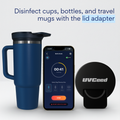
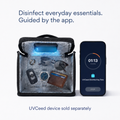
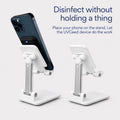
UVCeed is a portable, MagSafe-mounted UV-C device paired with a phone camera that visualizes which area of a surface has received light. It is a surface sanitizer. It is explicitly not a water-treatment device.
- Coverage you can see. The phone camera overlays a map of which parts of a water bottle mouthpiece, bottle cap threads, filter housing, or sink faucet handle have been exposed and which have not. The surfaces that touch your mouth and your clean water are where UV-C can plausibly reduce bacterial load.
- Dose verification. The device times exposure based on measured irradiance so the surface accumulates a defined dose.
What UVCeed is not: a drinking-water purifier, a well-water treatment system, an NSF/ANSI 55 certified UV device, a backcountry water device, or an FDA-cleared medical device. It is a general-wellness surface sanitizer. Users who need to disinfect drinking water should use boiling, chlorine tablets, or a certified UV water device like a SteriPEN with validated dose for the water volume. We put that distinction in writing because the market has not.
The bottom line
UV light kills bacteria in water when three things are true at the same time:
- The wavelength is in the germicidal range (254 nm or 265–280 nm UV-C, not UV-A).
- The dose is validated for the water quality and target organism — typically 10 to 40 mJ/cm² delivered through water with known UVT.
- The delivery system is engineered for water — a reactor with controlled flow, residence time, and dose, not a handheld pointed into a cup.
For municipal water, well-water whole-house systems, and purpose-built backcountry UV devices, UV-C is the dominant technology in global water disinfection. For a surface sanitizer aimed at a glass of water, it is not.
Any UV product that implies it can disinfect drinking water without naming its wavelength, residence time, dose validation, and UVT assumptions is selling theater, not science.
Sources
- Hijnen WAM, Beerendonk EF, Medema GJ. Inactivation credit of UV radiation for viruses, bacteria and protozoan (oo)cysts in water: a review. Water Res. 2006;40(1):3–22.
- EPA Ultraviolet Disinfection Guidance Manual for the Final Long Term 2 Enhanced Surface Water Treatment Rule, 2006
- EPA Long Term 2 Enhanced Surface Water Treatment Rule (LT2ESWTR)
- NSF/ANSI 55: UV Microbiological Water Treatment Systems
- CDC: Making Water Safe in an Emergency
- FDA Safety Communication: UV Wands May Pose Risks of Radiation Injuries (July 2022)
Want More Articles Like This?
Get research on UV-C treatment and product updates delivered to your inbox.