Short answer: yes, UV-C does inactivate Clostridioides difficile spores, but the dose required is roughly 5 to 10 times what it takes to kill ordinary vegetative bacteria, and that single fact drives every real-world decision about how to use UV against this organism. The landmark bench study by Nerandzic and colleagues at the Cleveland VA measured a greater than 2-log reduction of C. difficile spores at approximately 22,000 µWs/cm² (22 mJ/cm²) during a 50-minute automated room-UV cycle. (Nerandzic MM et al. BMC Infect Dis. 2010;10:197.) That is a hospital-grade dose from a hospital-grade machine, and this article is written for the family that just brought home a loved one with a C. difficile diagnosis.
What UV light does not do is replace a 1:10 bleach dilution with a 10-minute dwell on the hard surfaces this organism contaminates. It does not match a Xenex pulsed-xenon robot running an unattended room cycle. It does not kill spores through a towel or behind a toilet rim it did not illuminate. And it does not substitute for the most important household intervention after a C. diff diagnosis: handwashing with soap and water, which physically removes spores, rather than alcohol hand sanitizer, which does nothing to them.
Where UV-C earns a role at home is as a verifiable finishing layer on bathroom hard surfaces after bleach has done the primary work. The rest of this article explains why C. difficile is the hardest common household pathogen for UV, what the dose numbers say, and where a camera-verified handheld fits inside a protocol still built around chlorine and soap.
What C. difficile actually is, and why it comes home from the hospital
Clostridioides difficile (reclassified from Clostridium difficile in 2016, same organism) is a Gram-positive, spore-forming, obligately anaerobic bacillus that lives in the colon. In its vegetative form it is fragile; outside the gut it survives as a spore, and the spore is what matters for environmental transmission. According to the CDC, C. difficile causes roughly 500,000 US infections and contributes to approximately 15,000 to 30,000 deaths each year, with the majority of cases linked to healthcare exposure and recent antibiotic use. (CDC: C. diff (Clostridioides difficile))
The clinical picture is severe, watery, often bloody diarrhea driven by toxins A and B produced by the vegetative form after broad-spectrum antibiotics disrupt the normal gut flora. Recurrence is common. Transmission is fecal-oral, which in a shared-bathroom household means every surface touched between the toilet and the sink is a potential vehicle: flush handle, toilet seat and lid, toilet-paper holder, sink faucet, light switch, doorknobs, and hand towel. Spores shed in stool can persist on dry surfaces for months. The organism is a nosocomial problem first and a home problem second: hospitals built their environmental hygiene strategy around it because the spore survives standard quaternary-ammonium wipes.
Why C. difficile spores are the hardest common target in disinfection science

A bacterial spore is a metabolically dormant survival structure. C. difficile endospores have three features that explain their resistance to nearly every common disinfectant:
- A dipicolinic acid core. Calcium dipicolinate chelates water out of the core, leaving the DNA semi-crystalline and dehydrated. Dry DNA is physically harder to damage, and this is a major reason the UV dose for spores is multiples of the dose for vegetative cells.
- A thick peptidoglycan cortex and multiple protein coats. These layers absorb and scatter UV photons before they reach the genome, and resist penetration by oxidizers and alcohols.
- DNA-protective small acid-soluble proteins (SASPs). SASPs saturate the spore DNA and shield it from UV-induced thymine dimerization. Spores also carry repair enzymes that reverse some photoproduct damage after germination.
The same features explain a fact that catches most households off guard: alcohol-based hand sanitizers do essentially nothing to C. difficile spores. Ethanol and isopropanol disrupt vegetative cell membranes, but spores do not have exposed membranes to disrupt. This is why every CDC consumer page on C. diff says the same thing: wash with soap and water, not sanitizer, after bathroom contact in a C. diff household. (CDC: Prevent the Spread of C. diff) Soap and running water work by physical removal; the spore goes down the drain, which is where it belongs.
Bleach is different. Sodium hypochlorite at adequate concentration and contact time is sporicidal. The CDC/HICPAC-recommended protocol for C. difficile environmental decontamination is an EPA List K sporicidal disinfectant, in practice a 1:10 dilution of household bleach (approximately 5,000 ppm available chlorine), applied to a visibly clean hard surface and allowed a contact time of at least 10 minutes before being wiped off. (CDC/HICPAC Guideline for Disinfection and Sterilization, 2008, updated 2019; Rutala WA, Weber DJ. Infect Control Hosp Epidemiol. 2010;31(2):107–117.) A quick spray-and-wipe with 1:10 bleach, left on the surface for 30 seconds, is not the same intervention as a full 10-minute dwell.
The dose table: C. diff spores versus the organisms consumers already know
The numbers below are approximate 254 nm UV-C doses required for a 2 to 4-log reduction on exposed, nonporous surfaces, drawn from the published literature. They are presented together to show the roughly order-of-magnitude distance between C. difficile spores and the pathogens most consumers already assume UV handles well.
| Organism | Form | Approximate UV-C dose for 2–4 log reduction at 254 nm |
|---|---|---|
| Escherichia coli | Vegetative | 6–10 mJ/cm² |
| Staphylococcus aureus (incl. MRSA) | Vegetative | 5–10 mJ/cm² |
| SARS-CoV-2 | Enveloped RNA virus | 2–5 mJ/cm² |
| Clostridioides difficile | Endospore | ~22 mJ/cm² for >2-log (Nerandzic 2010); higher doses required for 3–4-log |
Sources: Nerandzic et al. 2010; Hijnen et al. 2006 for vegetative bacteria; 2020–2022 SARS-CoV-2 UV-C inactivation studies for the viral benchmark. The take-away is that any device, protocol, or dwell time built around E. coli or MRSA will not be adequate for C. diff without an explicit upgrade in exposure.
What hospital UV-C systems actually do, and why they are different machines
Hospital environmental services departments deploy dedicated no-touch UV disinfection systems as an adjunct to manual cleaning for discharge rooms. The two best-studied platforms are Xenex LightStrike (pulsed xenon, broad-spectrum UV) and Tru-D SmartUVC (continuous low-pressure mercury, 254 nm, dose-measured). These machines are rolled into an empty, pre-cleaned room, run for cycles typically in the 15 to 50-minute range, and are supervised by door sensors because the irradiance inside the room during a cycle is not safe for humans.
The 2017 Benefits of Enhanced Terminal Room (BETR) Disinfection study published in The Lancet randomized nine hospitals across four strategies and found that adding UV to standard quaternary-ammonium cleaning reduced acquisition of multidrug-resistant target organisms in exposed patients. (Anderson DJ et al. Lancet. 2017;389(10071):805–814.) The design is instructive: dose is accumulated over tens of minutes at close range in a cleared room, not over a few seconds of handheld sweep. A hospital uses a four-foot-tall robot and not a wand because the time-integrated dose a C. difficile spore requires is impractical to deliver by hand.
Where UV-C fits in a home after a C. diff diagnosis

UV-C at home is a supplement to a bleach-based cleaning protocol, not a replacement, and the right targets are the frequently touched hard surfaces in the bathroom where fecal-oral transmission happens.
The protocol, in order:
- Mechanical cleaning first. Visible soil and fecal residue must be physically removed with soap and water before disinfectant is applied. Organic matter inactivates bleach and shields spores from UV photons.
- Bleach contact time. Apply a freshly prepared 1:10 dilution of regular household bleach, or an EPA List K product, to the toilet seat (both sides), lid, flush handle, toilet-paper holder, sink faucet, light switch, both sides of the doorknob, and any grab bar. Keep the surface visibly wet for at least 10 minutes.
- Rinse and dry the hard surfaces that will contact skin, especially the toilet seat.
- UV-C as a verification pass, after bleach, on the same hard surfaces. The goal is a secondary layer with camera-verified coverage to catch spots the bleach wipe missed: the hinge behind the toilet seat, the underside of the flush handle, the back of the faucet, the edge of the light-switch plate.
- Soap and water for hands. Every household member washes with soap and water after bathroom use. Alcohol sanitizer stays off the counter for the duration of the recovery.
- Dedicated bathroom textiles. Hand towels and bathmats used by the recovering patient are laundered separately on hot. UV-C does not meaningfully penetrate fabric at household-tolerable exposure.
UV-C earns a role on step 4, not step 2, because the verification problem matters here more than for almost any other household pathogen: the spot a bleach wipe missed is the spot that will reinfect a family member.
Why handheld UV-C cannot achieve hospital decontamination, and that is OK
A handheld UV-C source cannot deliver a Xenex-level or Tru-D-level dose across an entire bathroom in a cycle a human will tolerate. Irradiance drops with the square of distance from the lamp, dwell per square inch is seconds not minutes, and the operator fatigues long before a 50-minute cycle finishes.
What a handheld device can do, when paired with camera-verified coverage, is deliver a meaningful dose to specifically selected high-touch hard surfaces after bleach has done the heavy lifting. This is not hospital decontamination. It is an additive layer in a household already doing the right thing with chlorine, soap, and separate laundry. Partial surface spore reduction on the toilet-seat hinge and faucet handle is a worthwhile contribution when the alternative is "we hoped the bleach wipe caught it." For C. difficile, the hardest problem is not photons; it is coverage auditing on surfaces most people clean partially and inspect never.
Where UVCeed fits in the C. diff conversation
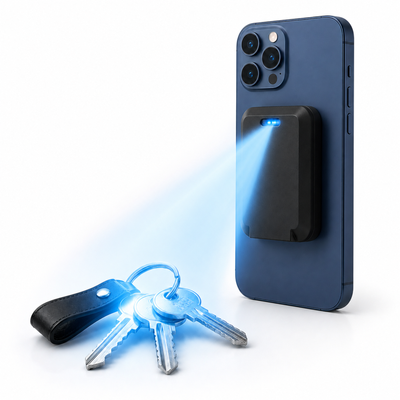
UVCeed is a MagSafe-mounted UV-C device that uses the phone camera to visualize which areas of a surface have received light. For C. difficile, the device is positioned as a supplementary verification layer on bathroom hard surfaces after a proper bleach dwell, not as a primary disinfectant.
- Coverage mapping on the exact surfaces that matter. The phone overlay shows which square inches of the toilet seat, flush handle, faucet, light switch, and doorknob have been exposed and which have not. For a household trying to prevent reinfection, the camera is doing the audit that would otherwise be invisible.
- Dose transparency. The device times and measures exposure, so the applied dose per surface is a known quantity rather than a sweep-and-hope estimate.
What UV-C cannot do about C. diff
- Replace bleach. Sodium hypochlorite at proper concentration and 10-minute contact time is the backbone of the CDC-recommended protocol. UV-C is additive, not substitutive.
- Achieve hospital decontamination from a handheld. Xenex and Tru-D exist because handheld dwell cannot approximate robot dwell.
- Kill spores through fabric or carpet without extended dwell well beyond what any consumer device sustains. Textiles get laundered hot; carpets get professionally cleaned or isolated.
- Eliminate the need for enhanced hand hygiene. Soap and water, not alcohol sanitizer, is the only hand hygiene that works for C. difficile spores, and that stays true regardless of what a surface tool has done.
The qualified yes at the top is the real answer. UV-C does kill C. difficile spores at adequate dose, and adequate dose is hospital-grade. The role for a camera-verified handheld, after a C. diff discharge, is a targeted finishing pass on bathroom hard surfaces that bleach has already handled, performed with visible coverage so the family can see what the bleach wipe did not reach.
Sources
- Nerandzic MM, Cadnum JL, Pultz MJ, Donskey CJ. Evaluation of an automated ultraviolet radiation device for decontamination of Clostridium difficile and other healthcare-associated pathogens in hospital rooms. BMC Infect Dis. 2010;10:197.
- Rutala WA, Gergen MF, Weber DJ. Room decontamination with UV radiation. Infect Control Hosp Epidemiol. 2010;31(10):1025–1029.
- Rutala WA, Weber DJ. Guideline for Disinfection and Sterilization in Healthcare Facilities, CDC/HICPAC, 2008 (updated 2019).
- Anderson DJ, Chen LF, Weber DJ, et al. Enhanced terminal room disinfection and acquisition and infection caused by multidrug-resistant organisms and Clostridium difficile (the Benefits of Enhanced Terminal Room Disinfection study): a cluster-randomised, multicentre, crossover study. Lancet. 2017;389(10071):805–814.
- Hijnen WAM, Beerendonk EF, Medema GJ. Inactivation credit of UV radiation for viruses, bacteria and protozoan (oo)cysts in water: a review. Water Res. 2006;40(1):3–22.
- CDC: C. diff (Clostridioides difficile).
- CDC: Preventing C. diff.
Want More Articles Like This?
Get research on UV-C treatment and product updates delivered to your inbox.