Short answer: yes, qualified. UV-C at 254 nm damages the DNA of Cyclospora cayetanensis oocysts, the same way it inactivates its better-studied cousin Cryptosporidium, which is why municipal water utilities use UV reactors as a protozoan barrier. But that answer has one load-bearing condition most buyers miss: the oocyst has to be on a surface the light actually touches, at a dose high enough to matter.
UV light does not reach cyclospora oocysts tucked inside the folded ribs of a romaine leaf. It does not sanitize a whole head of lettuce. It does not clean produce in a field. It does not substitute for a boil-water advisory. And it does not undo the fact that produce rinsing — the thing most consumers reach for during an outbreak — has been shown repeatedly to be nearly useless against this specific parasite.
What UV-C does do is kill cyclospora oocysts on hard, nonporous surfaces where the light actually lands at a dose comparable to the 20 to 40 mJ/cm² range used in validated water-treatment UV reactors. That is a real capability for the kitchen surfaces, cutting boards, and reusable containers that touched contaminated produce. It is not a solution for the produce itself. This article walks through the biology, the published doses, the three places UV-C genuinely helps with cyclospora, and the places it does not.
What UV light does to cyclospora at the molecular level
Cyclospora cayetanensis is a single-celled protozoan parasite. It is shed in human feces as an oocyst — a tough, roughly 10-micron sphere with a thick wall that protects the sporozoites inside. The oocyst has to sit in the environment for one to two weeks to become infectious, which is why direct person-to-person transmission is rare and why outbreaks almost always trace back to contaminated produce or water that carried already-sporulated oocysts into the food chain. (CDC: Cyclosporiasis — Clinical Overview)
UV-C disinfection targets DNA. When 254 nm photons hit a nucleic acid strand, adjacent thymine or cytosine bases fuse into pyrimidine dimers — covalent bonds in places where there should not be any. A dimer-studded genome cannot replicate, which means the sporozoites inside cannot excyst and establish infection in a human intestinal cell. The oocyst is still physically present on the surface, but biologically it is a dead end.
Direct inactivation studies on Cyclospora oocysts are limited because the organism is hard to culture — there is no reliable animal model. But the UV-dose data on Cryptosporidium parvum, a protozoan oocyst of similar size and wall structure, is extensive and used by EPA as the regulatory surrogate for all protozoa in drinking-water UV disinfection. A 3-log inactivation of Cryptosporidium oocysts requires roughly 12 mJ/cm² at 254 nm, and a 4-log reduction requires about 22 mJ/cm². (Hijnen WAM et al., Inactivation credit of UV radiation for viruses, bacteria and protozoan (oo)cysts in water: a review, Water Res. 2006)
Compare that to a virus like SARS-CoV-2 at 2 to 5 mJ/cm², or a vegetative bacterium like E. coli at 6 to 8 mJ/cm². Protozoan oocysts are the hardest common pathogens for UV to kill — not the easiest. Any product claim that lumps "viruses, bacteria, and parasites" together under a single short exposure number is leaning on the easy pathogens to sell the hard one.
Which UV wavelength is the right one
Not all ultraviolet light is germicidal. The band splits three ways:
- UV-A (315–400 nm) — the "black light" range. No practical effect on cyclospora oocysts. Cheap "UV sanitizer" wands sold on Amazon for $15 to $30 are almost always UV-A LEDs. The FDA pulled 13 of these off the market in July 2022 for making unsupported germicidal claims. (FDA Safety Communication, July 2022)
- UV-B (280–315 nm) — the sunburn range. Some activity, but a dose high enough to inactivate protozoa is a dose high enough to burn human skin. Not a practical surface tool.
- UV-C (100–280 nm) — the germicidal range. Specifically 254 nm from low-pressure mercury lamps and 265–280 nm UV-C LEDs. This is what kills cyclospora.
If a device does not specify a 254 nm or 265–280 nm wavelength on the spec sheet, assume it is UV-A and will do nothing to a protozoan oocyst.
Where UV light actually works against cyclospora
Published research and real-world deployments converge on three categories where UV-C earns its keep against this parasite.
1. Municipal and industrial water treatment. Validated UV reactors — Trojan, Atlantic, Wedeco systems — are installed at the inlet of water treatment plants and at food-processing produce-wash lines. These engineered systems deliver reduction-equivalent doses in the 20 to 40 mJ/cm² range through clear water with known residence times, meeting EPA LT2ESWTR requirements for Cryptosporidium credit, which also covers Cyclospora. (EPA UV Disinfection Guidance Manual, 2006) If you are drinking municipal tap water in a US city with a surface-water intake, UV has almost certainly been part of the protozoan barrier that reached your glass.
2. Hard-surface kitchen contact zones after handling implicated produce. The 2024 Taylor Farms bagged-salad outbreak was linked to over 11,000 cases across multiple states, and the 2026 cyclospora season has driven another surge of consumer searches. (FDA: Outbreak Investigation of Cyclospora — Bagged Salads, 2024) The oocysts that cause secondary infection in a household typically land on the cutting board, the colander, the counter, the knife, and the reusable produce container — not on the diner's fingertips. UV-C at 20 to 40 mJ/cm² on these nonporous surfaces hits the dose where Cryptosporidium and, by extrapolation, Cyclospora oocysts stop being infectious.
3. Reusable food-contact items that have held suspect produce. Plastic clamshells reused as leftover containers, cutting boards used for both suspect produce and ready-to-eat items, and the inside walls of refrigerator produce drawers where salad bags have leaked. These are the surfaces where a UV-C device with dose verification can plausibly interrupt cross-contamination between a contaminated incoming item and the next thing prepared on that surface.
Everything else involves either produce you cannot UV-sanitize meaningfully, or a sales pitch stretched past the physics.
Where UV light does not work against cyclospora
1. The produce itself. Cyclospora oocysts attach to and lodge in the folded, ridged, waxy surfaces of leafy greens, raspberries, basil, and cilantro — the four produce categories responsible for most US outbreaks. The oocysts sit inside leaf folds, in the crevices of raspberry drupelets, and under the cuticle wax layer in some cases. UV light cannot reach into those three-dimensional structures from a handheld device. A full head of romaine, a clamshell of raspberries, or a bunch of cilantro cannot be meaningfully UV-sanitized by a consumer device. This is also why rinsing does not work — the parasite is not loose on the surface, and even industrial produce washes with chlorinated water show inconsistent oocyst removal.
2. In-field or pre-harvest contamination. The source of nearly every US cyclospora outbreak is agricultural water contaminated with human sewage upstream of the field, or human-source contamination at the growing or harvesting stage. No consumer tool addresses this. The intervention point is agricultural-water management and worker sanitation on the farm — not any device in a home kitchen.
3. Drinking water that is already in the glass. UV-C at 254 nm penetrates clear water reasonably well — about 90% transmission per centimeter — but a portable surface sanitizer is not engineered for the residence time, flow geometry, and dose uniformity that a water-treatment reactor provides. During a boil-water advisory, boil the water. UV surface devices are not a boil-order substitute.
4. Produce washing as a strategy. Several studies and FDA advisories have been explicit: rinsing produce under tap water, rubbing it, or using commercial "produce wash" sprays does not reliably remove Cyclospora oocysts from leafy greens or berries. The organism attaches too tightly. If an outbreak is active and the implicated product is in your refrigerator, the correct action is to discard it, not to try to wash it clean. (CDC: Cyclosporiasis — Prevention)
Why most UV products overstate what they can do about cyclospora
Outbreak-driven search traffic for cyclospora peaks every summer when fresh produce outbreaks hit the news. The 2024 Taylor Farms outbreak and the 2026 season have both pushed cyclospora queries to multi-year highs. The incentive for a UV wand maker to say "yes, our device kills parasites" is strong. The incentive to add the two caveats that would actually help the buyer — that oocysts hide in leaf folds the light cannot reach, and that the required dose is 5 to 10 times what a virus needs — is weak.
So the typical consumer UV wand product page says: UV-C kills parasites and bacteria on produce. That claim collapses the moment you look at the geometry. The parasite is not loose on the leaf surface, and the handheld's irradiance at the user's working distance rarely accumulates to protozoan-grade dose in a reasonable sweep time. The buyer waves a wand over a salad, eats it, gets sick anyway, and concludes UV doesn't work. The real conclusion is that produce was the wrong target.
Where UVCeed fits in the cyclospora conversation
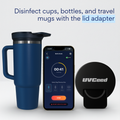
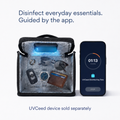
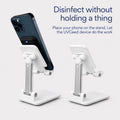
UVCeed is a portable, MagSafe-mounted UV-C device paired with a phone camera that visualizes which area of a surface has received light. It is designed for the specific scenario above: hard, nonporous surfaces where contaminated produce was handled, not the produce itself.
- Coverage you can see. The phone camera overlays a map of which parts of the cutting board, counter edge, colander rim, or refrigerator drawer have been exposed and which have not. Oocysts land on the places a sponge misses — the groove in a cutting board, the inside lip of a produce drawer, the hinge of a reusable salad container. UVCeed makes those misses visible.
- Dose verification. The device times exposure based on measured irradiance so the surface accumulates a dose in the protozoan-relevant range, not the lower virus-only range most spec sheets quote.
What UVCeed is not: a produce sanitizer, a drinking-water purifier, a boil-order substitute, a replacement for discarding recalled product, or an FDA-cleared medical device. It is a general-wellness surface sanitizer. Any of those other jobs is a different tool. We put that distinction in writing because the market has not.
The bottom line
UV light kills cyclospora oocysts on exposed nonporous surfaces when three things are true at the same time:
- The wavelength is in the germicidal range (254 nm or 265–280 nm UV-C, not UV-A).
- The dose is high enough for a protozoan oocyst — roughly 20 to 40 mJ/cm², which is 5 to 10 times what a virus requires.
- The surface is actually in line of sight long enough to accumulate that dose.
For kitchen contact zones after handling implicated salad, berries, or herbs, UV-C is a real tool. For the produce itself, for in-field contamination, or as a replacement for discarding recalled product and following boil-water advisories, it is not.
Any UV product that promises to sanitize produce or substitute for a boil-water order is selling theater, not science.
Sources
- Hijnen WAM, Beerendonk EF, Medema GJ. Inactivation credit of UV radiation for viruses, bacteria and protozoan (oo)cysts in water: a review. Water Res. 2006;40(1):3–22.
- CDC: Cyclosporiasis — Clinical Overview
- CDC: Cyclosporiasis — Prevention
- FDA: Outbreak Investigation of Cyclospora — Bagged Salads (May 2024)
- EPA Ultraviolet Disinfection Guidance Manual for the Final Long Term 2 Enhanced Surface Water Treatment Rule, 2006
- FDA Safety Communication: UV Wands May Pose Risks of Radiation Injuries (July 2022)
Want More Articles Like This?
Get research on UV-C treatment and product updates delivered to your inbox.