Short answer: yes, UV-C at 254 nm kills dust mites on direct-exposed fabric surfaces, and the published mortality curves are convincing. A 2013 study by Phrikanahok and colleagues at Mahidol University showed that Dermatophagoides pteronyssinus and Dermatophagoides farinae — the two mite species responsible for the vast majority of house-dust mite allergy — die at reasonable UV-C doses on cotton fabric. (Phrikanahok et al. 2013, PMID 23569994)
But that sentence has two load-bearing words most mattress-wand sales pages leave out: surface and mites. UV reaches the top 1 to 2 millimeters of a soft material. Dust mites live three to five centimeters deep inside the mattress, down in the pillow stuffing, in the pile of carpet, and in the fibers of upholstered furniture. The light does not reach them there. And the thing that triggers allergy and asthma attacks is not the live mite in the first place — it is the fecal pellet and shed body fragment, a protein called Der p 1 or Der f 1 that the mite has already deposited. UV-C does nothing to a protein that is already there.
So the useful answer for an allergy sufferer is narrower than the product-page answer. UV-C has a real role in a dust mite reduction strategy. It is not the strategy. This article walks through what UV-C does to a live mite, where surface treatment genuinely helps, where it does not, and why hot water, encasement, and a HEPA vacuum are still the backbone of any serious dust mite plan.
What UV light does to a dust mite at the biological level
Dust mites are arthropods — eight-legged relatives of ticks and spiders, about a quarter of a millimeter long, translucent, invisible to the naked eye. Unlike bacteria or mold spores, they have a chitinous exoskeleton, differentiated organs, a nervous system, and eggs with protective shells. The lethal UV mechanism is different from the one that kills a virus.
For microbes, UV-C at 254 nm damages DNA by fusing adjacent pyrimidine bases into dimers that block replication. For a mite, DNA damage still happens, but the pathway is broader: direct cellular damage in exposed epithelial tissue, oxidative stress in the hemolymph, and photochemical injury to exposed cuticle. Mites stop moving within minutes and die over the following hours. Eggs are harder to kill than adults — the chorion absorbs and scatters some of the incoming light, so egg mortality curves lag adult curves. (Chang et al. 1996, J Allergy Clin Immunol)
The Phrikanahok group measured mortality on cotton fabric at roughly 7.1 mW/cm² for 30 to 120 minutes at 254 nm. Adult mortality was essentially complete at the longer exposure, with egg hatchability dropping sharply. That is a real result on a thin cotton substrate with the mites sitting on top. It is not a result that generalizes to a mite buried in six centimeters of polyurethane foam.
Which UV wavelength is the right one
Not all ultraviolet light is germicidal, and not all germicidal UV is the same.
- UV-A (315–400 nm) — the "black light" range. No practical arthropod mortality at consumer doses. The $20 "UV mite killer" wands on Amazon are overwhelmingly UV-A LEDs. The FDA pulled 13 such wands off the market in July 2022 for overstating germicidal claims. (FDA Safety Communication, July 2022)
- UV-B (280–315 nm) — some biological activity, but doses high enough to kill mites also burn human skin. Not a surface-sanitation tool.
- UV-C (100–280 nm) — the germicidal range. The 254 nm line from low-pressure mercury lamps and the newer 265–280 nm UV-C LEDs. This is the band Phrikanahok and Chang tested, and this is the band that actually kills Dermatophagoides.
If a mite wand doesn't publish its wavelength, assume UV-A and move on.
Where UV-C actually works on dust mites
Three concrete scenarios where surface UV-C on a mite population earns its keep.
1. Pillow and mattress top surface before encasement. Allergy specialists recommend zippered mite-proof encasements for pillows and mattresses because the encasement physically traps mites below an impermeable barrier and keeps shed allergen from migrating up to the sleeper. (AAAAI dust mite allergen guidelines) Before you zip the encasement on, running a 254 nm UV-C device over the exposed pillow top and mattress top kills the live mites and reduces the egg load in the surface layer. The ones below the surface are still there, but they are now sealed off from the sleeper by the barrier, and the surface population is dead rather than migrating up through the fabric for the next week.
2. Stuffed animals, pet beds, and items that cannot survive a hot wash. The gold-standard dust mite kill is a 130°F / 54°C wash, hot enough to cook adult mites, eggs, and allergen protein in one cycle. (Platts-Mills & Chapman, J Allergy Clin Immunol) That cycle wrecks most stuffed animals, decorative pillows, delicate wool, and foam pet beds. For items that cannot take a hot wash, surface UV-C is a defensible alternative for the exposed outer layer. A stuffed bear that gets UV-C on both sides and a tumble in a hot dryer is in better shape than the same bear sitting on the shelf collecting mites for six months.
3. Sheets, towels, and bath mats as a between-wash treatment. Sheets and towels are the exact substrate Phrikanahok tested — thin cotton, no deep interior. A UV-C pass over the surface of a sheet, pillowcase, or bath towel will kill the mites and most of the eggs on that surface layer. This does not replace washing, which is still the only thing that removes the allergen protein. But as a between-wash intervention for a sensitive sleeper, or a treatment for a beach towel or gym towel before it goes back into the closet, surface UV-C is doing exactly what the published studies show it can do.
Where UV-C does not work on dust mites
1. Inside the mattress, pillow stuffing, carpet pile, or upholstered furniture interior. This is the central limitation. Dust mite surveys of residential mattresses find most of the population three to five centimeters below the surface, feeding on skin flakes that have worked their way down through the ticking. UV light does not travel through foam, polyester fill, cotton batting, or carpet pile. It does not reach the colony. Any "UV mattress sanitizer" advertising that it eliminates mites throughout a mattress is making a claim the physics will not support. Steam cleaners actually reach deeper, because water vapor and heat penetrate several millimeters further than photons do.
2. The allergen protein that already exists. Der p 1 and Der f 1 — the enzymatic allergens in dust mite feces and shed body parts — are the actual trigger for mite allergy and mite-driven asthma. They are proteins. UV-C damages nucleic acids efficiently and damages proteins only at much higher doses than consumer devices deliver. Killing the live mite population does not remove the allergen the mites deposited over the preceding months. For allergen removal, the only reliable interventions are hot wash, HEPA vacuuming, and encasement to prevent further allergen from reaching the sleeper. (Platts-Mills & Chapman, J Allergy Clin Immunol)
3. Deep carpet, rugs, and upholstery. The pile depth of a residential carpet is one to two centimeters. Mite populations live down at the base of the pile, in the carpet backing, and in the pad underneath. A UV-C pass sanitizes the top of the fibers and misses the colony entirely. Carpet is a HEPA vacuum problem and, for a seriously allergic sleeper, a replacement-with-hard-flooring problem. It is not a UV problem.
4. Airborne allergen in the room's general air. Mite allergen is heavy and settles quickly, but house dust activity — making the bed, vacuuming, children playing on carpet — kicks it back into the air for 20 to 30 minutes. Surface UV-C does nothing to allergen in the air. A HEPA air cleaner in the bedroom addresses this; a UV wand does not.
Why most UV mite products overstate what they can do
The dust mite search market is dense with product listings that take the Phrikanahok result and strip the caveats. The wand page says the device kills essentially all dust mites. It does not say that the test was done on a cotton coupon with mites sitting on top, at an exposure time most users will not match, with no claim about the mites living in the mattress interior. It does not say that killing live mites does not remove the fecal pellets causing the allergy. And it does not say that most of the wands on the market are UV-A anyway, so none of this is happening on your pillow at all.
A representative outcome: a parent of a child with dust mite asthma buys a mattress wand, uses it weekly for a month, sees no change in symptoms, and concludes dust mite control doesn't work. The real conclusion is that the device was treating one layer of a four-layer problem, and the other three layers — encasement, hot wash, HEPA vacuum — were never put in place.
Where UVCeed fits in the dust mite conversation
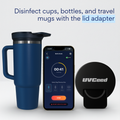
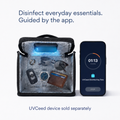
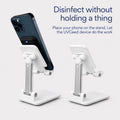
UVCeed is a portable, MagSafe-mounted UV-C device paired with a phone camera that visualizes which area of a surface has received light. It is designed for the specific category of dust mite application described above: surface treatment of fabric and soft items where line-of-sight exposure matters and verification matters.
The product makes two things true for mite surface applications that a wand cannot:
- Coverage you can see. The phone camera overlays a map of which parts of a pillow top, mattress top, stuffed animal, pet bed surface, or folded sheet have been exposed and which have not. Mite surface populations are not uniform — they concentrate at head-contact zones on pillows and at hip-and-shoulder zones on mattresses. Coverage verification is the difference between killing the population at the hotspot and missing it.
- Dose verification. The device times exposure based on measured irradiance, so the user knows the surface has received a dose consistent with the published mite mortality curves rather than a guess.
What UVCeed is not:
- A mattress-interior treatment. Mites below the top 1 to 2 millimeters are unreached.
- An allergen remover. Der p 1 and Der f 1 proteins already on the fabric are untouched by UV-C.
- A replacement for a mite-proof encasement, which is the single highest-leverage intervention for a sleeper with mite allergy.
- A replacement for a 130°F wash on anything that can take one.
- A carpet solution. Carpet is a HEPA vacuum or hard-flooring problem.
We've put that distinction in writing because the market has not.
The bottom line
UV-C kills dust mites on exposed fabric surfaces when three things are true at the same time:
- The wavelength is in the germicidal range (254 nm or 265–280 nm UV-C, not UV-A).
- The dose is sufficient — the Phrikanahok data suggests a sustained direct exposure, not a brief sweep.
- The mites are actually on the surface, not three centimeters down inside the mattress or the pillow stuffing.
For live mites on pillow tops, mattress tops before encasement, stuffed animals, pet bed surfaces, and sheets, UV-C is a real adjunct tool. For mites inside the mattress interior, the allergen protein the mites already deposited, deep carpet, and airborne allergen, it is not.
Any mite wand that doesn't name its wavelength, publish its irradiance, or acknowledge that the mite population lives below the surface is selling theater, not science. The real dust mite plan — encasement, hot wash, HEPA vacuum — stays the plan. Surface UV-C is a leg of the stool, not the stool.
Sources
- Phrikanahok N, et al. Mortality of house dust mites exposed to UV-C radiation (2013), PMID 23569994
- Chang JH, et al. Ultraviolet radiation on house dust mite eggs (1996), J Allergy Clin Immunol
- Platts-Mills TAE, Chapman MD. Dust mites: Immunology, allergic disease, and environmental control, J Allergy Clin Immunol
- AAAAI: Dust Allergy — patient guidance on allergen control
- FDA Safety Communication: UV Wands May Pose Risks (July 2022)
- Rutala WA, Weber DJ. Guideline for Disinfection and Sterilization in Healthcare Facilities, 2008 — CDC/HICPAC
Want More Articles Like This?
Get research on UV-C treatment and product updates delivered to your inbox.