Short answer: yes, unambiguously. E. coli is the textbook UV-C target - the inactivation data on it is the oldest and largest body of evidence in disinfection science, going back to the 1920s. The EPA uses E. coli as a benchmark organism in UV reactor validation. A 3-log reduction takes about 6 to 8 mJ/cm² at 254 nm; a 4-log reduction takes about 10 mJ/cm². Of every claim a UV-C product can make, "it kills E. coli" is the one with the deepest scientific backing.
What UV light does not do is reach E. coli inside the meat. It does not disinfect the uncut interior of a cantaloupe. It does not kill bacteria it does not actually touch. And it does not undo cross-contamination that happens after the UV pass, when a rinsed head of lettuce lands back on a cutting board that still has raw-chicken drippings on it.
What UV-C does do, reliably and at low dose, is kill E. coli on surfaces it illuminates. For a consumer, that translates into three concrete scenarios where UV-C genuinely moves the needle — and a few where it does not. This article walks through the biology, the published doses, where UV-C earns its place in a kitchen, and where other interventions (temperature, physical removal, chlorine) do the real work.
What UV light does to E. coli at the molecular level
Escherichia coli is a Gram-negative rod. Most strains are commensal residents of mammalian intestines and harmless. A few — notably E. coli O157:H7 and other Shiga-toxin-producing strains — cause severe illness, including hemorrhagic colitis and hemolytic uremic syndrome. These are the strains behind the romaine lettuce recalls of the past decade and the 2022 Wendy's outbreak linked to lettuce in the Midwest.
UV-C at 254 nm damages DNA. Adjacent thymine and cytosine bases absorb the photons and fuse into pyrimidine dimers. A dimer-studded genome cannot replicate. A bacterium that cannot divide cannot establish an infectious dose. This mechanism is identical whether the strain is a benign commensal or an O157:H7 outbreak isolate — Shiga toxin production is downstream of replication, and a cell that cannot divide also does not produce new toxin.
The foundational dose data for UV inactivation of E. coli was established by Chang, Ossoff, and colleagues at Harvard in 1985, which measured a 3-log reduction at approximately 6.5 mJ/cm² at 254 nm. (Chang JCH, Ossoff SF, Lobe DC, et al. UV inactivation of pathogenic and indicator microorganisms. Appl Environ Microbiol. 1985;49(6):1361–1365.) Later reviews confirmed and extended the finding: a 4-log reduction (99.99%) of E. coli across multiple studies falls in the 8 to 10 mJ/cm² range at 254 nm. (Hijnen WAM et al., Inactivation credit of UV radiation for viruses, bacteria and protozoan (oo)cysts in water: a review, Water Res. 2006)
For reference, this makes E. coli substantially easier for UV to kill than mold spores (100 to 300 mJ/cm²), moderately easier than protozoan oocysts (10 to 40 mJ/cm²), and roughly comparable to other vegetative bacteria. In the dose-response universe of UV disinfection, E. coli sits where it has always sat: well within reach of a correctly specified UV-C source at modest exposure.
Which UV wavelength is the right one
Not all UV light kills bacteria. The band splits three ways:
- UV-A (315–400 nm) — the "black light" range. No practical effect on E. coli at exposure times a consumer tolerates. Cheap "UV sanitizer" wands sold on Amazon for $15 to $30 are almost always UV-A LEDs. The FDA pulled 13 of these off the market in July 2022 for making unsupported germicidal claims. (FDA Safety Communication, July 2022)
- UV-B (280–315 nm) — the sunburn range. Some activity, but a dose high enough to disinfect is also a dose that damages human skin. Not practical.
- UV-C (100–280 nm) — the germicidal range. 254 nm from low-pressure mercury lamps and 265–280 nm UV-C LEDs are what kill E. coli.
The engineering foundation underneath these dose numbers is the Bolton–Linden standard method, which defined how UV-reactor dose should be calculated and reported — making dose numbers from one lab comparable to another and to real-world systems. (Bolton JR, Linden KG. Standardization of methods for fluence (UV dose) determination in bench-scale UV experiments. J Environ Eng. 2003;129(3):209–215.) If a device does not name its wavelength or publish its irradiance, assume UV-A and move on.
The three places UV light actually works on E. coli
1. Kitchen contact surfaces after handling raw ground beef, raw chicken, or raw produce from an outbreak zone. E. coli O157:H7 is shed in cattle feces, which is why ground beef, raw-milk cheese, and leafy greens irrigated with contaminated water are the three repeat offenders in US outbreaks. The organism lands on cutting boards, counter edges, the knife, the sink lip, the faucet handle you touched after handling the raw product, and the refrigerator drawer the ground beef package sat in. (CDC: E. coli Infection) At 254 nm, a dose of 10 mJ/cm² inactivates these surface bacteria at 4-log. That dose is reachable from a consumer UV-C device at reasonable exposure time on nonporous surfaces in line of sight.
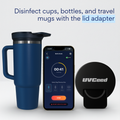
2. Reusable, nonporous items in frequent food contact. Water bottles (interior where you can reach the light, exterior mouthpiece, cap threads), hard cutting boards after bleach-free cleaning, metal and silicone utensils, baby bottle nipples and rings after dishwasher wash, and the inside of a lunch cooler used to transport raw proteins. These are the items where a UV-C pass after the primary cleaning step adds a verifiable final disinfection layer at an E. coli-relevant dose.
3. Point-of-use well-water users — with the water-treatment caveat. Well-water contamination with E. coli is a leading indicator of fecal contamination of the aquifer and the single most common reason home wells fail routine testing. The right intervention is a plumbed-in NSF/ANSI 55 Class A whole-house UV system downstream of filtration, not a handheld pointed at a glass of water. For that physics, see the separate article on bacteria in water — the engineering problem is distinct from the kitchen-surface case above.
The four places UV light does not kill E. coli
1. Inside the meat. The 1993 Jack in the Box outbreak and every subsequent US ground-beef recall underline the same point: E. coli O157:H7 lives inside the ground meat, not just on the outside. Grinding distributes the surface contamination of a single carcass into the interior of every patty made from that batch. UV-C does not penetrate meat. The intervention that kills interior E. coli is temperature — ground beef cooked to an internal temperature of 160°F (71°C) measured with a thermometer. (USDA FSIS: Ground Beef and Food Safety) UV passes over the raw patty do not substitute for this.
2. Inside intact produce, into leaf folds, or on the underside you didn't illuminate. The 2018 romaine recalls, the 2022 Wendy's outbreak, and the ongoing recurrence of leafy-green E. coli outbreaks involve bacteria attached to and sometimes internalized in plant tissue — not just loose on the surface. UV does not reach into leaf folds, into the stem crown of a lettuce head, or into the three-dimensional structure of a raspberry. For produce under recall, the correct action is to discard it, not to attempt to UV-sanitize it.
3. After cross-contamination that happens post-UV. The common failure mode is this: user sanitizes the cutting board, then puts rinsed produce back on a counter that still has raw-chicken juice on it. The produce is now contaminated again. UV kills what the light touched when it touched it; it does not create a persistent protective field. If both the cutting board and the counter are not sanitized, the chain is not broken.
4. Through turbid water, through grease films, through dried food residue. A surface with a visible film of fat, grease, blood, or dried protein will shield bacteria sitting under the film from the incoming photons. UV-C is a finishing step on a cleaned surface, not a replacement for the cleaning. If you can see the dirt, UV cannot see past it either.
Why most UV products overstate what they can do about E. coli
The irony of the E. coli claim is that it is the one UV claim with the strongest underlying science — and also the one most abused by products that do not deliver on it. A UV-A wand will not kill E. coli in any reasonable exposure, but the manufacturer still writes "kills E. coli" on the box, pointing at a 1985 paper that used a calibrated 254 nm mercury lamp at a known dose on a lab coupon.
The missing variable is almost always dose verification at the user's working distance on the user's actual surface. The buyer sweeps a wand across a cutting board for five seconds, assumes it worked, and keeps using the board. The E. coli data is real, but the dose the user delivered is not the dose the paper reports.
The result is a market where UV-C can and does kill E. coli in principle, while most consumer UV products cannot show that they do it in practice.
Where UVCeed fits in the E. coli conversation
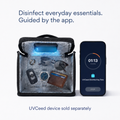
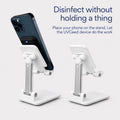
UVCeed is a portable, MagSafe-mounted UV-C device paired with a phone camera that visualizes which area of a surface has received light. For E. coli, which is a low-dose target well within reach of a correctly specified UV-C source, the design question is not "can the device deliver enough photons" but "did the user actually hit the surface everywhere it needed to."
- Coverage you can see. The phone camera overlays a map of which parts of the cutting board, counter edge, water bottle mouthpiece, or refrigerator drawer have been exposed and which have not. E. coli lives in the places a sponge misses — the groove in a cutting board, the back corner of a sink, the hinge of a reusable container. UVCeed makes those misses visible.
- Dose verification. The device times exposure based on measured irradiance so the surface accumulates a dose comfortably above the 10 mJ/cm² needed for 4-log E. coli reduction.
What UVCeed is not: a replacement for cooking ground beef to a thermometer-verified 160°F, a solution for interior-contaminated produce, a drinking-water device, or an FDA-cleared medical device. It is a general-wellness surface sanitizer. The temperature of hamburger interior, the discarding of recalled produce, and the plumbed treatment of well water are different jobs with different tools. We put that distinction in writing because the market has not.
The bottom line
UV light kills E. coli on exposed nonporous surfaces when three things are true at the same time:
- The wavelength is in the germicidal range (254 nm or 265–280 nm UV-C, not UV-A).
- The dose is in the vegetative-bacteria range — 6 to 10 mJ/cm² for 3 to 4-log reduction, which is modest and achievable at consumer-tolerable exposure.
- The surface is cleaned first, actually in line of sight, and covered everywhere the bacteria could be.
For kitchen contact surfaces after handling raw proteins, for reusable food-contact items after primary cleaning, and for the countertops around a ground-beef prep zone, UV-C is a real tool. For the inside of a hamburger, the inside of a recalled lettuce head, or the water in your glass, it is not.
Any UV product that promises to kill E. coli without naming its wavelength, publishing its irradiance, or acknowledging that temperature and discard are the real interventions for interior-contaminated food is selling theater, not science.
Sources
- Chang JCH, Ossoff SF, Lobe DC, Dorfman MH, Dumais CM, Qualls RG, Johnson JD. UV inactivation of pathogenic and indicator microorganisms. Appl Environ Microbiol. 1985;49(6):1361–1365.
- Hijnen WAM, Beerendonk EF, Medema GJ. Inactivation credit of UV radiation for viruses, bacteria and protozoan (oo)cysts in water: a review. Water Res. 2006;40(1):3–22.
- Bolton JR, Linden KG. Standardization of methods for fluence (UV dose) determination in bench-scale UV experiments. J Environ Eng. 2003;129(3):209–215.
- CDC: E. coli Infection
- USDA FSIS: Ground Beef and Food Safety
- FDA Safety Communication: UV Wands May Pose Risks of Radiation Injuries (July 2022)
Want More Articles Like This?
Get research on UV-C treatment and product updates delivered to your inbox.