Short answer: yes, UV-C at 254 nm damages the DNA of fungal cells and spores on exposed surfaces, which is why dermatology clinics, podiatry offices, and food-storage operations have used germicidal UV for decades. But that sentence has three load-bearing words most product pages leave out: exposed, surfaces, and dose.
UV light does not reach fungus growing inside the skin, under the nail plate, or down a hair follicle. It does not kill the yeast colonizing the gut or the dermatophyte that has already penetrated the stratum corneum. It cannot replace a topical azole, terbinafine, or an oral antifungal prescription. It does not fix the sweaty-shoe microclimate that let Trichophyton colonize in the first place. And it does not do any of this instantly — pigmented fungal spores are among the toughest microbial targets published in the UV literature.
What UV-C does do, reliably, is kill fungal cells and spores sitting on a surface the light actually touches, at a dose the light actually delivers, for a time the organism actually gets exposed. That is a real capability with real published data behind it. This article walks through the biology, the published doses for the fungi people actually care about — Trichophyton, Candida, Aspergillus, dermatophytes shed from feet and skin — the surfaces where UV-C genuinely moves the needle, and the places where it does not.
What UV light does to fungus at the molecular level
Fungal cells and spores share the same fundamental vulnerability to UV-C light at wavelengths around 250 to 265 nanometers as every other microorganism: the DNA that encodes their reproduction absorbs this specific band of ultraviolet photons strongly. When enough photons hit, adjacent thymine or cytosine bases fuse into pyrimidine dimers — covalent bonds in places where there should not be any. A dimer-studded strand cannot replicate, which means the yeast cannot bud, the hyphal cell cannot divide, and the spore cannot germinate.
Fungi are harder to kill than viruses or bacteria for three reasons. First, they are eukaryotes with a nucleus, more DNA, and more repair machinery than a virus or a bacterial cell. Second, many fungi have thick, chitinous cell walls that absorb and scatter some incoming UV. Third, and most important for product claims, the pigmented ones — fungi that produce melanin, like Aspergillus niger, Cladosporium, and the dematiaceous molds — have a built-in UV shield. Melanin absorbs UV before it reaches the DNA. The 2024 fungal photoinactivation data collection in International Journal of Environmental Research and Public Health summarized hundreds of published doses and found pigmented species routinely require 5 to 10 times the dose of unpigmented ones. (Fungal photoinactivation doses, PMC 11362276)
For the fungi most people search this question about, published D₉₀ values (the dose for a 90% reduction) cluster roughly like this:
- Candida albicans on surfaces: around 50 to 110 mJ/cm². (Shen et al. 2024, Candida UV-C inactivation)
- Trichophyton rubrum (the main athlete's foot and nail fungus organism): inactivation demonstrated at UV-C doses in the 50 to 150 mJ/cm² range in direct-exposure experiments. (Dai et al. 2013, PMID 23525830)
- Aspergillus niger conidia: around 226 mJ/cm² for a 2-log reduction, up to 800 mJ/cm² for durable growth inhibition. (PMC 11362276)
- Yeast cells generally: easier than filamentous fungi because the walls are thinner and no pigmented spore coat is involved.
Compare that to viruses, which are inactivated at 2 to 5 mJ/cm², or S. aureus at 6.5 mJ/cm². Fungi are 10 to 100 times harder to kill than a virus. Any product that groups "viruses, bacteria, and fungus" under one dose number is leaning on the easy pathogens to sell the hard one.
Which UV wavelength is the right one
Not all ultraviolet light is germicidal.
- UV-A (315–400 nm) — the "black light" range. Minor inhibitory effect on some fungi over very long exposures, but does not kill fungus at any practical consumer dose. Cheap "UV sanitizer" wands sold on Amazon for $15 to $30 are almost always UV-A LEDs. They are not germicidal. The FDA pulled 13 of these off the market in July 2022 after multiple caused eye and skin burns and none demonstrated the claimed disinfection. (FDA Safety Communication, July 2022)
- UV-B (280–315 nm) — the sunburn range. Modest antifungal activity, but a dose high enough to kill dermatophytes also burns human skin and damages human DNA. Not a practical surface-disinfection tool.
- UV-C (100–280 nm) — the germicidal range. Specifically, 254 nm from low-pressure mercury lamps and the newer 265–280 nm UV-C LEDs. This is what kills fungus. Kowalski's Ultraviolet Germicidal Irradiation Handbook (Springer, 2009) remains the canonical dose reference for engineered germicidal applications.
If a device does not specify a 254 nm or 265–280 nm wavelength on the spec sheet, assume it is UV-A and move on.
Where UV light actually works on fungus
Published research and real-world deployments converge on three categories where UV-C earns its keep against fungus.
1. Fungus shed onto nonporous, external surfaces. This is the big one for consumers. Dermatophytes like Trichophyton rubrum are shed as skin flakes and spore-bearing fragments onto the inside of shoes, the surface of shower floors, pedicure stations, locker-room benches, bath mats with a sealed vinyl backing, yoga mats, and the metal surface of nail clippers and pedicure tools. These are the surfaces where fungus is a thin biological layer sitting on top of a material light can reach. UV-C at 100 to 300 mJ/cm², delivered in line of sight, kills the exposed cells and reduces reinfection pressure. This is the mechanism behind the UV shoe sanitizers sold through podiatry offices and the UV cabinets in salons.
2. HVAC coils and food-storage environments. Aspergillus, Cladosporium, and Penicillium spores are major colonizers of cold, damp cooling-coil surfaces and refrigerated storage. Permanently installed 254 nm UV-C fixtures aimed at coil surfaces have been standard commercial practice for over three decades. Dose accumulates continuously; the lamp is on 24/7; the coil stays visibly cleaner, which improves airflow and reduces fungal spore load in the air downstream.
3. Candida on hospital high-touch surfaces. Whole-room UV-C disinfection systems used after terminal cleaning of hospital rooms have been shown to reduce environmental Candida auris contamination — a particularly difficult healthcare-associated yeast. (Shen et al. 2024) This is high-dose equipment run by trained staff in empty rooms, not a consumer scenario, but it demonstrates the ceiling of what UV-C can do against Candida when dose and coverage are controlled.
Everything else involves either a portable handheld device aimed at specific surfaces, or a sales pitch dressed up as science.
Where UV light does not kill fungus
1. Fungus inside the skin, nail, or hair. This is the single most important limitation and the one most product pages hide. Athlete's foot (tinea pedis) is a dermatophyte infection that has penetrated the stratum corneum. Toenail fungus (onychomycosis) is a colony growing inside the nail plate — a layer of keratin a millimeter thick that UV-C penetrates poorly and incompletely. Ringworm, jock itch, and scalp fungus are all tissue infections. UV-C sanitizes the external environment that reinfects you. It does not cure the infection. The treatment is topical azole or terbinafine for mild cases, oral terbinafine or itraconazole for nail infections, prescribed and monitored by a clinician. Separate companion content covers the specific nail-and-shoe reinfection pathway in more depth.
2. Fungus in porous substrates. Unsealed wood, raw concrete, grout where silicone has pulled away, inside fabric fibers of a cloth shoe, inside the foam of a running-shoe insole. Fungal hyphae grow into porous materials, not just on them. UV-C kills the exposed surface layer; the colony persists below the depth light penetrates and regrows. For a running shoe, this is why rotating pairs and drying thoroughly between wears matters as much as UV treatment.
3. Airborne fungal spores in your general room air. For UV to kill a spore floating through a room, that spore has to pass through a defined zone of sufficient irradiance for sufficient time. A handheld sweeping a surface does not do this to the room's air. A portable UV air purifier can, but only if airflow forces air past a UV chamber with enough residence time to deliver the 100-plus mJ/cm² that fungal spores require — not the much lower dose adequate for viruses that most spec sheets quote.
4. Deep-seated systemic or invasive fungal infection. Invasive candidiasis, invasive aspergillosis, cryptococcosis, and systemic mycoses are internal infections requiring systemic antifungal therapy. Nothing about surface disinfection changes that. Mentioned only because the search intent sometimes overlaps.
Why most UV products overstate what they can do about fungus
The fungus search traffic is enormous and emotionally charged. "Does UV kill foot fungus," "does UV kill toenail fungus," and "does UV kill ringworm" are searched hundreds of thousands of times a year in the United States, usually by people who have tried creams and want a new angle. The incentive for a wand or shoe-sanitizer maker to say "yes, kills fungus" is overwhelming. The incentive to clarify that UV sanitizes the shoe, not the toe, is weak.
So the typical consumer product page says: UV-C kills fungus. True in a lab, with a mercury lamp at a measured dose, aimed at T. rubrum on a plastic coupon. It leaves out that the device is UV-A, or that the exposure time required at the device's actual irradiance is minutes per square inch, or that the fungus the buyer actually cares about is inside their nail plate where no amount of surface light will reach.
The result is a market where buyers try a UV shoe sanitizer, see the athlete's foot come back in three weeks, and conclude UV doesn't work. The real conclusion is that UV worked on the shoe, the medication was needed for the foot, and the product page should have said so.
Where UVCeed fits in the fungus conversation
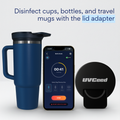
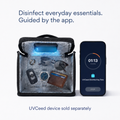
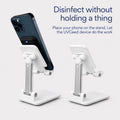
UVCeed is a portable, MagSafe-mounted UV-C device paired with a phone camera that visualizes which area of a surface has received light. It is designed for the specific category of fungus problem described above: external fungal contamination on nonporous surfaces where line-of-sight and dose matter.
The product makes two things true for fungus applications that a wand cannot:
- Coverage you can see. The phone camera overlays a map of which parts of the pedicure tool, nail clipper, shoe insole surface, bath mat, or shower floor have been exposed and which have not. Fungus accumulates exactly where surfaces skate past a cleaning wipe — the inside curve of a nail clipper, the back corner of an insole, the seam where a bath mat meets the tub. UVCeed makes those misses visible.
- Dose verification. The device times exposure based on measured irradiance, so the user knows the surface has received a dose in the range shown in the literature to inactivate the common dermatophytes, yeasts, and surface molds (generally 100 to 300 mJ/cm² for most relevant species).
What UVCeed is not: a treatment for athlete's foot, toenail fungus, ringworm, jock itch, scalp fungus, or any tissue infection. It is not a cure for Candida overgrowth, invasive aspergillosis, or any systemic mycosis. It is not an air purifier. It is not a replacement for prescribed topical or oral antifungal medication. Any of those is a different job and usually a different tool. The distinction is in writing here because the market has not put it there.
The bottom line
UV light kills fungus on exposed, nonporous surfaces when three things are true at the same time:
- The wavelength is in the germicidal range (254 nm or 265–280 nm UV-C, not UV-A).
- The dose is high enough for the species — fungi are 10 to 100 times harder to kill than a virus, and pigmented spores require the top of that range.
- The surface is actually in line of sight for the duration it takes to accumulate the dose.
For external fungus on pedicure tools, nail clippers, shoe insole surfaces, bath mats, yoga mats, shower floors, locker-room surfaces, and refrigeration environments, UV-C is a real tool. For fungus inside your skin, under your nails, or in the general room air, it is not — and no amount of marketing wattage changes that.
Any UV product that doesn't name its wavelength, publish its irradiance, or acknowledge the tissue-infection boundary is selling theater, not science.
Sources
- Fungal photoinactivation doses for UV radiation and visible light — a data collection (Int J Environ Res Public Health, 2024)
- Dai T. et al. Ultraviolet-C light for treatment of Candida albicans and Trichophyton rubrum infections (PMID 23525830)
- Shen et al. 2024, Candida UV-C inactivation on surfaces
- Kowalski W. Ultraviolet Germicidal Irradiation Handbook (Springer, 2009)
- Rutala WA, Weber DJ. Guideline for Disinfection and Sterilization in Healthcare Facilities, 2008 — CDC/HICPAC
- FDA Safety Communication: UV Wands May Pose Risks (July 2022)
Want More Articles Like This?
Get research on UV-C treatment and product updates delivered to your inbox.