Short answer: yes, UV-C at 254 nm inactivates mold spores by cross-linking the DNA inside them, but the dose required is roughly 10 to 100 times higher than the dose that kills most bacteria or viruses, and spores embedded in porous material or carried through the air need very different equipment than spores sitting on a bathroom tile. A handheld UV-C pass can knock out exposed spores on a hard surface. It cannot remediate a mold problem.
That gets lost in the marketing. Vendors quote a single "kills mold" number from a lab study, skip the species, skip the wavelength, and skip the fact that the FDA pulled 13 UV wands off the US market in July 2022 for failing to deliver what they claimed. This article walks through what a mold spore actually is, the published dose numbers for the species you are likely to encounter, the three places UV-C genuinely works on spores, the three it does not, and why the darkly pigmented species that includes "black mold" is particularly resistant.
What a mold spore actually is
A mold colony has two life stages that matter for a disinfection question. The vegetative stage is the mycelium: a web of thin-walled hyphae that grows into a food source, secretes enzymes, and digests the substrate. Hyphae are relatively soft targets. The reproductive stage is the spore: a compact, thick-walled cell optimized to survive long enough to land somewhere wet and start a new colony.
Spores are the hard target. Three features make them resist UV-C compared to vegetative cells:
- A thick, layered cell wall of chitin, glucans, and in many species a dense melanin coat that absorbs UV photons before they reach the DNA inside.
- Low metabolic activity and dense cytoplasm, which slows the propagation of damage.
- Active DNA repair enzymes that reverse some pyrimidine dimer damage after exposure, so a sub-lethal dose can be fully repaired within hours.
Melanized spores (Aspergillus niger, Cladosporium, Stachybotrys chartarum, Alternaria) are the toughest. Lightly pigmented spores (Penicillium, some Aspergillus species) are easier but still require far more UV-C than a bacterium. Peccia and Hernandez quantified this in 2004, showing fungal spores need one to two orders of magnitude more dose than vegetative bacteria for equivalent inactivation (DOI 10.1016/j.atmosenv.2004.03.019). Kowalski's 2009 Ultraviolet Germicidal Irradiation Handbook (Springer, ISBN 978-3-642-01999-9) remains the canonical compilation of UVGI dose constants.
The practical consequence is simple. A dose that inactivates a virus population will barely dent a mold spore population. Any UV-C product that advertises a single blanket disinfection number is quoting the easy target.
Published UV-C doses for common mold spores

The table below lists dose values from peer-reviewed sources for a 1-log (90%) and 3-log (approximately 1000-fold) reduction of airborne or surface spores at 254 nm. Doses vary across studies based on humidity, substrate, and whether the spores are suspended in air or deposited dry. The ranges below reflect the typical span across the primary literature.
| Species | 1-log (D90) mJ/cm² | 3-log mJ/cm² | Notes |
|---|---|---|---|
| Aspergillus niger | 130 to 230 | 400 to 700 | Heavily melanized; among the most UV-resistant indoor molds |
| Aspergillus fumigatus | 50 to 90 | 150 to 270 | Clinically important respiratory pathogen |
| Penicillium chrysogenum | 40 to 90 | 120 to 270 | Common indoor contaminant; relatively UV-sensitive |
| Cladosporium spp. | 100 to 150 | 300 to 450 | Dematiaceous (melanized); common on HVAC coils |
| Stachybotrys chartarum ("black mold") | 150 to 300+ | 450 to 900+ | Among the most UV-resistant; heavily melanized spores |
| Alternaria alternata | 100 to 200 | 300 to 600 | Melanized; outdoor and indoor allergen source |
Sources: Kowalski 2009 UVGI Handbook (Springer); Peccia and Hernandez 2004 (DOI 10.1016/j.atmosenv.2004.03.019); Menetrez et al. 2010 on indoor fungal UV susceptibility (DOI 10.1016/j.jaerosci.2009.11.001); Lee et al. 2008 on bioaerosol UV-C inactivation (DOI 10.1016/j.jaerosci.2008.07.004).
For context, SARS-CoV-2 is inactivated at roughly 2 to 5 mJ/cm², S. aureus at about 6.5 mJ/cm². A 3-log reduction of Stachybotrys spores can require more than one hundred times the dose of a 3-log virus reduction. That ratio is why a product that "kills viruses in seconds" may do very little to a visible black mold stain after a full minute of exposure.
Why Stachybotrys (black mold) is harder
Stachybotrys chartarum earns its reputation for two reasons that both complicate UV-C treatment.
First, the spore wall. Stachybotrys produces conidia with dense melanin pigmentation and a mucilaginous coat that further scatters incident UV. A 2022 bioRxiv preprint found peak inactivation of Stachybotrys occurred closer to 267 nm than the standard 254 nm, and even at the optimal wavelength the required dose exceeded that of lighter-pigmented molds. The same pigment that makes the colony look black is what protects the DNA inside the spore.
Second, the mycotoxins. Stachybotrys produces trichothecenes (satratoxins, roridins) that are chemically stable, remain in the material after cells die, and drive the health concerns associated with heavy indoor Stachybotrys growth. UV-C cross-links DNA. It does not break down trichothecenes. Killing the colony with light leaves the toxins where they were. Serious Stachybotrys contamination requires physical removal. Light cannot substitute, which is why EPA and CDC remediation guidance does not list UV-C as a stand-alone treatment.
The three places UV-C works on mold spores

1. Spores sitting on direct-exposed hard surfaces. Silicone caulk on a bathtub, ceramic tile face, sealed grout, refrigerator door gasket, front-load washing machine door seal, humidifier reservoir, stainless sink basin, shower glass, painted window frame. If the spore is in line of sight on a non-porous surface, a sufficient UV-C dose at 254 nm will inactivate it. Depending on species that means 100 to 500 mJ/cm² or more; for Stachybotrys, the top of that range.
2. HVAC coil UV and air handler surfaces. A continuously operating 254 nm fixture mounted inside the air handler and aimed at the cooling coil has been standard commercial practice for over three decades. The coil receives dose around the clock, and over hours and days the cumulative total is far above what any handheld delivers in a pass. Documented in ASHRAE technical guidance and in Kowalski 2009.
3. Upper-room UVGI for airborne spores. Ceiling-mounted UV-C fixtures aimed above human head height create a continuous disinfection zone in the upper air layer. Convection cycles room air through the beam over minutes. Lee et al. 2008 and related bioaerosol studies demonstrated meaningful reductions in airborne fungal spore counts under sustained upper-room UVGI with adequate air mixing. This is engineered equipment, not a handheld scenario.
The three places UV-C does not work on mold spores
1. Spores embedded in porous material. Mold hyphae grow into the paper facing of drywall, unsealed grout, concrete block pores, fiberglass insulation, carpet backing, and wood fibers. Spore-forming structures develop inside those materials, not just on the surface. UV-C penetrates porous substrates to depths measured in micrometers at best. The exposed cap of a colony is inactivated; the roots regrow in days to weeks. The material has to be removed.
2. Airborne spores in general room air without engineered airflow. For a floating spore to be inactivated it has to pass through a defined irradiance zone for a defined residence time. A handheld sweeping a counter does not do this. A portable UV air purifier can, but only if airflow forces air through a chamber long enough and bright enough to deliver 100-plus mJ/cm² at the species of concern. Most consumer UV air purifiers publish only a virus-level dose, which is one to two orders of magnitude short of the mold-spore requirement from Peccia and Hernandez 2004.
3. The moisture that created the problem. Spores need liquid water or sustained high humidity to germinate. Every indoor mold problem is a water problem first: a leak, a condensing surface, an unventilated bathroom, a basement humidity above about 60%. UV-C does not change humidity, repair plumbing, improve ventilation, or dry a wall cavity. Killing the visible spore layer without fixing the moisture produces a new colony within weeks from spores still inside the material and new spores drifting in.
Where UVCeed fits
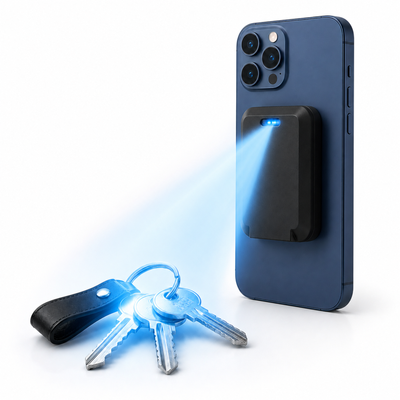
UVCeed is a portable, MagSafe-mounted UV-C device paired with the phone camera to visualize which part of a surface has received light. It is designed for the category described in Place 1 above: surface spores on direct-exposed, non-porous materials where line-of-sight and dose can be verified.
Two things make UVCeed useful here that a plain wand cannot:
- Coverage you can see. The phone camera overlays a map showing which parts of a caulk seam, grout line, gasket fold, or window track have been exposed and which have been missed. Spore-prone zones in a home are almost always edges and seams skipped by a sponge: the inside corner of a shower enclosure, the fold of a washing machine door gasket, the under-lip of a refrigerator seal, the bead where silicone meets porcelain. UVCeed makes those misses visible.
- Dose verification. The device times exposure based on measured irradiance, so a user can know a given area received a dose in the range the literature supports for inactivation of common surface molds.
A daily or weekly pass on bathroom tile grout seams, around sink and tub seals, caulk edges inside the shower enclosure, the inside of refrigerator gaskets, and the drum-door gasket of a front-load washing machine is a legitimate maintenance use. These are hard, non-porous, direct-exposed surfaces where spores land and where moisture encourages germination.
What UVCeed is not: a mold remediation tool, an air purifier, an HVAC coil fixture, a solution for mold inside walls, or a substitute for drying and fixing a leak. Thinking about UV-C instead of calling a remediator is using the tool wrong.
What UV-C cannot do about mold
No handheld UV-C device, UVCeed included, will remediate a mold problem. Remediation means removing the material that houses the colony, drying the cavity, and eliminating the moisture source.
EPA guidance draws the line at approximately 10 square feet of visible mold. Below that, a careful homeowner using containment, PPE, and physical removal of affected porous material can proceed. Above that, contact a certified professional. The credential to look for is IICRC certification (Institute of Inspection, Cleaning and Restoration Certification), specifically the S520 Standard for Professional Mold Remediation. An IICRC-certified remediator will contain the work area, remove affected porous material, HEPA-vacuum, dry the cavity to measured moisture content, and verify completion.
The sequence that works:
- Find and fix the moisture source. If water is still arriving, nothing else matters.
- Dry the material to measured standards using moisture meters, dehumidifiers, and directed airflow.
- Remove visibly contaminated porous material: drywall, insulation, carpet pad, affected framing.
- HEPA-vacuum to capture settled spores.
- Clean non-porous surfaces with detergent, rinse, dry.
- Only after the first five does UV-C have a maintenance role: a verified dose over hard surfaces where spores can resettle.
The FDA's July 2022 UV wand safety communication is relevant as a credibility check on the category. The agency identified devices marketed with disinfection claims that either delivered insufficient UV-C or produced UV at wavelengths risking eye and skin injury without germicidal effect. A legitimate UV-C device names its wavelength, publishes its irradiance, and bounds its claims to the physics. One that does not should be treated the way the FDA treated the ones it recalled.
UV-C is a real tool for inactivating exposed spores on hard surfaces. It is not a wall treatment, an air cleaner, or a replacement for remediation. We put that in writing because the market has not.
Sources
- Kowalski W. Ultraviolet Germicidal Irradiation Handbook: UVGI for Air and Surface Disinfection. Springer, 2009. ISBN 978-3-642-01999-9. https://link.springer.com/book/10.1007/978-3-642-01999-9
- Peccia J, Hernandez M. UV-induced inactivation rates for airborne Mycobacterium bovis BCG and fungal species. Atmospheric Environment, 2004. DOI 10.1016/j.atmosenv.2004.03.019. https://doi.org/10.1016/j.atmosenv.2004.03.019
- Menetrez MY, Foarde KK, Dean TR, Betancourt DA. The effectiveness of UV irradiation on vegetative bacteria and fungi surface contamination. Journal of Aerosol Science, 2010. https://doi.org/10.1016/j.jaerosci.2009.11.001
- Lee BU, Yermakov M, Grinshpun SA. Removal of fine and ultrafine particles from indoor air by UV-C irradiation and related bioaerosol inactivation. Journal of Aerosol Science, 2008. https://doi.org/10.1016/j.jaerosci.2008.07.004
- EPA. A Brief Guide to Mold, Moisture, and Your Home. https://www.epa.gov/mold/brief-guide-mold-moisture-and-your-home
- IICRC S520 Standard for Professional Mold Remediation. https://iicrc.org/iicrcs520/
- FDA Safety Communication: UV Wands May Pose Risks (July 2022). https://www.fda.gov/medical-devices/safety-communications/uv-wands-may-pose-risks-radiation-injuries-fda-safety-communication
- CDC/HICPAC: Guideline for Disinfection and Sterilization in Healthcare Facilities. https://www.cdc.gov/infection-control/hcp/disinfection-and-sterilization/
Want More Articles Like This?
Get research on UV-C treatment and product updates delivered to your inbox.