Short answer: yes. UV-C at 254 nm inactivates norovirus on exposed hard surfaces at roughly 10 to 25 mJ/cm², with peer-reviewed data from Shaffer et al. 2024 showing greater than 3-log inactivation of norovirus surrogates at 254 nm in the 10 to 15 mJ/cm² band and comparable results at 222 nm far-UVC. For a non-enveloped RNA virus, that is a tractable number for a well-designed UV-C device.
The complication is everything surrounding that number. Human norovirus is notoriously difficult to culture, so most UV-C literature uses surrogate viruses, principally murine norovirus (MNV) and feline calicivirus (FCV). UV-C does not penetrate the vomit or diarrhea soil loads that drive real outbreaks. It does not reach particles trapped in carpet fibers, cruise-ship upholstery, or grout lines around a daycare toilet. The CDC and EPA both recommend a sodium hypochlorite solution as the first line against confirmed norovirus contamination, and UV-C is best understood as a supplementary surface pass applied after the bleach cleanup, not a replacement.
What norovirus is and why it survives surfaces so well
Norovirus is a small, non-enveloped single-stranded RNA virus in the family Caliciviridae. The infectious dose is extraordinarily low. As few as 18 particles can cause clinical illness, and a single episode of projectile vomiting can aerosolize billions. The virus resists freezing, surface drying for days to weeks, pH between 3 and 10, alcohol-based sanitizer, and quaternary ammonium disinfectants at label concentrations.
That resistance profile is why norovirus is the leading cause of acute gastroenteritis in the United States and the pathogen behind nearly every large-scale cruise-ship outbreak the CDC investigates. It is also why norovirus is harder for UV-C to inactivate than enveloped respiratory viruses. Without an envelope to disrupt, UV-C must drive enough photons into the capsid-protected RNA genome to produce pyrimidine dimers that stop ribosomal translation. That takes more dose than a flu particle, but far less than a bacterial endospore like Clostridioides difficile.
The dose numbers: norovirus compared to other pathogens

The following doses are approximate values from the peer-reviewed UV-C literature at 254 nm, expressed as the dose required for roughly 3-log (one thousand-fold) inactivation on direct-contact nonporous surfaces. Values vary by study, surface material, humidity, and surrogate used; these are representative ranges.
| Pathogen | Approx. 3-log dose at 254 nm | Category |
|---|---|---|
| Influenza A (H1N1, H3N2) | 5 to 10 mJ/cm² | Enveloped RNA virus |
| SARS-CoV-2 | 5 to 15 mJ/cm² | Enveloped RNA virus |
| RSV | 5 to 10 mJ/cm² | Enveloped RNA virus |
| Rhinovirus | 8 to 12 mJ/cm² | Non-enveloped RNA virus |
| Norovirus (via MNV/FCV surrogates) | 10 to 25 mJ/cm² | Non-enveloped RNA virus |
| Adenovirus | 60 to 120 mJ/cm² | Non-enveloped DNA virus |
| E. coli O157:H7 | 6 to 10 mJ/cm² | Gram-negative bacterium |
| Staphylococcus aureus | 7 to 11 mJ/cm² | Gram-positive bacterium |
| Clostridioides difficile spores | 50 to 100+ mJ/cm² | Bacterial endospore |
Norovirus is harder than influenza, similar to rhinovirus, substantially easier than adenovirus, and dramatically easier than C. difficile spores. A UV-C device sized to deliver 20 to 25 mJ/cm² to a direct-contact surface covers enveloped respiratory viruses, norovirus surrogates, and common vegetative bacteria in one pass. It does not cover C. diff spores.
The published data on UV-C and norovirus
Shaffer et al. 2024, Applied and Environmental Microbiology. The most recent and most directly relevant study. The authors measured UV-C inactivation of human norovirus and surrogates at 254 nm and 222 nm (far-UVC excimer). They reported greater than 3-log inactivation at both wavelengths in the 10 to 15 mJ/cm² range, with 222 nm performing comparably to 254 nm per unit dose. (Shaffer et al. 2024, DOI 10.1128/aem.02514-25)
Park et al. 2010, Letters in Applied Microbiology. Surrogate work on feline calicivirus and murine norovirus established log-linear inactivation kinetics at 254 nm on stainless steel and other hard surfaces, with roughly 1-log reductions per 3 to 5 mJ/cm². (Park et al., DOI 10.1111/j.1472-765X.2010.02982.x)
Tseng & Li 2007, Journal of Occupational and Environmental Hygiene. This paper measured UV-C susceptibility across a panel of viral surrogates and showed that non-enveloped single-stranded RNA viruses fall in a middle band of UV-C susceptibility, higher than enveloped viruses but well below adenovirus and spore-formers. (Tseng & Li 2007, DOI 10.1080/15459620701329012)
The common caveat: human norovirus cannot be cultured in a routine lab, so direct infectivity assays are difficult. Shaffer et al. 2024 uses RT-qPCR and human intestinal enteroid infection assays as modern readouts, but the historical literature leans on MNV and FCV surrogates. The data are strong and the surrogates well-validated.
Cruise ship outbreaks: where norovirus hits hardest and UV-C has a role
The CDC's Vessel Sanitation Program (VSP) tracks acute gastroenteritis outbreaks on cruise ships calling at U.S. ports. For twenty years, norovirus has been the most common identified cause of reportable cruise outbreaks, and 2023 through 2025 have been particularly active. Royal Caribbean, Princess, Holland America, Celebrity, and Cunard have each reported multiple norovirus outbreaks in this window, with attack rates often in the 3 to 8 percent range of passengers and crew.
The cruise environment is close to a worst case for norovirus transmission. Thousands share buffets, elevator buttons, casino chips, theater armrests, and gym equipment. One index case vomiting in a buffet line can seed contamination that outlives any single sanitation pass.
VSP protocol for a confirmed outbreak centers on sodium hypochlorite (bleach) at 1,000 to 5,000 ppm applied to affected cabins and public spaces. Where UV-C fits is after the bleach pass: a secondary disinfection step on high-touch nonporous surfaces (elevator buttons, handrails, slot-machine buttons, door handles, keycard readers, buffet-tong handles). UV-C adds a verifiable physical inactivation pass on top of chemistry. It does not substitute for it.
Daycares and winter season spikes
The CDC's NoroSTAT network tracks reported norovirus outbreaks across participating state health departments. The seasonal pattern is predictable: outbreak counts climb through October, peak December through February, and taper by May. Daycares, elementary schools, long-term care, and healthcare facilities account for the overwhelming majority. (CDC NoroSTAT)
A daycare is in some ways a harder environment than a cruise ship. Children do not reliably wash their hands. Toys are shared constantly. A sick child who vomits in a classroom can contaminate a dozen surfaces before anyone notices.
Standard daycare protocol is bleach-based cleanup of visible soil, laundering of contaminated fabric at the hottest tolerated temperature, exclusion of symptomatic children and staff for 48 hours after resolution, and reinforced hand hygiene with soap and water (not alcohol gel, which is poorly effective here). UV-C fits on nonporous surfaces amenable to a verified-coverage pass: light switches, doorknobs, cubby handles, faucet handles, plastic chair backs, laminated tabletops, and hard-surface toys that cannot run through a dishwasher. For soft toys and fabric, laundering remains the better tool.
Why bleach is the EPA List G primary disinfectant for norovirus
The EPA maintains "List G" of disinfectant products registered against norovirus. The dominant chemistry is sodium hypochlorite at 200 ppm for lightly contaminated food-contact surfaces up to 5,000 ppm for heavily soiled vomit cleanup. Three properties make bleach the primary tool.
Soil-load penetration. Bleach in wet solution reaches into cracks, grout lines, textured plastic, and the fluid film around a soiled surface. UV-C reaches only what has direct line-of-sight. A norovirus particle buried under a film of vomit protein is physically shielded from UV photons. Bleach dissolves into that film and inactivates virus throughout the soil layer.
Breadth across resistant pathogens. The same bleach pass that inactivates norovirus also inactivates C. difficile spores, rotavirus, and resistant bacterial contamination. An outbreak disinfectant needs to cover more than one pathogen in a single step.
EPA registration and contact time. List G products have measured wet contact times (typically 1 to 10 minutes) with efficacy data under EPA review. UV-C devices, except for specific hospital-grade whole-room systems, are not generally registered on List G for norovirus.
The role of UV-C is therefore specific: a verified, coverage-mapped pass applied after cleanup and chemical disinfection, on hard nonporous surfaces, as a supplementary layer.
Where UV-C fits in a norovirus protocol

UV-C has three defensible applications.
1. Post-cleanup surface pass on hard nonporous surfaces. After bleach cleanup of a daycare bathroom, cruise stateroom, or long-term-care common area, a UV-C pass on light switches, door handles, faucet handles, grab bars, elevator buttons, and keypads adds a measurable physical inactivation step. Shaffer et al. 2024 doses of 10 to 15 mJ/cm² at 254 nm are achievable in seconds to tens of seconds at working distance.
2. Personal electronics during outbreak season. Phones, badge holders, pagers, car keys, remotes, nurse-call devices, and tablets used in healthcare and daycare cannot be bleach-wiped without material damage. UV-C delivers the dose the surrogate studies support, without the material problem chlorine creates.
3. Verified coverage where line-of-sight matters. A wipe that skates past a ridge or misses the inside curve of a door handle leaves viable virus. On-device coverage visualization makes misses observable in real time.
Where UVCeed fits in the norovirus conversation
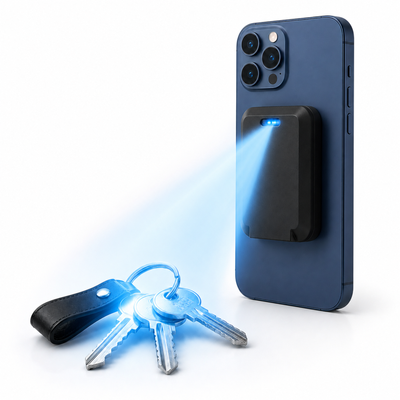
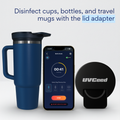
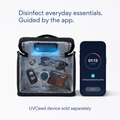
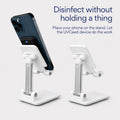
UVCeed is a MagSafe-mounted UV-C device paired with a phone camera that visualizes which areas of a surface have received light. Two behaviors matter for norovirus:
Coverage visibility. The camera overlay shows which parts of a surface have been exposed and which have been missed. Norovirus contamination clusters where surfaces meet (handle-to-door, button-to-panel, faucet-base-to-sink), which is also where wipes commonly skip.
Dose verification. The device times exposure against measured irradiance, so a pass can be mapped to the range Shaffer et al. 2024 and Park et al. support (roughly 10 to 25 mJ/cm² at 254 nm).
UVCeed is not an EPA List G registered disinfectant and not a substitute for the bleach pass that CDC and EPA recommend as the primary step. It is a complementary verified-coverage tool for the step that follows cleanup.
What UV-C cannot do about norovirus
Work through visible soil. Vomit, diarrhea, mucus, and food debris block UV photons. Particles embedded in a soil load are shielded regardless of how long the lamp runs. The soil must be mechanically removed first.
Replace bleach on soft furnishings. Carpet, upholstery, cushions, stuffed animals, drapery, and cloth-covered chairs harbor norovirus below the surface layer UV-C can reach. Steam cleaning, laundering at the hottest tolerable temperature, or disposal are the right tools.
Kill norovirus you cannot see. Contaminated surfaces look identical to clean ones. UV-C solves the dose and coverage questions on hard surfaces; it does not solve the question of which surfaces got contaminated in the first place.
Replace handwashing with soap. Soap and running water is the single most effective norovirus intervention. Alcohol gel is poorly effective. UV-C on skin is not safe at germicidal doses at 254 nm. Twenty seconds of soap and water remains the primary personal defense.
The bottom line
UV-C inactivates norovirus on direct-contact hard surfaces at roughly 10 to 25 mJ/cm² at 254 nm, with 222 nm far-UVC performing comparably per unit dose. UV-C fits as a supplementary verified-coverage pass applied after cleanup and after bleach, on hard nonporous high-touch surfaces. Bleach remains the primary tool. Soap and water remains the primary personal defense. UV-C adds a measurable, dose-verified physical step on top of both.
Any UV-C device marketed as a replacement for bleach in a norovirus outbreak is overselling. Any device without a published wavelength, measured irradiance, or coverage verification is theater. The useful specific thing UV-C does for norovirus is close the surface-coverage problem on exposed hard surfaces at a dose the literature supports.
Sources
- Shaffer M. et al. UV-C inactivation of human norovirus and surrogates at 254 nm and 222 nm (Applied and Environmental Microbiology, 2024). DOI 10.1128/aem.02514-25
- Tseng C.C., Li C.S. Inactivation of viruses on surfaces by ultraviolet germicidal irradiation (Journal of Occupational and Environmental Hygiene, 2007). DOI 10.1080/15459620701329012
- Park G.W. et al. Evaluation of a new environmental sampling protocol for detection of human norovirus and surrogate inactivation by UV-C (Letters in Applied Microbiology, 2010). DOI 10.1111/j.1472-765X.2010.02982.x
- CDC NoroSTAT: Reported norovirus outbreaks surveillance data
- CDC Vessel Sanitation Program: Outbreak updates for international cruise ships
- CDC Norovirus: Prevention and control, including cleaning and disinfection guidance
- EPA List G: Antimicrobial products registered with EPA for claims against norovirus
- Rutala WA, Weber DJ. Guideline for Disinfection and Sterilization in Healthcare Facilities, 2008 (CDC/HICPAC)
Want More Articles Like This?
Get research on UV-C treatment and product updates delivered to your inbox.