Short answer: yes, germicidal UV-C at 254 nm inactivates Trichophyton and Microsporum - the dermatophyte fungi that cause ringworm in humans, cats, and dogs - on hard surfaces. A 2013 paper by Dai and colleagues at Massachusetts General Hospital showed UV-C was effective against Trichophyton rubrum on exposed substrates. (Dai et al. 2013, PMID 23525830)
But "ringworm" is misleading as a name twice over. It is not a worm. And the live infection does not sit on top of surfaces the way bacteria do — it burrows into hair shafts, into the top layers of skin, and into the keratin of nails. UV-C does not penetrate skin or hair safely. It does not reach the hyphae inside the host. It kills the spores the infected pet or person sheds into the environment, which is useful. It does not treat the infection itself.
The split matters because a cat ringworm diagnosis typically triggers a panic-cleaning of the entire house, and the owner wants to know which tools do what. UV-C sanitizes hard surfaces and tools. It does not sanitize the cat, the couch cushion, or the shedding hair, each of which carries live spores for up to 18 months per CDC. (CDC: Ringworm — About) This article walks through where UV-C genuinely helps, where it does not, and what the real decontamination plan looks like.
What UV light does to ringworm at the biological level
Ringworm is caused by dermatophyte fungi — most commonly Microsporum canis (most feline ringworm and most pet-to-human transmission), Trichophyton rubrum (most human athlete's foot, jock itch, and body ringworm), and Trichophyton mentagrophytes. These organisms exist in two environmental forms: hyphae (growing filaments inside infected tissue) and arthroconidia (durable spore-like fragments that break off infected hair and skin and persist in the environment).
UV-C at 254 nm damages fungal DNA through pyrimidine dimer formation, the same mechanism that inactivates bacteria and viruses. Arthroconidia are harder to kill than vegetative hyphae because they are pigmented, their cell walls are thicker, and their metabolism is reduced. Fungal photoinactivation reviews put dermatophyte spore inactivation doses in the hundreds of millijoules per square centimeter — well above viral kill doses, and comparable to mold spores. (Fungal photoinactivation doses, PMC 2024)
The Dai 2013 result showed UV-C inactivation of T. rubrum at doses achievable with a standard low-pressure mercury lamp on exposed nonporous substrate. The biology is settled. The practical question is whether the surface you are pointing the lamp at is one where that biology applies.
Which UV wavelength is the right one
Not all ultraviolet light is germicidal, and the market is full of UV-A wands that are not.
- UV-A (315–400 nm) — the "black light" range. Veterinary Wood's lamps use UV-A to fluoresce M. canis on infected hair, which is a diagnostic use, not a kill use. UV-A does not inactivate dermatophytes at consumer doses.
- UV-B (280–315 nm) — some antifungal effect, but doses high enough to kill fungi also burn human and pet skin. Not a sanitation tool.
- UV-C (100–280 nm) — the germicidal range. The 254 nm line from mercury lamps and 265–280 nm UV-C LEDs are what the Dai study and the broader dermatophyte photoinactivation literature are built on.
The FDA pulled 13 consumer UV wands off the market in July 2022 for overstating germicidal claims; most were UV-A LEDs. (FDA Safety Communication, July 2022) If a wand marketed for ringworm cleanup doesn't publish its wavelength, assume UV-A.
Where UV-C actually works on ringworm
Three concrete scenarios where surface UV-C earns its keep in a ringworm cleanup.
1. Hard surfaces the infected pet or person touched. Tile floors, countertops, bathroom sinks and tubs, metal exam tables, kennel and crate interiors, cat tree hard components, hard plastic cat condos, and the hard parts of a pet carrier. The AAHA infection control guidelines treat dermatophytes as environmentally persistent and specifically call for decontamination of surfaces an infected animal contacts. (AAHA Infection Control, Prevention, and Biosecurity Guidelines) UV-C at a sufficient dose, delivered within line-of-sight to a hard surface, kills the arthroconidia sitting on that surface. Combined with a bleach or accelerated hydrogen peroxide wipe, it is a reasonable surface protocol.
2. Shared grooming and medical tools. Pet nail clippers, grooming scissors, electric clipper blades (plastic and metal parts), slicker brushes with hard backing, combs, flea combs, and the hard surfaces of grooming tables. Moriello's veterinary dermatophytosis review emphasizes that fomite transmission through grooming equipment is a documented route in catteries, shelters, and multi-pet households. (Moriello KA. Feline Dermatophytosis: Topics of Interest, 2014) Dropping clippers and scissors into a UV-C exposure, with the moving parts opened so light reaches the interior surfaces, is a practical secondary disinfection on top of mechanical cleaning.
3. Smooth gym and athletic equipment. Wrestling mats (surface), weight bar grips, bench vinyl, locker room benches, yoga blocks, climbing holds, and the hard parts of pads and gear. Trichophyton infections in high-contact sports — wrestling especially — are documented and sometimes outbreak-scale. UV-C on the exposed surface of a mat between sessions, or on the grip of a shared implement, is doing the exact job the Dai study describes: 254 nm on exposed fungal spores on a nonporous substrate.
Where UV-C does not work on ringworm
1. On the pet or the person. This is non-negotiable. UV-C at germicidal doses is cytotoxic to mammalian skin and corneal tissue. The infection sits inside the hair shaft and in the stratum corneum of the skin — tissue UV-C cannot safely penetrate. Treating the active lesion requires topical antifungals (miconazole, terbinafine, clotrimazole) or systemic antifungals (itraconazole, terbinafine, griseofulvin) prescribed by a veterinarian or physician. For a cat with confirmed M. canis, the standard of care is twice-weekly lime sulfur dips or an antifungal shampoo combined with oral itraconazole, over three to six weeks of overlapping treatment. (Moriello KA. Feline Dermatophytosis: Topics of Interest, 2014) UV-C has no role in that treatment.
2. Fabric: couch cushions, blankets, carpet, cloth cat trees, bedding. Dermatophyte arthroconidia work down into fabric fibers the way dust and pet hair do. UV-C penetrates fabric to a depth of one or two millimeters at most. The spores lodged in the pile, in the batting, in the carpet backing, and in the seat cushion foam are unreached. For fabric, the AAHA protocol is hot wash — 140°F if the fabric tolerates it — with a fungicidal detergent additive, repeated, and in persistent cases disposal. Steam cleaning is a reasonable adjunct because heat and moisture penetrate deeper than photons. UV-C surface treatment of a couch is theater; the spores are a centimeter below where the light stops.
3. The hair itself. Infected cats and dogs continue to shed microscopic infected hair fragments throughout the course of the infection and for weeks after apparent clinical cure. CDC guidance notes that Microsporum spores on shed hair can remain viable in the environment for up to 18 months. (CDC: Ringworm — About) The decontamination strategy that actually works is physical removal — vacuuming (with a disposable bag or an immediately emptied canister), damp dusting, lint rollers, and discarding what cannot be laundered. UV-C does not substitute for removal. The hair has to leave the environment.
4. Deep nail bed infection (onychomycosis). Dermatophyte infection of a human toenail or fingernail is a treatment problem that oral antifungals struggle with, and that in-office medical devices sometimes attempt with specialized lasers. A consumer UV-C sanitizer does not clear onychomycosis. The nail plate blocks the light, and the infection is below the plate.
Why most UV products overstate what they can do about ringworm
The ringworm search market combines two highly motivated audiences — pet owners who just got a diagnosis and gym users who recognized the circular lesion — and the typical wand page tells both of them the device solves the problem. It does not acknowledge that the hair carries live spores for months, that fabric and carpet are untouched, that the active infection on the host is a medical treatment problem, or that most of the wands on the market are the wrong wavelength.
A representative outcome: a family with a shelter-adopted kitten gets a ringworm diagnosis, buys a UV wand, waves it over the cat tree and the couch and the kitten's bedding, and three weeks later a child develops a ringworm lesion on the forearm. The cause is not that UV-C failed in the lab; it is that the fabric, the shed hair, and the kitten itself were all outside what UV-C can do, and nothing in the marketing told the family that.
Where UVCeed fits in the ringworm conversation
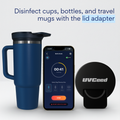
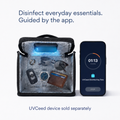
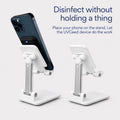
UVCeed is a portable, MagSafe-mounted UV-C device paired with a phone camera that visualizes which area of a surface has received light. It is designed for the specific category of ringworm application described above: surface sanitation of hard, nonporous materials where line-of-sight and dose matter.
The product makes two things true for ringworm surface applications that a wand cannot:
- Coverage you can see. The phone camera overlays a map of which parts of a counter, exam table, crate interior, cat tree hard surface, grooming tool, or gym bench have been exposed and which have not. Dermatophyte decontamination is a coverage problem — missing one corner of a surface preserves a viable spore reservoir that reseeds the room.
- Dose verification. The device times exposure based on measured irradiance, so the user knows the surface has received a dose consistent with published dermatophyte inactivation data rather than a guess.
What UVCeed is not:
- A treatment for an active ringworm infection on a pet or a person. That is a veterinary or medical treatment.
- A fabric or carpet decontamination tool. The spores are below where the light reaches.
- A substitute for physical removal of infected hair. Vacuum, lint roller, discard.
- A substitute for the environmental bleach or accelerated hydrogen peroxide step in a multi-pet household with confirmed M. canis. UV-C is one leg of a three-legged plan — surface disinfection, fungicidal shampoo or dip on the pet, and physical removal of contaminated hair — not the whole plan.
We've put that distinction in writing because the market has not.
The bottom line
UV-C inactivates ringworm fungi on exposed, nonporous surfaces when three things are true at the same time:
- The wavelength is in the germicidal range (254 nm or 265–280 nm UV-C, not UV-A).
- The dose is high enough for dermatophyte spores — comparable to mold spore doses, well above viral kill doses.
- The surface is actually in line of sight, not fabric with the spore buried in the pile and not the hair or skin of the infected host.
For hard surfaces the pet or person touched, shared grooming and medical tools, and smooth gym equipment, UV-C is a real adjunct tool. For the active infection on a pet or person, fabric and carpet, shed hair carrying viable spores, and nail bed infection, it is not.
Any UV product sold for ringworm cleanup that doesn't name its wavelength, publish its irradiance, or acknowledge that the hair and fabric reservoirs are outside its reach is selling theater, not science. The real cleanup plan — antifungal treatment on the host, bleach or accelerated hydrogen peroxide on hard surfaces, hot wash and physical removal for soft materials — stays the plan. Surface UV-C is a leg of the stool, not the stool.
Sources
- Dai T, et al. Ultraviolet C irradiation: an alternative antimicrobial approach to localized infections? (2013), PMID 23525830
- Moriello KA. Feline Dermatophytosis: Topics of Interest to the Practitioner (2014)
- CDC: Ringworm — About
- AAHA Infection Control, Prevention, and Biosecurity Guidelines
- Fungal photoinactivation doses for UV radiation and visible light — a data collection (Int J Environ Res Public Health, 2024)
- FDA Safety Communication: UV Wands May Pose Risks (July 2022)
- Rutala WA, Weber DJ. Guideline for Disinfection and Sterilization in Healthcare Facilities, 2008 — CDC/HICPAC
Want More Articles Like This?
Get research on UV-C treatment and product updates delivered to your inbox.