Short answer: yes. Salmonella enterica is a vegetative Gram-negative bacterium with no spore coat and no particular UV resistance, which puts it among the easiest common foodborne pathogens for UV-C to inactivate. A 3-log reduction at 254 nm takes about 7 to 10 mJ/cm², well inside what a correctly specified consumer UV-C device delivers on a nonporous surface in line of sight.
What UV-C does not do is cook the chicken, reach Salmonella soaked into a wooden cutting board, or substitute for soap after handling raw poultry. The useful question is which surfaces in a real kitchen are the ones where a UV-C pass changes the risk picture, and which are jobs for the oven, the sink, or the trash can.
What Salmonella actually is, and why the US sees so much of it
Salmonella is a genus of rod-shaped Gram-negative bacteria in the Enterobacteriaceae family. The non-typhoidal serotypes that dominate US foodborne disease are Salmonella enterica subspecies enterica, with Typhimurium and Enteritidis most frequently reported in outbreak data. These are vegetative cells with no endospores and no unusual DNA-repair advantage against UV-C compared to the standard E. coli benchmark. (CDC: Salmonella)
The CDC estimates Salmonella causes about 1.35 million illnesses, 26,500 hospitalizations, and 420 deaths in the US every year, making it the most common bacterial foodborne illness in the country and the second-most-common foodborne illness overall after norovirus. Most cases are self-limited gastroenteritis; deaths cluster among infants, elderly, and immunocompromised patients.
The common exposure sources recur in the outbreak record year after year:
- Raw and undercooked poultry, where Salmonella is part of the normal intestinal flora of chickens and turkeys
- Eggs with intact shells, where S. Enteritidis can be present inside the egg via transovarial transmission
- Raw sprouts (alfalfa, mung bean, clover), where warm humid germination is an ideal bacterial incubator
- Backyard chickens and ducks, linked by the CDC to multi-state outbreaks in nearly every year of the past decade
- Pet reptiles and amphibians (turtles, bearded dragons, frogs), which shed Salmonella intermittently
- Cantaloupe, where the netted rind traps bacteria and transfers them to the flesh at the knife cut (periodic multi-state recalls)
- Peanut butter and other low-moisture foods, where Salmonella survives for months (periodic national recalls)
A single raw chicken package produces a wide contamination footprint from grocery bag to counter to cutting board to sink.
What UV-C does to Salmonella at the molecular level
UV-C at 254 nm is absorbed by adjacent pyrimidine bases in bacterial DNA, which fuse into cyclobutane pyrimidine dimers. A genome studded with dimers cannot be replicated, and a cell that cannot replicate cannot establish an infectious dose. The mechanism is identical across Salmonella, E. coli, Shigella, Campylobacter, and Listeria.
The foundational dose data was measured by Chang and colleagues at Harvard in 1985, which reported UV inactivation constants for Salmonella Typhimurium alongside E. coli, with 3-log reductions in the single-digit mJ/cm² range at 254 nm. (Chang JCH, Ossoff SF, Lobe DC, et al. UV inactivation of pathogenic and indicator microorganisms. Appl Environ Microbiol. 1985;49(6):1361-1365.) Kowalski's Ultraviolet Germicidal Irradiation Handbook (Springer, 2009) compiles subsequent studies into tabulated dose-response constants for Salmonella serotypes, clustering around 7 to 10 mJ/cm² for 3-log on surfaces and in thin water films.
Where Salmonella sits relative to its vegetative-bacterium peers at 254 nm, drawn from the Chang 1985 and Kowalski 2009 data:
| Organism | ~3-log dose at 254 nm |
|---|---|
| Salmonella Typhimurium | 7 to 9 mJ/cm² |
| Salmonella Enteritidis | 7 to 10 mJ/cm² |
| E. coli O157:H7 | 6 to 8 mJ/cm² |
| Listeria monocytogenes | 5 to 10 mJ/cm² |
| Campylobacter jejuni | 2 to 5 mJ/cm² |
| Staphylococcus aureus | 5 to 7 mJ/cm² |
Salmonella sits in the middle of the easy-UV-target band. If a device hits E. coli at the published dose, it hits Salmonella at the published dose. This is not a borderline organism for UV-C the way C. difficile spores or mold spores are.
The right wavelength
Not every lamp labeled "UV" is a germicidal lamp. The band splits three ways:
- UV-A (315 to 400 nm), the near-visible blacklight range. No meaningful activity on Salmonella. Most sub-$30 "UV sanitizer wands" sold online are UV-A LEDs. The FDA pulled 13 of these in 2022 for unsupported germicidal claims. (FDA Safety Communication, July 2022)
- UV-B (280 to 315 nm), the sunburn range. Weak germicidal activity; a dose high enough to disinfect also damages skin.
- UV-C (100 to 280 nm), the germicidal range. The 254 nm emission of low-pressure mercury lamps and the 265 to 280 nm band of UV-C LEDs are what actually kill Salmonella.
If a product does not disclose its wavelength and irradiance, assume UV-A and move on.
Where Salmonella hides in a kitchen that handles raw poultry
Salmonella persists as the top bacterial foodborne cause in the US not because people fail to cook chicken (most do), but because of cross-contamination to surfaces that then touch ready-to-eat food. The surveyed hot spots:
- Cutting boards, especially after a knife has made score marks that trap juice and bacteria below the surface plane
- Knife handles, where the blade-handle junction collects moisture and is almost never wiped
- Faucet handles, touched with raw-chicken hands to turn the water on before any handwash can happen
- Cabinet handles and refrigerator door handles, same mechanism
- Phone screen, flagged in USDA studies as a frequent destination for raw-protein-contaminated hands checking a recipe mid-prep
- Reusable grocery bags, which carry raw-meat leaks into the car and back onto the counter, usually unwashed between runs
- Dish sponges and cloths, a separate biofilm problem outside the scope of UV-C
Cross-contamination is a chain, and the chain breaks at whichever link gets interrupted. Cooking the chicken breaks the chain for the chicken, not for the cutting board, the knife, the faucet handle, or the phone.
Cutting board sanitation, and why wipes miss what UV-C reaches
Cutting boards split into wood (end-grain or edge-grain hardwoods) and plastic (HDPE, polyethylene). Both develop knife score marks over time, and both can harbor Salmonella in grooves below the top surface after raw-poultry contact.
Wood has a modest antibacterial property attributed to capillary action pulling bacteria below the surface where they desiccate over hours. Plastic has no such property. In either case, the enemy of surface disinfection is the knife score. A disinfectant wipe hits the top plane and the shoulders of the grooves; it does not reliably reach the bottom of a deep score holding residual moisture or fat.
UV-C with verified coverage addresses a different part of the problem. The wipe does physical removal. UV-C, applied after the surface is visibly clean, pushes a measured dose into the groove geometry at line-of-sight angles. The light still has to hit the surface, and the surface has to be clean enough that photons are not absorbed by chicken fat sitting on top of the bacteria.
Reusable grocery bags: the ignored vector

Charles Gerba's widely cited 2010 University of Arizona study on reusable grocery bag contamination found coliform bacteria in roughly half of surveyed bags and E. coli in a meaningful fraction, with raw meat and poultry juice identified as the primary source. The follow-up survey asked how often consumers washed the bags. The answer was: almost never. (Gerba CP, Williams D, Sinclair RG. Assessment of the potential for cross-contamination of food products by reusable shopping bags. Food Prot Trends. 2011;31(8):508-513.)
The bag that carried raw chicken home remains a vector for Salmonella, E. coli, and norovirus for days, and most consumers treat it as inert. The primary intervention is washing bags that have carried raw proteins: fabric bags in the laundry, woven polypropylene bags with soap and water. UV-C is a reasonable supplementary pass for the inside surface, the handles, and the seams. It is not a substitute for washing a bag with visible residue.
Backyard chicken coops and egg collection

Backyard chicken keeping has grown steadily in the US, and the CDC has traced multi-state Salmonella outbreaks to live poultry contact in nearly every year of the past decade. The exposure is handling the birds, cleaning the coop, and bringing contaminated hands or boots into the house.
UV-C does not replace coop cleaning, changing clothes after coop work, or handwashing after handling a bird. What it can reasonably do, on items already physically cleaned:
- Pass over the exterior of egg collection baskets after eggs are refrigerated and the basket wiped
- Pass over work gloves (nonporous nitrile, not fabric) between uses
- Pass over coop tool handles after cleaning
- Pass over the phone that went into the coop
Primary biosecurity remains coop hygiene, flock health, dedicated footwear, and strict handwashing. (CDC: Backyard Poultry)
Where UV-C does not replace soap
Three failure modes recur:
Raw chicken juice itself. Pooled poultry drippings need a paper towel plus soap and water first, and then (optionally) a UV-C pass on the cleaned surface. UV-C aimed at a puddle of juice is absorbed by the organic load long before it reaches the bacteria suspended in it.
Visible contamination of any kind. The published dose constants are for bacteria on a clean, dry, nonporous surface. Dried food, grease films, blood smears, and sauce residue all absorb UV-C photons. If you can see the dirt, UV-C cannot see past it either.
Inside the knife handle, inside the sponge, inside the biofilm. Fully-submerged bacteria in a mature biofilm are protected both chemically and optically. A contaminated sponge needs replacement or a microwave or dishwasher cycle. A knife handle with a cracked seam needs a soap-and-brush cleaning that reaches into the seam.
Where UVCeed fits in the Salmonella conversation
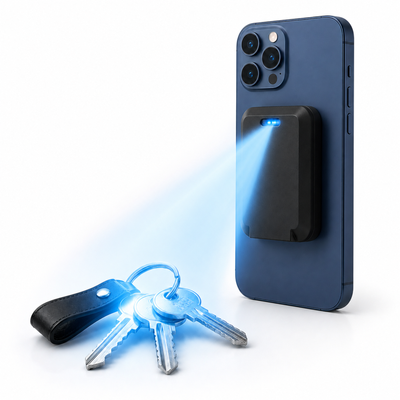
UVCeed is a portable UV-C device that pairs with a phone camera to visualize which parts of a surface have accumulated adequate dose. For Salmonella, firmly in the easy-to-inactivate band at 7 to 10 mJ/cm², the engineering problem is not generating enough photons. It is placing them on every square inch of the surface that needs them.
Practical use cases on the Salmonella risk map:
- Cutting board after a raw-chicken prep session washed with soap and water
- Knife handle junction, after cleaning
- Faucet, cabinet, and refrigerator handles after a raw-protein prep session
- Phone screen after cooking
- Egg collection basket (exterior) after wiping
- Interior, handles, and seams of a reusable grocery bag after bag washing
UVCeed is not a replacement for a thermometer, a solution for interior-contaminated food, a drinking-water device, or an FDA-cleared medical device. It is a general-wellness surface sanitizer for the surfaces that the sponge and the wipe routinely miss.
What UV-C can't do about Salmonella
UV-C does not replace any of the following, and no amount of coverage mapping changes that:
- Cooking poultry to a thermometer-verified internal temperature of 165°F (74°C). This is the intervention that kills Salmonella inside the chicken, where no light reaches.
- Cooking ground beef to 160°F (71°C). Salmonella contaminates beef less often than E. coli O157:H7, but the temperature rule is the same.
- Penetrating raw chicken, raw turkey, a whole cantaloupe, a jar of peanut butter, or any three-dimensional food. UV-C is a surface tool.
- Working through visible contamination. Clean first. Light second.
- Replacing soap-and-water handwashing after handling raw poultry, eggs, reptiles, or backyard birds. Twenty seconds of soap and warm water is the single highest-return intervention in the entire Salmonella chain.
Treat UV-C as what it is: a verifiable final disinfection pass on cleaned, nonporous surfaces where Salmonella could have landed after a raw-protein prep session, an egg collection, or a reusable bag coming home from the store. The temperature, the soap, and the discard pile do the rest.
Sources
- Chang JCH, Ossoff SF, Lobe DC, Dorfman MH, Dumais CM, Qualls RG, Johnson JD. UV inactivation of pathogenic and indicator microorganisms. Appl Environ Microbiol. 1985;49(6):1361-1365. PMID 2990336.
- Kowalski W. Ultraviolet Germicidal Irradiation Handbook: UVGI for Air and Surface Disinfection. Springer, 2009.
- CDC: Salmonella
- CDC: Backyard Poultry and Salmonella
- USDA FSIS: Chicken from Farm to Table
- USDA FSIS: Safe Minimum Internal Temperatures
- Gerba CP, Williams D, Sinclair RG. Assessment of the potential for cross-contamination of food products by reusable shopping bags. Food Prot Trends. 2011;31(8):508-513.
- FDA Safety Communication: UV Wands May Pose Risks of Radiation Injuries (July 2022)
Want More Articles Like This?
Get research on UV-C treatment and product updates delivered to your inbox.