Short answer on skin: no. Do not point a UV-C device at your body to treat scabies, and do not let a product page talk you into it. On fabrics, furniture, and mattresses the answer is a qualified maybe for off-host mites sitting on an exposed surface, but UV-C will not reach the mites that are burrowed into fabric fibers or seams, and it is not what the CDC, WHO, or any dermatology society recommends for environmental decontamination in a scabies case.
We make a UV-C surface sanitizer. We would like to tell you ours plays a role in a scabies outbreak. On a person, it does not. On the laundry pile, hot water and a hot dryer do the job the research supports. This article walks through what scabies is, why UV-C is the wrong tool on skin, and what the real treatment protocol looks like. The fastest way out is the right prescription, not a wand.
What scabies actually is
Scabies is a parasitic skin infestation caused by the mite Sarcoptes scabiei var. hominis. The WHO estimates 150 to 200 million cases a year globally and lists scabies as a neglected tropical disease because of its load in resource-limited settings and crowded living conditions (WHO: Scabies). It is not an infection on the skin surface. It is an infestation under it.
An adult female mite is about 0.3 to 0.45 mm long, barely visible without magnification. After mating on the skin surface, she burrows into the stratum corneum (the outermost layer of the epidermis) and tunnels a serpentine track where she lays two to three eggs a day for the four to six weeks she lives. Eggs hatch in three to four days. Larvae leave the burrow, molt on the surface, and the cycle restarts. Full egg-to-adult cycle: roughly 10 to 17 days (CDC: Scabies Biology).
The classic presentation is intense itching, worse at night, with a papular rash in the finger webs, wrists, elbows, axillae, waistband, groin, and buttocks. The itch is a delayed hypersensitivity reaction to the mite and its waste, which is why a first infestation takes four to six weeks to become symptomatic and a reinfestation becomes symptomatic within days. By the time an adult patient notices the rash, there are typically 10 to 15 adult mites on the body: a small, deeply embedded colony, not a surface swarm.
Crusted scabies, sometimes called Norwegian scabies, is a different story. In immunocompromised patients, elderly nursing-home residents, and people on long-term topical steroids, the mite population can grow into the thousands or millions, with thick hyperkeratotic crusts packed with mites. It is far more contagious, sheds mites into the environment at much higher rates, and requires more aggressive environmental cleaning in addition to combination drug therapy.
Why UV-C fails on skin
The germicidal wavelength that gets used against bacteria and viruses is 254 nm UV-C from a mercury lamp, or 265 to 275 nm from a UV-C LED. These wavelengths work by causing dimerization in nucleic acids, which is excellent for microorganisms sitting on an exposed surface and bad news for human skin.
Three facts make UV-C the wrong instrument for a person with scabies.
1. The mites are under the skin surface, not on it. A female S. scabiei and her eggs sit in a burrow inside the stratum corneum, typically 0.1 to 0.5 mm below the surface. UV-C at 254 nm penetrates intact human skin to roughly 10 to 30 micrometers, essentially the top few cell layers of the stratum corneum. The mite, the eggs, and the burrow itself are below the depth UV-C can reach at any dose.
2. The dose that would damage the mite is far above the dose that burns the patient. The ACGIH threshold limit value for 254 nm UV-C on unprotected skin and eyes is approximately 6 mJ/cm² over an 8-hour day, with the action spectrum peaking near 270 nm at an even lower threshold around 3 mJ/cm². Doses that reliably inactivate microorganisms on a hard surface sit in the 5 to 40 mJ/cm² range. Doses relevant for a chitinous arthropod under keratin are orders of magnitude higher. You cannot deliver that to a mite without delivering a severe erythemal and carcinogenic dose to the skin above it.
3. The regulatory record on UV wands and skin is explicit. In July 2022 the FDA issued a safety communication naming 13 handheld UV wand products as presenting a risk of radiation injury to skin and eyes, with reports of burns, inflammation, and painful photokeratitis among consumers using them as directed (FDA: UV Wands May Pose Risks). IARC classifies the entire UV spectrum, including UV-C, as a Group 1 human carcinogen. The dose required to meaningfully irritate a mite burrowed in your wrist would, delivered to the wrist, cause an acute erythemal reaction and raise long-term skin cancer risk at that site. That is not a tradeoff worth making for a parasite that permethrin cream clears in two applications.
Dai et al. 2013 reviewed UV germicidal action against microorganisms and documented the dose-response that makes UV-C useful on bacteria, fungi, viruses, and spores. The paper limits its claims to microbial targets and does not extend to multicellular parasites in a mammalian host (Dai et al., Virulence, 2013, PMC 3906432). No credible dermatology or parasitology literature establishes UV-C as a scabicide.
The qualified maybe on fabrics and surfaces
Scabies mites off a human host survive about 24 to 36 hours at room temperature and up to 72 hours in cool, humid conditions (CDC: Scabies Prevention). That window is why the environmental step exists. Bedding, towels, and clothing worn in the three days before treatment can carry viable mites that reinfest the patient or household contacts.
UV-C has real germicidal activity on exposed surfaces. On a hard, flat, line-of-sight surface at a controlled distance, 254 nm UV-C at a measured dose will inactivate bacteria, viruses, and spores reliably, and will damage a mite exoskeleton given enough time and dose. The qualifier keeps appearing: exposed surface, line of sight, controlled distance, measured dose.
That is not what a mite on a bedsheet or inside a mattress seam looks like. The mite settles between fabric fibers the way it burrows into stratum corneum. Fibers scatter and absorb UV-C within the top one or two millimeters of the weave, so a mite one fiber layer deep gets a tiny fraction of the surface dose. A handheld UV-C pass does not deliver a mite-lethal dose at those depths, especially in ticking, quilt stitching, or edge piping.
The thermal protocol is unambiguous. CDC guidance is to wash bedding, clothing, and towels used in the three days before treatment in hot water and dry on the hot cycle, or seal non-washable items in a plastic bag for at least 72 hours. The temperature target that reliably kills S. scabiei and its eggs is 50°C (122°F) for 10 minutes, which a standard hot dryer cycle exceeds easily. No published scabies protocol has UV-C replacing the hot wash plus hot dryer step.
What actually treats scabies

The CDC and WHO protocols are consistent across both agencies, and align with the clinical dermatology literature.
First-line topical: permethrin 5% cream. Applied from the neck down (and including the scalp and face in infants, elderly patients, and crusted cases), left on for 8 to 14 hours, washed off, and repeated 7 to 14 days later to catch mites that hatched after the first application. Cure rates in adult ordinary scabies exceed 90% when both applications are completed and household contacts are treated simultaneously (CDC: Scabies Treatment).
Oral: ivermectin. 200 µg/kg orally, repeated 7 to 14 days later. Preferred for institutional outbreaks, crusted scabies (in combination with topical therapy), and cases where compliance with a whole-body cream is unlikely. Not labeled for pregnant women or children under 15 kg.
Alternative topicals. Benzyl benzoate 10 to 25%, crotamiton 10%, and precipitated sulfur 5 to 10% in petrolatum, used where permethrin is unavailable or in populations (infants, pregnancy) where its risk-benefit is reconsidered.
Simultaneous treatment of household contacts. Everyone sharing the household and anyone with prolonged skin-to-skin contact in the preceding six weeks is treated at the same time, symptomatic or not. Partial treatment restarts the cycle.
The environmental step. Hot wash plus hot dryer for bedding, clothing, and towels worn in the three days before treatment. Non-washable items sealed in a plastic bag for 72 hours (longer if the household includes a crusted-scabies case). Vacuum upholstered furniture and mattresses once; the mite does not persist long off a host and does not require ongoing environmental spraying.
For crusted scabies specifically. Combination therapy with topical permethrin every two to three days for one to two weeks plus oral ivermectin on days 1, 2, 8, 9, and 15 (sometimes 22 and 29). Aggressive environmental cleaning. Isolation precautions in healthcare settings.
Environmental UV-C is nowhere on either list. The broader scabies epidemiology literature frames the disease as one of close human contact and under-recognized public health burden, and the control measures throughout are drug therapy for people and heat or isolation for fomites (Hay et al., Scabies in the developing world, 2012, PMC 3486431).
Where UV-C does not fit in a scabies case
If you have scabies, this is the wrong product for that problem. Call a dermatologist or your primary care clinician. Get the permethrin or ivermectin. Treat the household. Do the laundry.
A UV-C surface sanitizer is not a scabicide. It is not a replacement for permethrin. It is not a shortcut around the hot wash and hot dryer. It is not a treatment for burrowed mites, and attempting to use it on skin is a radiation exposure with no therapeutic benefit and real injury risk. The common pattern on misleading UV wand pages is to lump "mites" into a bullet list next to bacteria and viruses, collapsing the distinction between a bacterium on a counter and a multicellular arthropod burrowed into living tissue. The two targets are not comparable.
Where UV-C does fit in the home

UV-C has a real role. On hard, exposed, line-of-sight surfaces at a measured distance and dose, 254 nm UV-C inactivates bacteria and viruses reliably. That is a decades-old finding and the basis for UV-C's legitimate use in water treatment, upper-room air disinfection, and surface decontamination of hard goods.
In a home, the surfaces where UV-C is genuinely useful are the ones most people never clean the same way they clean a plate:
- Phone screens, cases, and the earpiece area, where hand-to-face transfer concentrates bioburden.
- Remote controls, game controllers, and keyboards, which rarely see a wet cloth and are shared across household members.
- Light switches, door handles, cabinet pulls, and faucet handles.
- Kitchen cutting boards and counter surfaces after rinsing, as a non-chemical finishing step.
- Baby items that go in the mouth and cannot tolerate bleach.
- Toothbrush handles, electric razor heads, and other hard-surface personal-care items.
- Travel surfaces like hotel nightstands, airplane tray tables, and the hard shell of a suitcase.
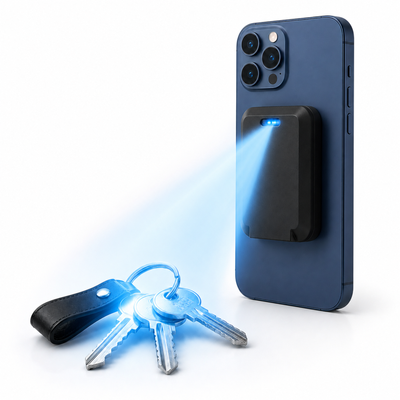
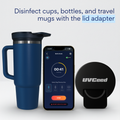
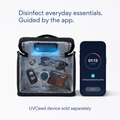
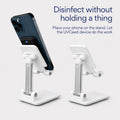
UVCeed is built for that use case. The phone camera verifies that UV-C has illuminated each part of the surface, so coverage is not left to guesswork and dwell time is tied to the measured dose. On a hard, flat, exposed surface, that is the use UV-C was engineered for.
It is not a scabies treatment. It is not a replacement for permethrin or ivermectin, and not a substitute for the hot wash and hot dryer at the center of the CDC and WHO protocols. If you came here from a search for "does UV light kill scabies," the useful answer is the one at the top: not on skin, and not reliably on the fabric reservoirs where the mite survives its 24 to 72 hours off a host. Treat the person, launder the fabric, and let UV-C do the surface work it is actually suited for.
Sources
- CDC: Scabies (About, Biology, Prevention, Treatment)
- WHO: Scabies fact sheet
- Dai T, Vrahas MS, Murray CK, Hamblin MR. Ultraviolet C irradiation: an alternative antimicrobial approach to localized infections? (Virulence, 2013, PMC 3906432)
- FDA Safety Communication: UV Wands May Pose Risks of Radiation Injuries (July 2022)
- Hay RJ, Steer AC, Engelman D, Walton S. Scabies in the developing world: its prevalence, complications, and management (Clinical Microbiology and Infection, PMC 3486431)
- American Academy of Dermatology: Scabies diagnosis and treatment
- ACGIH Threshold Limit Values for Ultraviolet Radiation
Want More Articles Like This?
Get research on UV-C treatment and product updates delivered to your inbox.