Short answer: yes. UV-C at 254 nm destroys the RNA and DNA inside viruses faster and at lower doses than it destroys any other class of microorganism, which is why hospitals, water-treatment plants, biosafety cabinets, and ambulance decontamination systems have used germicidal UV for the better part of a century. SARS-CoV-2, influenza A and B, rhinovirus, RSV, and most other respiratory viruses are inactivated at 2 to 5 mJ/cm² on direct-contact surfaces — a dose a well-designed UV-C device delivers in seconds.
But the answer has caveats, and the market has been full of products that stretch "UV kills viruses" into claims the physics does not support. UV light does not reach viruses deposited inside the fabric of a couch cushion. It does not disinfect airborne droplets suspended in your room's general air. It does not substitute for a mask, ventilation, or vaccination. And a $25 Amazon wand labeled "UV sanitizer" is almost always UV-A, which does not inactivate viruses at any practical dose.
What UV-C does do, reliably, is destroy viruses sitting on a surface the light actually touches, at a dose the light actually delivers, for a time the virus actually gets exposed. For a world that spent 2020 and 2021 wiping down groceries, this is the useful specific capability. This article walks through the molecular mechanism, the published doses for the viruses people actually search for, the three places UV-C genuinely moves the needle, and the four places it does not.
What UV light does to viruses at the molecular level
A virus is essentially a short strand of RNA or DNA wrapped in a thin protein coat, sometimes surrounded by a lipid envelope. There is no cell wall. There is no nucleus. There is no DNA-repair machinery. There is no spore coat. From the perspective of UV-C, a virus is the most exposed genetic payload in biology.
UV-C photons in the 250 to 265 nanometer band are strongly absorbed by the nucleotide bases of nucleic acids. When enough photons hit, adjacent pyrimidines (thymine or cytosine in DNA, uracil or cytosine in RNA) fuse into pyrimidine dimers. A single-stranded RNA genome studded with dimers cannot be translated by host ribosomes. A dimer-studded double-stranded DNA genome cannot be replicated. The viral particle is physically intact but biologically dead — it cannot infect a new cell.
Because the viral genome is small, exposed, and unprotected by repair enzymes, the dose required to inactivate 90% of a viral population (D₉₀) is small. Representative published values at 254 nm:
- SARS-CoV-2: roughly 2 to 5 mJ/cm² for 1-log inactivation on a surface; higher-log reductions in the 10 to 20 mJ/cm² range. (Buonanno et al. 2020, Sci Rep, PMC 7324301)
- Influenza A (H1N1, H3N2): 2 to 4 mJ/cm² for 1-log inactivation. (Walker & Ko 2007, Environ Sci Technol)
- Rhinovirus: around 3 mJ/cm².
- RSV: envelope-wrapped RNA virus, similar range to influenza.
- Human coronavirus 229E and OC43: 1 to 3 mJ/cm² at 222 nm (far-UVC). (Welch et al. 2018, Sci Rep, PMC 5807329)
- Norovirus (non-enveloped, more UV-resistant than respiratory viruses): around 20 to 25 mJ/cm². (Shaffer et al. 2024, Applied and Environmental Microbiology, DOI 10.1128/aem.02514-25)
- Adenovirus (non-enveloped, double-stranded DNA, among the toughest viruses): 60 to 120 mJ/cm².
The general rule: enveloped RNA viruses — the ones that cause most respiratory illness — are the easiest UV-C targets in the microbial world. Non-enveloped viruses like norovirus and adenovirus are tougher but still an order of magnitude easier to kill than fungal spores.
Compare that to A. niger mold spores at 226 mJ/cm² for 2-log reduction. Viruses are 30 to 100 times easier to kill with UV-C than fungal spores, and 2 to 5 times easier than most bacteria.
Which UV wavelength is the right one
Not all ultraviolet light is germicidal, and the post-COVID market filled up with devices sold on the word "UV" without specifying which band.
- UV-A (315–400 nm) — the "black light" range. Does not inactivate viruses at any practical consumer dose. The majority of $15 to $40 "UV sanitizer" wands and pouches sold through Amazon marketplaces during 2020 and 2021 were UV-A LEDs. In July 2022 the FDA issued a safety communication after pulling 13 of these from the market — several caused eye and skin burns, and none demonstrated the virucidal performance claimed on the packaging. (FDA Safety Communication, July 2022)
- UV-B (280–315 nm) — some germicidal activity, but doses high enough to inactivate viruses on a surface also burn human skin. Not a practical surface tool.
- UV-C (100–280 nm) — the germicidal range. 254 nm low-pressure mercury lamps have been the industrial standard for decades. 265 to 280 nm UV-C LEDs are the modern solid-state equivalent. 222 nm far-UVC is an emerging category studied for occupied-space disinfection because at that wavelength UV cannot penetrate the outer dead layer of human skin or the tear film of the eye, while remaining strongly virucidal. (Welch et al. 2018, PMC 5807329)
If a device does not specify a 222 nm, 254 nm, or 265–280 nm wavelength on the spec sheet, assume it is UV-A and move on.
Where UV light actually works on viruses
Published research and real-world deployments converge on three categories where UV-C earns its keep against viruses.
1. Personal high-touch electronics and small objects. Phones, keyboards, computer mice, remote controls, car keys, earbuds, glasses, pens, badge lanyards, pediatric toys. These are nonporous, geometrically awkward, and go directly from a surface to a hand to a face. They are rarely cleaned with alcohol because alcohol damages screen oleophobic coatings and silicone keyboard membranes. UV-C at the virus-level dose of 5 to 20 mJ/cm² inactivates respiratory viruses on these surfaces within seconds of direct exposure. This is the single highest-leverage virus-on-surface application for a consumer.
2. High-touch shared surfaces during respiratory virus season. Door handles, elevator buttons, bathroom faucet handles, grocery-cart handles, airplane tray tables, hotel-room remotes and light switches, pediatric clinic exam-table surfaces, waiting-room chair armrests. Flu, RSV, rhinovirus, and SARS-CoV-2 deposit on these surfaces from respiratory droplets and hands and persist for hours. UV-C delivers a dose high enough to inactivate the virus faster than most liquid disinfectants (which require 1 to 10 minutes of wet contact time to meet their label claims).
3. Pediatric and immunocompromised settings. Pediatric exam rooms, NICU equipment surfaces, dialysis chairs, chemotherapy infusion bays, and home environments with a transplant recipient or an infant under three months. The absolute viral dose matters more in these settings; UV-C adds a layer of surface inactivation on top of standard cleaning without introducing chemical residues that irritate pediatric or immunocompromised skin and lungs.
Everything else involves either a portable handheld device aimed at specific surfaces, or a marketing claim leaning on physics that does not apply.
Where UV light does not kill viruses
1. Airborne viruses in your general room air. The transmission mode most people cared about during COVID was airborne. Handheld UV-C does not solve this. For UV to inactivate a virus-laden aerosol floating through a room, that aerosol has to pass through a defined zone of sufficient irradiance for sufficient residence time. A wand sweeping a surface does nothing for the air. An in-duct UV-C system or an upper-room UV fixture in a high-ceiling space can reduce airborne viral load, but these are architectural installations, not handhelds. Masks and ventilation remain the frontline for airborne respiratory viruses.
2. Virus inside the fibers of soft and porous surfaces. Couch cushion fabric, pillow interior, carpet pile below the surface layer, teddy bears, upholstered chairs. Respiratory droplets deposit into fibers and the virus is sheltered below the depth UV-C penetrates. UV inactivates the exposed top layer; what sits a millimeter deeper is unaffected. Laundering soft goods remains the better tool for soft surfaces.
3. Virus already inside a person. This is obvious to state but worth stating because the post-COVID marketing blurred it. UV-C on surfaces reduces fomite transmission. It does not treat an active infection, prevent an infection that has already begun, or replace vaccination. Nobody at the FDA or CDC claims it should.
4. The underlying transmission system. If an office returns to open seating with poor ventilation and no filtration, UV-C on the keyboards is a small layer on top of a larger problem. Ventilation (ACH, air changes per hour), filtration (MERV 13 or HEPA), and masking during peak respiratory virus season do more for population-level transmission than any amount of surface UV. UV-C is a point-of-use tool, not an environmental control strategy.
Why most UV products overstate what they can do about viruses
Between March 2020 and mid-2022, the search volume for "UV virus killer" and its variants exceeded that of every other UV topic combined. The supply response was a flood of UV-A wands, UV-A phone sanitizer pouches, and UV-A "sterilizing" closets marketed as COVID solutions. Most of them did not inactivate SARS-CoV-2 at any practical dose because they were the wrong wavelength or had no measurable irradiance at working distance.
The typical product page said: UV kills coronavirus. The citation was a lab study using a 254 nm mercury lamp at a measured dose, which has nothing to do with a 395 nm LED wand sold on Amazon. The FDA's July 2022 safety communication pulled 13 of these from the market and specifically called out that many caused skin burns from unshielded UV-A exposure while delivering no demonstrated virucidal benefit. The agency's reasoning is in the public safety communication linked at the end of this article.
Buyers who purchased those wands and later caught COVID anyway concluded UV didn't work. The real conclusion is that most of what was sold as "UV virus killer" during the pandemic was the wrong wavelength at an un-verifiable dose, and the virucidal UV-C literature itself was never the thing being sold.
Where UVCeed fits in the virus conversation
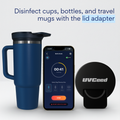
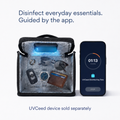
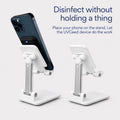
UVCeed is a portable, MagSafe-mounted UV-C device paired with a phone camera that visualizes which area of a surface has received light. It is designed for the specific category of virus problem described above: respiratory virus deposition on personal high-touch nonporous surfaces where line-of-sight and dose matter.
The product makes two things true for virus applications that a wand cannot:
- Coverage you can see. The phone camera overlays a map of which parts of the phone back, keyboard, remote, elevator button, pediatric exam-table surface, or stroller handle have been exposed and which have not. Virus-laden droplets land exactly where surfaces skate past a wipe — the ridge around a phone case, the space between keyboard keys, the inside curve of a door handle. UVCeed makes those misses visible.
- Dose verification. The device times exposure based on measured irradiance, so the user knows the surface has received a dose in the range shown in the peer-reviewed literature to inactivate respiratory viruses — generally 5 to 20 mJ/cm² for a meaningful log-reduction against SARS-CoV-2, influenza, rhinovirus, and RSV.
What UVCeed is not: an air purifier, an airborne-transmission control, a mask substitute, a ventilation substitute, a vaccine substitute, a treatment for active viral infection, or a tool for soft and porous surfaces. Any of those is a different job and often a different tool. The distinction is in writing here because the pandemic market did not put it there.
The bottom line
UV light kills viruses on exposed, nonporous surfaces when three things are true at the same time:
- The wavelength is in the germicidal range (254 nm, 265–280 nm, or 222 nm — not UV-A).
- The dose is high enough — fortunately, viruses are the easiest target in the UV literature, with most respiratory viruses inactivated at 2 to 20 mJ/cm².
- The surface is actually in line of sight for the duration it takes to accumulate the dose.
For respiratory viruses on phones, keyboards, remotes, door handles, elevator buttons, and other high-touch nonporous surfaces, UV-C is a real tool and arguably the easiest hygiene win it offers. For airborne droplets in your room's general air, for viruses lodged in soft fabrics, or for an infection that has already started, it is not.
Any UV product that doesn't name its wavelength, publish its irradiance, or acknowledge the airborne-transmission boundary is selling theater, not science.
Sources
- Buonanno M. et al. Far-UVC light (222 nm) efficiently and safely inactivates airborne human coronaviruses (Sci Rep, 2020 — PMC 7324301)
- Welch D. et al. Far-UVC light: A new tool to control the spread of airborne-mediated microbial diseases (Sci Rep, 2018 — PMC 5807329)
- Walker C.M., Ko G. Effect of ultraviolet germicidal irradiation on viral aerosols (Environ Sci Technol, 2007 — DOI 10.1021/es070056u)
- Shaffer M. et al. UV-C inactivation of human norovirus surrogates (Applied and Environmental Microbiology, 2024 — DOI 10.1128/aem.02514-25)
- CDC: Norovirus — Prevention and Control
- Rutala WA, Weber DJ. Guideline for Disinfection and Sterilization in Healthcare Facilities, 2008 — CDC/HICPAC
- FDA Safety Communication: UV Wands May Pose Risks (July 2022)
Want More Articles Like This?
Get research on UV-C treatment and product updates delivered to your inbox.