TL;DR
Florida's Department of Health confirmed a locally acquired chikungunya case in Miami-Dade County in its arbovirus surveillance report covering September 6 through 12, 2026, with symptom onset in August. That is Florida's first locally transmitted chikungunya case since 2014, when 11 such cases were reported statewide. It arrives alongside a much bigger number: locally acquired dengue cases in Florida have already topped 150 for 2026. Sixty-six chikungunya cases with travel history to an endemic area have also been reported this year, 37 of them from Miami-Dade alone. None of this is theoretical risk. It is active mosquito-borne disease transmission happening in a US state right now, and it is a useful reminder that the "world outside my home" threat model includes more than just surfaces.
What actually happened
According to reporting on Florida's weekly arbovirus surveillance data, the Florida Department of Health's report for the week of September 6 to 12, 2026 recorded one locally acquired chikungunya case in Miami-Dade County, the state's first locally transmitted case since 2014. The CDC's historical record confirms that 2014 was the last time Florida saw sustained local transmission, when 11 cases were tied to mosquitoes that had picked up the virus from travelers and then transmitted it locally. In the 12 years between, essentially every chikungunya case in Florida has been travel-associated, meaning someone caught it abroad and brought it home, without the virus establishing a local mosquito-to-human transmission chain. This year's case breaks that streak.
Separately, and at much larger scale, locally acquired dengue cases in Florida have already exceeded 150 for 2026, according to the same surveillance reporting. Sixty-six chikungunya cases tied to travel have also been logged this year, with Miami-Dade County alone accounting for 37 of them, largely linked to travel from Cuba, where both viruses are circulating. Florida's year-round mosquito season and dense international travel corridor make it the most consistent entry point in the continental US for mosquito-borne viruses that are common in the Caribbean and Latin America.
Why one local case matters more than the number suggests
A single locally acquired case sounds small next to 150-plus dengue cases, but epidemiologists watch it closely for a specific reason: it confirms that local Aedes mosquitoes, the same species responsible for dengue and Zika transmission in Florida, are capable of picking up chikungunya from an infected traveler and passing it to someone who never left the state. Once that transmission chain exists, it can, in principle, repeat. That is exactly the mechanism that produced Florida's first-ever locally acquired chikungunya cases back in 2014, and it is why a single confirmed local case triggers expanded mosquito surveillance and control efforts in the surrounding area rather than being treated as a one-off curiosity.
Both viruses share the same mosquito vector and overlapping symptoms, fever, joint pain, rash, and fatigue, though chikungunya's joint pain is notoriously severe and can persist for months after the acute illness resolves. Neither has a widely available antiviral treatment; care is supportive, meaning rest, fluids, and pain management while the body clears the virus.
What actually protects you
- Eliminate standing water around your home weekly. It takes as little as a bottle cap of water for Aedes mosquitoes to breed.
- Use EPA-registered mosquito repellent when outdoors during daylight hours in affected areas, since Aedes mosquitoes are aggressive daytime biters, unlike the mosquitoes behind West Nile virus.
- Screen windows and doors, and consider mosquito netting for infants and anyone who spends significant time outdoors.
- If you have traveled to the Caribbean or Latin America recently and develop fever with joint pain, tell your doctor about the travel history specifically so they test for the right pathogen.
- Support local mosquito control efforts, spraying notifications and standing water reports, rather than assuming it is someone else's problem.
Where UVCeed fits
This one calls for the same honesty as our coverage of West Nile virus: chikungunya and dengue spread through mosquito bites, not contaminated surfaces, so no surface disinfection device changes your risk of infection. UV-C is not a mosquito-borne illness prevention tool, and we are not going to pretend otherwise. Where it fits is downstream, in the household of someone actually sick and recovering. A person recovering from dengue or chikungunya spends a lot of time on the couch, in bed, using shared items, phone, remote, water glass, thermometer, tissues, and those items get touched by caregivers and other family members repeatedly during a recovery period that can stretch for weeks with chikungunya specifically because of the lingering joint pain.
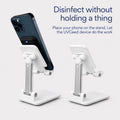
With UVCeed, you aim the device at one section, the phone, the remote, the nightstand, and hold it steady until the app confirms that section is complete, then move to the next section. It supports a household caring for someone sick; it does not replace repellent, standing water removal, or medical care.
FAQ
Can chikungunya or dengue spread person-to-person, or only through mosquitoes? Both spread almost exclusively through mosquito bites. A mosquito bites an infected person, picks up the virus, and can then transmit it to the next person it bites. Direct person-to-person spread through casual contact does not occur.
Why is a single locally acquired case in Florida considered significant? It confirms that local mosquitoes have picked up the virus from a traveler and transmitted it to someone who did not travel, which is the mechanism that could allow the virus to spread further within the local mosquito population if not controlled quickly.
How long does chikungunya joint pain last? Acute symptoms typically resolve within a week or two, but the joint pain associated with chikungunya can persist for months, and in some cases longer, which is one of the features that distinguishes it from dengue.
Is there a vaccine for chikungunya or dengue available in Florida? A chikungunya vaccine exists and has expanded availability in some states, with reporting indicating Florida pharmacists may soon be authorized to administer it; a dengue vaccine exists but is recommended only for specific populations with prior dengue infection. Talk to your doctor about eligibility.
Does UV-C disinfection reduce my risk of catching a mosquito-borne illness? No. Chikungunya and dengue are transmitted by mosquito bites, not by contaminated surfaces, so surface disinfection does not reduce your exposure risk. Repellent, eliminating standing water, and mosquito control are the actual protective measures.
Want More Articles Like This?
Get research on UV-C treatment and product updates delivered to your inbox.