TL;DR
NFL and college football kickoff means packed stadiums, shared tailgate coolers, and armrests touched by thousands of strangers over a single afternoon. Research on comparable public seating surfaces, including a widely cited Auburn University study on public transit-style seating materials, found disease-causing bacteria like MRSA and E. coli O157:H7 can survive on armrests and seat-back materials for days. Game day is fun. It's also a genuinely dense surface-contact event.
What actually happened
Football season kicked off across the NFL and major college conferences in late August and early September, drawing tens of thousands of fans per stadium into shared seating, concourses, and tailgate lots for hours at a time. There isn't stadium-specific bacterial research the way there is for, say, airplane cabins, but the closest available science is instructive. Researchers at Auburn University contaminated public seating materials, including armrest and seat-back fabric similar to what's used in stadiums and transit, with MRSA and E. coli O157:H7 and tracked survival time. ABC News and today.com's coverage of the study found MRSA survived up to 168 hours (7 days) on seat-back material, and E. coli O157:H7 survived up to 96 hours (4 days) on armrest material.
A separate consumer test by Good Morning America swabbed public seating in high-traffic venues and consistently found bacterial counts on armrests and seat surfaces well above what most people would expect from a surface that looks clean. The takeaway isn't that any specific stadium is dirty; it's that any hard public seating surface touched by thousands of people over a season, and rarely deep-cleaned between individual games, behaves the same way structurally.
Where the exposure actually concentrates
- Stadium seats and armrests: touched by every occupant for hours, rarely wiped down between games.
- Tailgate coolers and shared serving utensils: passed hand to hand for an entire afternoon, often in direct sun with food sitting at unsafe temperatures.
- Concession counters and condiment stations: high touch, high traffic, minimal cleaning cadence during a live game.
- Stadium railings and concourse surfaces: thousands of contacts per game day.
What to actually do on game day
- Bring hand sanitizer and use it before eating anything at your seat or in the tailgate lot.
- Keep raw and ready-to-eat tailgate food on separate surfaces and coolers, and don't let food sit out longer than two hours (one hour in hot weather).
- Wipe down your seat and armrest before settling in for a multi-hour game.
- Avoid touching your face after handling shared tailgate serving spoons, coolers lids, or stadium railings.
Where UVCeed fits
254 nm UV-C is effective against a broad range of bacteria, including MRSA and E. coli, on hard, non-porous surfaces with direct line of sight and adequate contact time. For tailgating specifically, that means cooler handles, serving utensils, and the folding table you're prepping food on are all realistic targets for a quick session before you start cooking, a chemical-free option when you don't want cleaning spray anywhere near food prep.
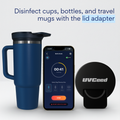
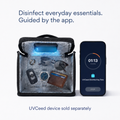
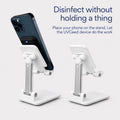
With UVCeed, you aim the device at one section, a cooler handle, a serving utensil, a folding table surface, and hold it steady until the app confirms that section is complete, then move to the next section for anything larger than the coverage area. USB-C charging means it's an easy addition to a tailgate bag alongside the sanitizer and wipes you're probably already bringing.
FAQ
How long can bacteria survive on stadium seats? Research on comparable public seating materials found MRSA survived up to 7 days and E. coli O157:H7 up to 4 days on armrest and seat-back surfaces, suggesting hard public seating carries bacteria for extended periods between cleanings.
Is tailgate food actually risky? Yes, more than most people assume. Food left out at unsafe temperatures for more than two hours, or one hour in hot weather, is a real foodborne illness risk, independent of surface contamination.
Can UV-C be used on tailgate food itself? 254 nm UV-C inactivates bacteria on food surfaces, but FDA rules prevent citing a specific reduction percentage on food, so we don't make that claim. It's best used on prep surfaces, utensils, and cooler handles rather than the food directly.
Does wiping down a stadium seat actually help? Yes. Removing surface bioburden before you sit down for hours reduces the transfer opportunity, even without a lab-grade disinfectant.
What's the single biggest risk area at a tailgate? Shared serving utensils and coolers that go hand to hand for hours, combined with food sitting at unsafe temperatures, tend to be the bigger practical risk compared to the stadium seats themselves.
Want More Articles Like This?
Get research on UV-C treatment and product updates delivered to your inbox.