TL;DR
Publix's GreenWise organic frozen blueberries are under E. coli O145:H28 recall as of July 3, 2026 - supplied by a Chilean grower and distributed across eight southeastern states. If you thawed a bag last week and rinsed the berries in your sink, the recall does not stop at the trash can. It stops after you disinfect the sink strainer, the colander lid, the counter, and the phone you were holding while cooking.
What was recalled and why
- Product: Frozen GreenWise-brand organic blueberries, 10 oz packages, lot code 60401, best-by February 9, 2028 (FDA Outbreak Investigation of E. coli, July 2026).
- Supplier: Frutas y Hortalizas del Sur S.A., San Carlos, Chile (CDC E. coli Outbreak Investigation, July 2026).
- States affected: Alabama, Florida, Georgia, Kentucky, North Carolina, South Carolina, Tennessee, Virginia.
- Strain: E. coli O145:H28 - a Shiga-toxin-producing E. coli associated with hemolytic uremic syndrome in children.
Frozen berries transfer more than you'd think
People assume "frozen = safe." It doesn't. Freezing suspends bacteria; it does not kill them. When frozen fruit thaws in a colander, contaminated melt-water runs across your strainer, into your sink, onto your counter - and any surface it touches becomes a reservoir until you actively disinfect it (CDC E. coli Prevention).
Peer-reviewed work on Shiga-toxin E. coli persistence has shown viable cells on stainless steel and plastic prep surfaces for more than 24 hours at room temperature (NIH: STEC survival on food-contact surfaces).
The hidden surface: your phone
You checked a recipe while the berries were thawing. Your phone is now closer to the raw contamination than your cutting board is - and the CDC guidance on food-contact surfaces says nothing about the device sitting six inches from the sink (CDC Cleaning and Sanitizing Guidance).
What to disinfect after a berry recall event
- Toss the bag in a sealed second bag before it hits the trash.
- Bleach the sink and colander (one tablespoon bleach per gallon of water, 60-second dwell).
- Wipe the counter with a food-safe disinfectant.
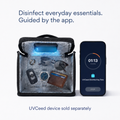
- Run a UVCeed session on your phone, the fridge handle, the freezer door, and the utensil pull-drawer - aim, hold steady until the app confirms that section is complete, then move to the next section for surfaces larger than the coverage area.
- Wash hands for 20 seconds with soap (CDC Handwashing).
Where UVCeed fits
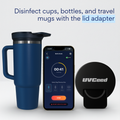
UVCeed uses 254nm UV-C, the germicidal wavelength validated by peer-reviewed research to inactivate E. coli, Salmonella, Listeria, and norovirus on hard surfaces (NIH: 254nm UV-C efficacy against enteric pathogens). It's the tool for the surfaces you can't put in the dishwasher - your phone, your fridge handle, the freezer door - because chemical wipes damage electronics and leave residue.
The app-guided session tells you exactly when a section is complete. USB-C charge. Tilt-safety shutoff. Pocketable.
FAQ
Can I still eat frozen berries? Only ones not covered by the recall, and cook them to 165°F to be safe during an active outbreak.
Does UV-C work on melt-water splatter? UV-C works everywhere and on the surfaces after you wipe up the visible moisture. Wipe first, then run a session on the dried surface.
How long is a session? About 30 - 60 seconds per section on a non-porous surface. The app tells you when each section is done.
The bottom line
The bag is out of your freezer. Now go get the surfaces that touched it.
Want More Articles Like This?
Get the latest research on UV-C disinfection, health protection, and product updates delivered to your inbox. Join thousands of readers who stay ahead of the curve.