With the 2026 FIFA World Cup kicking off across the US, public health experts are warning fans about a risk that has nothing to do with the action on the field: the unprecedented surge in respiratory viruses in crowded indoor spaces from coast to coast.
"We are seeing a perfect storm of conditions for viral transmission," said Dr. Amanda Carlson, an infectious disease specialist at the University of Washington Medical Center. "Large crowds, indoor fan zones with questionable ventilation, high-touch surfaces everywhere - it's a setup for people to come home with more than just memories."
The specific threat Carlson and other experts are raising the alarm about: surfaces. Doorknobs. Elevator buttons. Armrests. Tray tables on flights to match cities. The handrail on the bus to the stadium. All the everyday objects that travelers don't just touch - they touch immediately before touching their face.
"People dramatically underestimate how many of the surfaces they interact with are contaminated - and how long those pathogens can survive on a surface under the right conditions. A plastic tray table on a flight to LA can carry active influenza for 48 hours."
RSV. Rhinovirus. New COVID strains. Adenovirus. For most people, these are background concerns - right up until their family is the one getting sick.
"The challenge is you can't see any of this. You can't see a virus on an elevator button. And you definitely can't see which surfaces you missed when you tried to disinfect your phone in your hotel room," Carlson said. "People have no idea how much they aren't covering."
Why "Just Wiping It Down" Isn't the Safety Blanket You Think It Is
If your plan is to pack some disinfectant wipes in your clear stadium bag and "just be careful," the science has some troubling news: that careful wipe-down you're doing probably isn't covering nearly as much as you think.
Studies have consistently shown that even in hospitals, manual disinfection with wipes misses between 30% and 50% of a surface - especially on objects with irregular shapes, buttons, ports, or crevices.
"A wipe will clean what it touches, but most people just hit the obvious spots. The screen of their phone. The TV remote buttons. But the speaker grille, the charging port, the back of the case - those are exactly the spots where pathogens linger," Carlson said.
The reason hospitals use UV-C light boxes instead of relying on wipe-downs is because photons don't miss corners. They flood a surface from all angles, hitting every microscopic contour, and damaging viral RNA on contact.
The problem, until now, has been that you couldn't see your coverage. UV-C is invisible. Without a way to confirm you actually hit everything, you're still fundamentally working on faith.
UVCeed: The World's First UV-C Disinfection Device That Shows You What You're Disinfecting
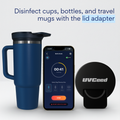
UVCeed is solving the "coverage confidence" problem in a way no other consumer device has before: it shows you exactly what you're disinfecting, in real-time, while you work.
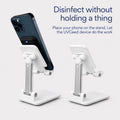
The device attaches magnetically to any iPhone 12 or newer via MagSafe. No pairing, no special case, no fiddling - just snap it on.
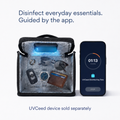
Open the app and you're looking at a live camera view of the surface you're disinfecting. As you pass UVCeed over an airplane tray table or the remote in your Miami hotel room, you can see precisely what the UV-C photons are hitting. The app builds a coverage map in real-time. You can see the nooks you missed on the first pass. You can see when you've gotten every square inch.
No other consumer UV device currently offers this. Until UVCeed, you were choosing between "guessing" and "hoping."
| Wipes | UV Wand | UV Box | UVCeed | |
|---|---|---|---|---|
| Kills 99.9% on surfaces | Yes | Yes | Yes | Yes |
| Works on irregular objects | Sometimes | Yes | No | Yes |
| Confirms coverage | No | No | No | Yes |
| Travel-friendly | Yes | Yes | No | Yes |
| As easy as point-and-shoot | No | No | No | Yes |
For World Cup fans packing their carry-ons, this is a game-changer.
"I'm flying to Dallas next week for the semi-finals and this is coming with me. Being able to actually confirm I got every surface in my airplane seat, in my hotel room, in my rental car - especially before I fly home to my wife and kids - that's huge. I trust a wipe to clean a surface but I trust being able to see it actually happen more."
- Robert H., New York native traveling to Dallas for 2026 World Cup semi-finals
Protecting Your Family From the Germs You Can't See
As millions of fans prepare to crisscross the country following their teams, public health experts are urging them to think about the microscopic "souvenirs" they might be bringing home with them.
RSV - the virus that causes more infant hospitalizations than any other - can live for up to 24 hours on a plastic surface. Rhinovirus, the predominant cause of the common cold, can survive on surfaces for days. The latest Omicron subvariants are proving more durable than ever on the objects we touch every day.
You can't see any of them. And until UVCeed, you also couldn't see what you were doing about them.
Packing your wipes is a start. Packing a UV wand isn't a bad idea. But packing the only device that lets you confirm your coverage?
That's a level of protection you literally can't see anywhere else.
Stop Guessing. Start Seeing.
The only UV disinfection device with a live camera view. See your coverage. Confirm you got every inch. Know you're protected.
Free 2-day shipping for World Cup ticket holders
Disclosure: This article is sponsored by UVCeed. Product efficacy claims are based on published research on UV-C germicidal irradiation at 254nm wavelength. UVCeed is not a medical device and is not intended to diagnose, treat, cure, or prevent any disease.
Want More Articles Like This?
Get research on UV-C treatment and product updates delivered to your inbox.