TL;DR: Repeat environmental studies, most recently a 2026 follow-up out of a U.S. university hospital system, confirm that warm-air and jet-air hand dryers pull restroom aerosol onto your freshly washed hands. Paper towels do not. If you cannot avoid the dryer, hit your phone and any item you touch next with a UV-C disinfection device.
You wash your hands. You walk to the dryer. You hold your wet palms under the nozzle. The dryer pulls in the air around it, including the plume that lifted off the toilet flush eight feet away, and dries your hands with it.
That is what the petri dish data has been showing for nearly a decade. The 2026 sampling reconfirmed it: jet-air dryers spread up to 60 times more bacterial colonies onto exposed surfaces than paper towel dispensers do, and warm-air dryers spread roughly 1,300 times more than paper towels.
Your hands come out drier. They are also dirtier than when they went in.
What's Actually in the Air
The bacterial mix recovered from dryer plumes consistently includes:
- Staphylococcus aureus (skin colonizer, sometimes MRSA)
- Escherichia coli (fecal indicator)
- Clostridioides difficile spores (in healthcare settings)
- Enveloped viral fragments after flu and norovirus season
The flush of a lidless commercial toilet sends a plume up to six feet vertical. The dryer intake pulls a slice of that plume back down onto whatever is under the nozzle.
Why You Cannot Just Skip The Dryer
Wet hands transfer up to a thousand times more bacteria than dry hands. So if the paper towel dispenser is empty, you are stuck choosing between transferring restroom bacteria off the dryer or transferring whatever you touch next off your own wet skin.
The realistic answer is: dry on the dryer if you must, then immediately disinfect the next surface you contaminate. For 99% of people, that surface is the phone they pull out of their pocket on the walk back to the table.
The 60-Second Restroom Recovery Session
Run this in your car, at your desk, or back at your seat:
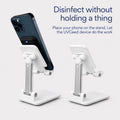
- UV-C session on your phone front and back, 30 seconds
- UV-C session on your watch face and band, 15 seconds
- UV-C session on your sunglasses, 15 seconds
That is the route the dryer aerosol takes from your hands to your face. Cut the route.
What About Skipping Restrooms?
You cannot. Airport, restaurant, gas station, office. The exposure is unavoidable. The fix is not avoidance, it is interception. UV-C at 254 nm cross-links the DNA of E. coli and the RNA of norovirus on the surfaces that left the restroom with you.
Why UVCeed's Handheld Fits This Use Case
- 254 nm germicidal output
- 60-second cycle covers a phone front and back
- USB-C rechargeable, lives in a bag or glove box
- Auto-shutoff tilt sensor
- No chemicals on the screen, no streaks
Frequently Asked Questions
Are jet dryers worse than warm dryers?
The 2026 work shows jet dryers spread more colonies further, but warm-air dryers spread a higher absolute count of certain skin and gut bacteria. Both are worse than paper towels.
Should I just air-dry?
Air-drying leaves enough residual moisture that hand contact transfer stays high. Dry fully, then disinfect what you touch next.
Does UV-C work on a phone case?
Yes, on hard plastic and silicone cases. Run a slower pass over textured grip areas.
What about the door handle on the way out?
Use a paper towel on the handle if available, then UV-C your phone once you are clear.
The Bottom Line
Hand dryers are not going away. The 2026 data shows they are still a measurable bacterial spreader. Buy a UVCeed.com disinfection device and run a 60-second session on your phone after every public restroom stop. That single habit closes the loop the dryer just opened.
Want More Articles Like This?
Get research on UV-C treatment and product updates delivered to your inbox.