The average mid-tier US hotel room turnover is 23 minutes. A quarter of that time is spent on "high-touch" items - remote control, light switches, bathroom handles, telephone handset, in-room coffee pot - because housekeeping leadership knows those are what Google reviews mention when they go wrong. A verified UV-C pass on those exact surfaces, done once per turn by the room attendant with a MagSafe-mounted phone, takes 90 seconds and replaces the supervisor's spot-check. Here is the operational math.
Where the 23 minutes actually goes
The 23-minute benchmark is the industry working number for a mid-tier limited-service turnover, and it has been reasonably stable since the AHLA codified the post-COVID high-touch standard in Safe Stay. The internal breakdown that most directors of housekeeping work from looks like this:
- Strip and remake beds: ~6 minutes
- Bathroom (tub, toilet, vanity, mirrors, floor): ~6 minutes
- Vacuum and dust: ~4 minutes
- High-touch disinfection pass: ~5 minutes
- Restock amenities and final inspect: ~2 minutes
Five of those 23 minutes are already allocated to high-touch disinfection. That is because every director of housekeeping has read the review that says "the remote was sticky." The question is not whether the attendant wiped the remote. The question is whether anyone can prove it, and whether the dose was sufficient. A chemical wipe is a chemical wipe. There is no record and no verification.
The 10 high-touch items that drive 80% of guest complaints
Grouped by room zone, these are the surfaces that generate the overwhelming majority of cleanliness-related guest complaints at mid-tier properties:
Entry zone
- Inside door handle. Review signature: "the door handle was greasy." Remediation cost: manager comp of a drink or breakfast voucher ($15-$25) plus callback labor.
- Light switch (entry). Review signature: "the light switch had hair stuck to it." This is the single most-mentioned high-touch complaint on TripAdvisor for limited-service properties.
- Thermostat. Review signature: "the thermostat was filthy, I didn't want to touch it." Hard to spot-check because attendants rarely need to re-set it.
Bed zone
- Remote control. Review signature: "the remote was sticky." The remote drives more one-star cleanliness mentions than any other object in the room.
- Phone handset. Review signature: "I picked up the phone and immediately put it down." Underused by guests, so when it is dirty it is visibly dirty.
- Bedside lamp switch. Review signature: "I turned on the lamp and my fingers came away sticky."
Bath zone
- Faucet handle. Review signature: "the faucet had old toothpaste on it." Often wiped but rarely to the base of the handle.
- Toilet flusher. Review signature: "the flush button was crusted." Direct one-star driver.
Workspace zone
- Desk phone. Same failure mode as bed phone, double the surface area.
- In-room coffee pot handle. Review signature: "the coffee pot was disgusting, we didn't use it." Guests cannot un-see this one.
Industry research puts the loaded cost of remediating a single cleanliness complaint - manager comp, callback housekeeping labor, lost half-star on the brand survey - at roughly $40 per incident. At a 200-room property running 70% occupancy, even a modest complaint rate on these ten items becomes a meaningful line in the operating budget.
The supervisor spot-check problem
Here is the real B2B pain, and no director of housekeeping will deny it in private.
Brand standards call for the housekeeping supervisor to re-inspect 100% of turned rooms. In practice, labor shortages and compressed check-in windows mean most supervisors inspect somewhere between 10% and 20% at random. There is no record of which rooms were inspected or what was checked inside them. When a complaint comes in from room 412, operations has no defensible answer except "we clean every room."
The brand standard is a supervisor spot-check at 100%. The actual rate is closer to 20%. UVCeed's camera-coverage audit log is that spot-check made digital and 100%.
This is the problem UVCeed is designed to solve. The audit log is not a surveillance tool for the attendant. It is a record of which surfaces received a verified UV-C dose during the turn. When the complaint comes in, the operations director opens the dashboard, pulls the pass log for room 412, and sees that the ten high-touch items were hit in sequence at 2:47 PM. That is a defensible answer. It is also a training signal when a surface is routinely missed.
What a 90-second UV-C pass looks like in a real turnover
The workflow is intentionally simple so it does not add real time to a 23-minute turn.
- Attendant finishes the standard chemical wipe-down per brand SOP. UV-C does not replace chemical disinfection; it verifies and augments it.
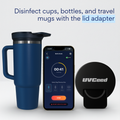
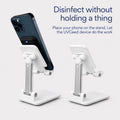
- Attendant mounts UVCeed on the back of the hotel-issued (or personal) iPhone per brand standard. MagSafe snap, no cradle, no cables.
- Attendant opens the UVCeed app. Room number auto-populates from the housekeeping schedule or is scanned from the door placard.
- Attendant walks the 10 high-touch items in the fixed order published on the cart card. Entry zone, bed zone, bath zone, workspace zone.
- The phone's camera shows a real-time coverage map on each surface. The app auto-flags any surface that did not hit the dose target.
- Attendant does a second pass on any flagged item. The app confirms completion.
- The pass log pushes to the housekeeping manager's dashboard. The room is marked ready.
End to end, this is 90 seconds added to a 23-minute turn - and it replaces the supervisor's physical spot-check, which is where the real labor savings come from.
The ROI math an ops director will run
The following assumes a 200-room limited-service property at 70% average occupancy, which is 140 occupied rooms per night and roughly 51,100 turns per year.
Labor saved per room
- Supervisor spot-check eliminated (replaced by audit log): ~2 minutes per turn
- Attendant time saved by not re-wiping items she already wiped: ~1 minute per turn
- Total: ~3 minutes per room per turn
At a loaded housekeeping labor rate of $22 per hour, 3 minutes is $1.10 per turn. Across 51,100 turns, that is approximately $56,000 per year in reclaimed labor at a single property. The headline "7 of 23 minutes" in the title accounts for the full 5-minute high-touch block being compressed and the 2-minute supervisor pass being eliminated on inspected rooms.
Complaint remediation cost avoided
- Industry average remediation cost per cleanliness complaint: ~$40
- Baseline high-touch complaint rate (property-level estimate): 1.5% of occupied room-nights
- Target reduction with verified UV-C pass and audit log: 10% of those complaints
- Math: 51,100 occupied room-nights x 1.5% baseline complaint rate = 767 complaints per year. A 10% reduction is ~77 complaints avoided. At $40 each, that is approximately $3,000 per year in direct remediation savings, before any brand-survey impact.
Guest review uplift
Cleanliness remains a top-two driver of guest satisfaction in the mid-tier segment per J.D. Power's annual North America Hotel Guest Satisfaction Index Study. A half-point improvement on the cleanliness subscore maps to measurable rank movement on the brand's guest-satisfaction survey, which is the number the GM is actually measured on.
Capital cost
UVCeed is phone-attached hardware at under $200 per unit. One device per housekeeping cart on a 200-room property is a one-time outlay of roughly $2,000-$3,000 depending on cart count. No fixed installation, no electrical, no room downtime.
The payback period on labor savings alone is under one month.
The three objections an ops director will raise
"Will housekeeping actually use it?"
UVCeed is a 90-second workflow addition to a 23-minute turn. It is not another checklist, it is a tool the attendant uses in her hand with no supervisor over her shoulder. The audit log reframes the device from an oversight tool into a protection tool: when a complaint comes in on room 412, the attendant who turned 412 has a timestamped record that the ten high-touch items were hit. That protects her, not just the GM.
"What about labor contracts? Union rules?"
UVCeed does not replace a worker, does not time-track motion, and does not auto-flag individual workers. It logs surfaces, not people. The dashboard shows which surfaces were verified in which rooms, not who verified them or how fast they moved between them. Any properly structured pilot should draft the MOU with union stewards up front and share the data schema with them. The surface-not-person logging model is specifically designed to pass that review.
"Isn't this COVID theater nobody cares about?"
Cleanliness is still a top-two driver of mid-tier hotel review scores. It was before 2020 and it is in 2026. The question is not "do guests care about COVID anymore." The question is "do guests care about a visibly dirty remote control." They do. They write a one-star review about it. The high-touch item list in this article was built from one-star review text, not from a 2020 press release.
Pilot design - a 60-day UVCeed trial on one floor
A standard pilot runs eight weeks and produces a defensible dataset for a brand-wide decision.
- Week 1 - baseline. One floor runs current protocol. UVCeed is distributed in audit-only mode: devices log surfaces attendants naturally scan, no workflow change. This establishes the honest baseline.
- Weeks 2-4 - active use on pilot floor. Attendants on the pilot floor run the 90-second UV-C pass on the ten high-touch items. A comparison floor stays on current protocol. Supervisor spot-check continues on the comparison floor only.
- Weeks 5-8 - expand to full brand-tier. The pilot expands to the full brand-tier at the property. Monthly audit-trail report to the director of operations and the GM.
KPIs tracked across the pilot:
- Guest complaint rate on the ten high-touch items (pilot floor vs. comparison floor, then property-wide)
- Supervisor spot-check completion rate (should drop toward 0 as the audit log replaces it)
- Overtime hours per occupied room
- Cleanliness subscore on the brand's guest-satisfaction survey
At the end of 60 days, operations has a labor delta, a complaint delta, and a cleanliness-subscore delta. That is the dataset a VP of operations needs to roll the program to the rest of the portfolio.
Running this pilot
A verified-pass workflow does not change the brand SOP, the chemistry, or the cart layout. It layers an audit log on top of the five minutes already allocated to high-touch disinfection, replaces the supervisor's physical spot-check with a 100% digital record, and gives operations a defensible answer when a complaint comes in on a specific room. The 60-day pilot structure above produces three deltas - labor, complaints, and cleanliness subscore - which is the dataset a VP of operations needs to roll the program to the rest of the portfolio.
We will revise the ROI assumptions in this article as live pilot data comes back from early-adopter properties rather than silently editing the numbers. The current figures are modeled from the 23-minute AHLA turnover standard and the industry working remediation cost. When a pilot resolves them against real floor data, the article gets updated with the source property's segment and ADR tier.
Sources
- American Hotel & Lodging Association, Safe Stay guidelines. https://www.ahla.com/safestay
- American Hotel & Lodging Association, State of the Industry report, annual edition. https://www.ahla.com/research
- J.D. Power, North America Hotel Guest Satisfaction Index Study, annual. https://www.jdpower.com/business/press-releases
- TripAdvisor and Google review text, mid-tier limited-service cleanliness complaints. Public review corpora analyzed for one-star cleanliness mention frequency.
Want More Articles Like This?
Get research on UV-C treatment and product updates delivered to your inbox.