Parenting - Home & Health - Tips for Families
If you have a toddler in daycare, you already know the drill. They bring something home, you catch it, your partner catches it, and three weeks later the whole thing starts over with a different virus. By March you are convinced your child is personally responsible for incubating every respiratory pathogen in a 10-mile radius.
You are not imagining it. The average child in group childcare gets between 8 and 12 respiratory infections per year. The average parent of that child catches somewhere between 3 and 6 of them. And here is the part that the standard advice - "wash hands frequently, keep sick kids home" - never quite addresses: a significant portion of those transmissions are not happening through the air or through direct contact with a sick child. They are happening through surfaces. Objects. The things your baby touches, mouths, drops, picks back up, and hands to you.
The good news is that this is actually the part you have the most control over. And the approach that works best for families with young children is not more chemical wipes near your crawling baby. It is something a lot simpler, a lot safer, and genuinely more effective.
Here is what is actually going on in your home, and the routine that changes it.
Why Your Baby Keeps Getting Sick (It Is Not What You Think)
Most parents focus on the most visible transmission events - the coughing child at the playdate, the runny nose at music class. Those exposures are real. But the route that drives the most household transmission is quieter and more constant: your baby's hands, and everything those hands touch.
Babies and toddlers touch their faces an average of 80 times per hour. They mouth objects constantly as a primary way of exploring the world - this is normal developmental behavior, not a hygiene failure on your part. And the objects they mouth the most - pacifiers, teethers, stacking toys, board books, TV remotes - are the objects that get the least rigorous cleaning in most households.
Meanwhile, the viruses that hit young children hardest - RSV, rhinovirus, human metapneumovirus, influenza - are all capable of surviving on hard, non-porous surfaces for hours to days. RSV, the most common cause of infant hospitalization in the United States, can survive on a plastic toy for up to 24 hours. Your phone, which you handle constantly and then use near your baby's face, can carry viable respiratory viruses for the same duration.
The transmission chain looks like this: a child at daycare is in the early contagious phase of a viral infection before symptoms appear. They touch a shared toy. Your child touches the same toy. Your child's hands go to their face. Your child touches your phone while sitting in your lap. You touch your face. The cycle runs itself.
Interrupting that chain at the surface level - the objects in your home, your car, your diaper bag - is where you have the most leverage. And doing it safely around a young child means doing it without the chemical residues, skin irritants, and toxic splashes that come with liquid disinfectants.
The Numbers Every Parent Should See Once
| Fact | Detail |
|---|---|
| 8-12 | Respiratory infections per year for the average child in group childcare (CDC) |
| 80 times per hour | How often babies and toddlers touch their faces on average |
| Up to 24 hours | How long RSV survives on plastic toys and hard surfaces |
| 4-10 minutes | Required wet contact time for disinfectant wipes to actually kill viruses at their advertised rate - most surfaces dry in seconds |
| 2,600+ | Times the average smartphone is touched in a single day |
| 30 seconds | How long UV-C disinfection takes to eliminate 99.9% of viruses on a surface |
That second-to-last row is worth sitting with. The disinfecting wipes you are using require the surface to stay visibly wet for 4 to 10 full minutes to deliver their labeled kill rate. Watch a wipe dry on a countertop and time it. It is rarely more than 30 seconds. This is not a criticism of any particular brand - it is a physical chemistry constraint that applies to every liquid disinfectant. The contact time requirement is printed on the label because it is real, and almost nobody meets it in daily practice.
8 Objects in Your Home That Need Daily Disinfection - And the Easiest Way to Do It
1. Pacifiers and Teethers
These go in your baby's mouth dozens of times a day and land on every surface in your home in between. Chemical disinfectants are not appropriate for objects your baby mouths - even products labeled as baby-safe leave residues on surfaces, and the contact time required to actually kill viruses means the pacifier would need to be soaking in solution, not just quickly wiped.
UV-C disinfection is the right tool for pacifiers and teethers specifically because it is chemical-free and leaves zero residue. A 30-second UV-C treatment eliminates pathogens without any substance that needs to be rinsed off before the object goes back in your baby's mouth. This is not a minor convenience - it is the only disinfection method that is both effective and genuinely appropriate for objects with direct mucosal contact.
2. Your Phone
You already know your phone is covered in bacteria. What most parents do not fully absorb is that your phone is also the object most likely to bridge the gap between the outside world and your baby's immediate environment. You carry it everywhere, handle it constantly, and then sit with your baby in your lap while holding it near their face during video calls with grandparents.
A daily UV-C pass of your phone before the end-of-day home routine - takes 30 seconds, does not damage the screen coating the way chemical sprays do over time - is the single highest-leverage surface disinfection habit in a household with a young child.
3. Stacking Toys, Soft Blocks, and Plastic Play Objects
These are the objects in your home with the highest direct mouth contact and the lowest disinfection frequency. Plastic and non-porous surfaces are exactly where respiratory viruses survive longest. A UV-C sweep of the toy basket at the end of the day before baby goes to sleep takes about two minutes and covers everything at once.
4. The TV Remote
Every adult in the household touches the remote while also touching their face, handling food, and managing a baby whose hands are everywhere. The remote almost never gets cleaned. Its irregular surface, button gaps, and crevices make liquid disinfectants nearly impossible to apply with correct coverage and contact time. UV-C light covers irregular surfaces completely - there is no gap between buttons it cannot reach.
5. Car Seat Buckles and Stroller Handles
These are the transition objects - the things that go between your outside world and your home most directly. Stroller handles and car seat buckles are touched at every pickup and dropoff, in every parking lot, at every park. They are almost never disinfected. A UV-C pass of both before your baby goes in the car or stroller is a 60-second habit.
6. Doorknobs and Light Switches at Baby's Level
Once babies are pulling up and cruising along furniture, every doorknob and light switch within reach becomes a lick-and-grab target. A nightly wipe of these high-contact surfaces with a UV-C device - no spray, no residue, no wet surface for a curious mouth to find - is the most practical version of this habit for households with crawlers.
7. Changing Table Surface and Diaper Bag
The changing table surface has a very high pathogen load by design, and the diaper bag moves between your home, daycare, the car, the doctor's office, and the floor of every venue you visit with a baby. A UV-C sweep of the changing table surface before each use and of the diaper bag exterior at end of day closes two of the more underappreciated transmission loops in a young family's daily routine.
8. High Chair Tray and Feeding Surfaces
Babies wipe their hands on their high chair tray, drop food, put it back in their mouth, and hand contaminated objects to parents throughout every feeding. The tray is usually wiped down with a damp cloth, which spreads rather than eliminates pathogens. A UV-C pre-treatment of the tray before each meal - before the food goes on it - is a direct, zero-residue disinfection step that liquid wipes cannot replicate safely on a surface food will contact immediately.
The Chemical-Free Problem That Every Parent Eventually Runs Into
When your baby is newborn, you quickly figure out that the standard disinfection toolkit - bleach wipes, isopropyl spray, antibacterial surface cleaners - was not designed with a person who mouths everything in mind. The active ingredients that make these products effective are the same ones that cause skin irritation on contact, that you do not want on a pacifier, that you are not supposed to breathe in an enclosed space, and that build up on surfaces your baby touches and crawls on.
This creates an impossible-feeling trade-off. You want clean surfaces. You also do not want your baby exposed to the chemicals you are using to clean those surfaces. Most parents resolve this by cleaning less thoroughly near baby spaces, which is a rational response but not a satisfying one.
UV-C disinfection resolves this trade-off completely. There is no chemical. Nothing is deposited on the surface. There is no residue to rinse, no off-gassing to ventilate, no contact time that requires keeping a baby away from a surface. The UV-C light treats the surface and leaves it exactly as it was - physically unchanged, pathogen load reduced by 99.9%.
This is why UV-C has been used in neonatal intensive care units for surface disinfection. The chemical-free requirement in environments with fragile newborns is not optional, and UV-C is the technology that meets it.
What We Actually Recommend for Young Families
UVCeed is the device we recommend for families with young children, and the reasons start with the chemical-free piece above and get more practical from there.
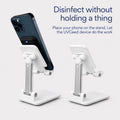
It was developed by Dr. Peter Bonutti and is currently in use at Sarah Bush Lincoln Healthcare for professional surface disinfection - the same 265nm UV-C wavelength used in hospital infection control, in a compact, rechargeable device that works with your iPhone via MagSafe. The companion app guides you through each disinfection session in real time using your phone's camera, showing you exactly what surfaces have been covered and flagging anything you missed. A built-in safety sensor automatically shuts the UV-C off the moment it detects a person or pet in the field - so there is no risk of accidental exposure, no need to clear the room, no complicated safety protocol to manage while also managing a toddler.
The practical daily routine for a family with a baby or toddler takes about five minutes at end of day:
- 30 seconds on your phone
- 60 seconds sweeping the toy basket
- 30 seconds on the TV remote and any other high-contact electronics
- 60 seconds on the changing table surface and diaper bag exterior
- 60 seconds on doorknobs, light switches and cabinet handles at baby's level
- 30 seconds on tomorrow's pacifiers and teethers
That is the entire routine. It requires no chemical products, generates no waste, leaves no residue on anything, and reduces the pathogen load on the objects most directly linked to viral transmission in your household by 99.9%.
What parents love most about UVCeed:
- Zero chemicals - safe for objects that go directly in baby's mouth
- App-guided - you can actually see that you covered the whole surface
- Safety shutoff - no risk around curious toddlers
- 30 seconds per object - fits into a real evening routine
- One rechargeable device replaces ongoing wipe and spray purchases
- Compact - fits in the diaper bag for on-the-go disinfection at grandparents' houses, travel, hotel rooms
What Real Parents Are Saying
5/5 - "Our daughter started daycare at 4 months and the first winter was brutal - she was sick constantly and we caught everything she brought home. We started the UVCeed routine when she was about 8 months and the difference in the second winter was dramatic. We stopped treating it like a magic solution and started thinking of it as just part of our evening routine, like washing bottles. It works."
- Megan T., Austin, TX
5/5 - "I was genuinely nervous about using any disinfectant around my son because he puts everything in his mouth. UVCeed is the first thing I have found that I feel completely comfortable using on his toys, his pacifiers, his teethers. No residue, no chemicals, no rinsing. I use it every night before I go to bed and it takes about four minutes."
- James R., Denver, CO
5/5 - "The app is the thing nobody talks about enough. You can actually see what you have treated and what you missed. I didn't realize how inconsistent I was being with my phone until the app showed me I was covering about 60% of the surface. Now I get it right every time."
- Priya K., San Jose, CA
5/5 - "I'm a pediatric nurse and a mom of two under three. I was skeptical because I've seen a lot of consumer health products that don't hold up scientifically. UVCeed is legitimate - correct wavelength, correct dosing, proper safety controls. I recommend it to parents at work and I use it at home."
- Lauren S., Nashville, TN
Building the Habit: A Simple Weekly Rhythm
The families who get the most out of UVCeed are not the ones who use it during sick season or when they remember. They are the ones who built a consistent routine early. Here is the simplest way to structure it:
Every evening (5 minutes): Phones, remote, toy basket sweep, pacifiers and teethers for the next day, changing table surface, diaper bag exterior.
Every morning before leaving (2 minutes): Car seat buckles and stroller handles. Takes 90 seconds and closes the biggest outside-world transmission loop before your day starts.
After any high-exposure outing (2 minutes): Doctor's office, urgent care, hospital visit, airplane travel. Treat your phone, your keys, and the diaper bag exterior before anything comes into the house.
Weekly (5 minutes): Full sweep of the toy collection, high chair tray, and any new items brought into the house - gifts, borrowed items, things picked up at consignment sales.
That is it. Eleven minutes a day on a typical day, spread across two short sessions. Most parents find they stop thinking of it as a task within a few weeks and it becomes as automatic as locking the front door.
Start Your Family's Routine Today - Use Code SAFECLEAN for 10% Off
The endless sick cycle is genuinely one of the most exhausting parts of the early parenting years. It is not entirely preventable - immune system development requires exposure, and some of those infections are doing useful work. But the portion of that cycle driven by surface transmission in your own home is something you have real control over, and the tool that addresses it safely around young children is now small enough to fit in a diaper bag.
Get UVCeed at UVCeed.com - Free Shipping
Use code SAFECLEAN at checkout for 10% off. Free shipping. Satisfaction guaranteed.
Questions Parents Ask Us Most
Is UV-C light safe to use around babies and toddlers? UV-C light should never make direct contact with skin or eyes, which is why UVCeed's patented AI safety sensor automatically shuts the device off the moment it detects a person or pet in its field. The device is designed for surface treatment of objects - you treat the toy, put the device down, and hand the toy to your child. It is not operated near a child who is present. The safety shutoff is the same logic used in clinical UV disinfection systems and is one of the key features that distinguishes UVCeed from lower-quality consumer UV devices that have no person-detection capability. The bottom line: when used as directed, the device is appropriate for households with babies and toddlers, and the zero-chemical output makes it safer for baby-contact surfaces than any liquid disinfectant.
Can I use it on pacifiers and teethers that go directly in my baby's mouth? Yes, and this is one of the primary use cases UVCeed was designed to address. Because UV-C disinfection leaves zero chemical residue on the surface, it is appropriate for objects that will make immediate contact with mucous membranes. You cannot say the same of any liquid disinfectant, including products labeled as baby-safe. A 30-second UV-C treatment followed by no rinsing is safer for a pacifier going into your baby's mouth than any wipe-and-use protocol with a chemical product.
How is this different from the cheap UV wands sold online? The differences are significant. Most inexpensive UV wands emit UV-A or UV-B wavelengths with little or no germicidal efficacy, or emit UV-C at insufficient dosage levels with no guidance on how fast to move the device, how far to hold it from the surface, or whether you achieved effective coverage. Germicidal UV-C requires the correct wavelength (265nm), the correct dosage, and the correct exposure time at the correct distance. UVCeed provides: the correct 265nm medical-grade wavelength; app-guided real-time visual confirmation that you have covered the surface properly; a dosing model that accounts for distance and movement speed; and the AI safety sensor that cheaper devices do not have. It is also the only consumer UV-C device currently deployed in an active healthcare facility (Sarah Bush Lincoln Healthcare), which is the clearest available validation of its professional-grade performance.
How long does the battery last and how do I charge it? UVCeed is rechargeable via standard charging and is designed for daily household use. Battery life supports multiple full sessions between charges under normal use patterns. The compact form factor means it fits in a diaper bag or kitchen drawer without taking up meaningful space.
Will it actually reduce how often my family gets sick? No device eliminates all illness, and any claim to the contrary would be misleading. What UVCeed addresses is one specific and meaningful contributor to household viral transmission: contaminated surfaces and objects. For families with children in group childcare - where exposure to circulating viruses is continuous - reducing the surface transmission loop within the home does not prevent all exposure but does reduce the frequency and dose of exposures that originate from your own household surfaces. The parents who see the most meaningful difference are typically those who are consistent with the daily routine across the full cold and flu season rather than using the device reactively when someone is already sick.
What happens when a new family member gets sick - can I use it to contain the spread within the household? Yes, and this is the reactive use case where many families first discover how much they value the device. When one household member is sick, a UV-C pass of every shared surface they have touched - doorknobs, remote, bathroom fixtures, phone, kitchen surfaces - within a few hours of confirmed illness significantly reduces the viable pathogen load on those surfaces before other household members contact them. Combined with the normal daily routine, this creates a meaningful barrier against household secondary transmission that handwashing and behavioral precautions alone do not reliably provide.
Sources: CDC childcare illness statistics; American Academy of Pediatrics guidance on infant oral exploration and developmental behavior; Hall et al., Journal of Infectious Diseases RSV fomite transmission study; CDC RSV surface survival data; NIH UV-C germicidal efficacy literature; UVCeed product specifications and laboratory testing documentation.
This article contains affiliate product information. UVCeed product claims are based on manufacturer laboratory testing and published UV-C efficacy literature. UV-C disinfection is a risk-reduction tool and complements rather than replaces handwashing, vaccination, and other recommended hygiene practices. Use code SAFECLEAN for 10% off at UVCeed.com.
Want More Articles Like This?
Get research on UV-C treatment and product updates delivered to your inbox.