TL;DR
On July 17, 2026, Taylor Farms initiated a recall of iceberg lettuce sourced from central Mexico and shipped to 27 states, including product delivered to Walmart, Jack in the Box, and multiple food service accounts (FDA - Investigations of Foodborne Illness Outbreaks; CDC HAN 00531). The lettuce is linked to a nationwide Cyclospora outbreak - 6,707 confirmed cases with roughly 11,500 more under review as of late July, making this one of the largest foodborne parasite outbreaks in U.S. history (CNN, July 21 2026). If a bag is already in your fridge, do not try to save it. And the household cleaner you were about to reach for probably will not help.
What actually happened
- CDC tracked confirmed Cyclospora cayetanensis infections across multiple states starting in May 2026.
- FDA traceback identified iceberg lettuce from a Taylor Farms Mexico growing region as the common source.
- Taylor Farms initiated the recall on July 17. Product went to grocery retailers and food service in 27 states.
- Fresh cut salad blends and wraps that used the recalled lettuce were also recalled downstream.
Cyclospora is a single-celled parasite. Symptoms include watery diarrhea, cramping, fatigue, and weight loss, and often last weeks to months without treatment (CDC - Cyclosporiasis Signs and Symptoms). Kids and immunocompromised family members can have a rougher time with it than healthy adults.
Why washing your lettuce will not fix this
This is the part that catches most families off guard.
- The FDA explicitly states that chlorine and other common antimicrobial chemical treatments are not effective against Cyclospora cayetanensis because the parasite has a thick-walled oocyst that resists them (FDA - Cyclosporiasis and Fresh Produce).
- Iodine does not work either. CDC guidance groups both chlorine and iodine as insufficient (CDC - Cyclospora Prevention).
- No EPA-registered disinfectant currently lists Cyclospora on its approved label.
- Vegetable washes, produce-safe sprays, and even a solid soak in vinegar are not documented kill steps for this parasite.
- The only reliable in-home kill step in FDA guidance is heat: 158 °F (70 °C) (FDA Retail Food Safety Guidance).
Which is a problem, because iceberg lettuce is not something you cook.
What to actually do in your kitchen right now
- Check every bag, clamshell, and pre-made salad in your fridge. If it contains iceberg from Taylor Farms, or was purchased at Walmart or Jack in the Box during the recall window, discard it in a sealed bag directly to outdoor trash. Do not "just wash it."
- Wash the shelf and drawer it was sitting on. Cyclospora oocysts can transfer to the surrounding refrigerator surface via the bag or leaked liquid. Soap and warm water first.
- Run a UV-C session on the shelf, drawer, and gasket where the bag was resting. Aim, hold steady until the app confirms the section is complete, move to the next section for the full shelf. This is the surface disinfection step the parasite is actually vulnerable to.
- Session the produce drawer handle, the refrigerator door handle, and the faucet handle. These are the touchpoints that carried oocysts from the recalled bag to the rest of your kitchen when you first put it away.
- Session the cutting board and knife you used if you already prepped any of the recalled product. Then wash them thoroughly.
- If anyone in your household is symptomatic - watery diarrhea lasting more than 3 days, especially with fatigue and weight loss - call your pediatrician or primary care. Cyclospora is treatable with trimethoprim-sulfamethoxazole (CDC - Cyclosporiasis Treatment).
A note on other produce
The recall is iceberg specifically. But Cyclospora has been linked in previous years to cilantro, raspberries, blackberries, basil, and pre-made salad mixes (CDC - Cyclosporiasis Past Outbreaks). Same principle applies to any of these: rinse thoroughly, know that rinsing is not a kill step, cook where possible, and give the prep zone a UV-C session.
Where UVCeed fits
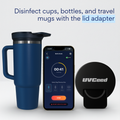
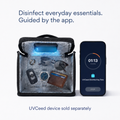
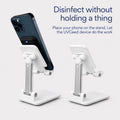
UVCeed is a 254 nm UV-C device with an app that guides you through sessions: aim at one section of the surface (a cutting board, a refrigerator shelf, a faucet handle), hold steady while the app confirms the section is complete, then move to the next section for surfaces larger than the coverage area.
For a family kitchen dealing with a Cyclospora recall, that session-based approach is what matters. You are not sweeping quickly. You are giving each section the dwell time the peer-reviewed Cryptosporidium-class dose data suggests is needed for these resistant oocysts (Bukhari et al., 1999; EPA UV Disinfection Guidance).
UVCeed is USB-C, has a tilt-based safety shutoff (helpful when kids are underfoot in the kitchen), and stores in a drawer.
FAQ
Can I use UVCeed on the lettuce itself? 254 nm UV-C inactivates bacteria and protozoa on food surfaces including leafy greens. FDA rules prevent us from citing a specific reduction percentage on food, so we do not. And critically, if your lettuce is under an active recall, discard it - do not attempt to treat it and eat it. UV-C is a supplement for produce you are confident about, not a rescue for recalled product.
What if my kid already ate a salad from the recalled bag? Watch for symptoms over the next 1-14 days - the Cyclospora incubation period (CDC - Cyclosporiasis Signs and Symptoms). Watery diarrhea lasting more than 3 days warrants a pediatrician call. The infection is treatable.
Do bleach wipes work on the fridge shelf? Bleach at proper concentration is effective on hard surfaces for many pathogens, but for Cyclospora specifically the parasite is chlorine-resistant. Soap and water plus a UV-C session is the more reliable combination for this pathogen.
How long does Cyclospora survive in my fridge? The oocyst is durable and can persist in cool moist environments for weeks (CDC - Cyclospora General Information). Which is why the shelf gets a session, not just a wipe.
Is this the first time Taylor Farms has had a Cyclospora recall? No. Cyclospora outbreaks linked to bagged salad and fresh cut produce have been a recurring seasonal event since the 1990s, with major recalls in 2013, 2018, and 2020 (CDC - Cyclosporiasis Past Outbreaks).
The bottom line
Your family's produce drawer got hit by a recall you cannot wash away. Chlorine does not work. Iodine does not work. Vegetable wash does not work. The only reliable in-home options for Cyclospora are heat, disposal, and UV-C on the surfaces.
If it is in your fridge, throw it out. Then session the shelf.
Want More Articles Like This?
Get research on UV-C treatment and product updates delivered to your inbox.