TL;DR
- Every Medicare/Medicaid-certified long-term care facility must run a formal Infection Prevention and Control Program under 42 CFR 483.80, and failing a survey on this tag can trigger civil money penalties, denial of payment, or termination from Medicare/Medicaid (CMS).
- Over half of all norovirus outbreaks reported in the United States happen in long-term care facilities, and illness in this population is "more severe, and occasionally even deadly," per the CDC.
- Real cases show what happens when infection control fails: an Iowa nursing home operator faced 17 wrongful death and negligence claims in 16 months, several tied to untreated infections that progressed to sepsis (Iowa Capital Dispatch).
- Portable UV-C is not a replacement for EPA-registered disinfectants or hand hygiene, but it is a fast, documented way to hit high-touch surfaces and shared equipment between mandated cleanings.
The regulatory reality nobody in senior living gets to ignore
If you run infection prevention at an assisted living community or skilled nursing facility, you already know the stakes are not theoretical. Every facility certified for Medicare or Medicaid participation must maintain an Infection Prevention and Control Program (IPCP) under 42 CFR 483.80, which requires a system for preventing, identifying, reporting, investigating, and controlling infections for every resident, staff member, volunteer, and contracted service provider in the building. The rule also requires facilities to designate at least one qualified infection preventionist who reports directly to the quality assessment and assurance committee.
That single tag carries real financial teeth. CMS enforcement remedies for deficiencies include civil money penalties, denial of payment for new admissions, and, in the worst cases, termination of the provider agreement entirely (CMS Nursing Home Enforcement). CMS has also proposed dramatically expanding its authority to impose per-day and per-instance civil monetary penalties during nursing home surveys, with per-day penalties potentially reaching $25,847 and combined per-instance exposure running into the millions for the most serious violations (Maynard Nexsen). Whatever the final number lands on, the direction is clear: infection control deficiencies are getting more expensive, not less.
And in December 2025, a multisociety panel representing SHEA, IDSA, APIC, PALTmed, and the American Geriatrics Society published updated guidance for infection prevention in nursing homes, explicitly calling for dedicated infection preventionist time and adequate staffing and supplies as baseline requirements, not aspirational extras (SHEA; PMC). Surveyors increasingly measure facilities against this kind of professional consensus, not just the regulatory floor.
Why the outbreak math is worse in your building than almost anywhere else
Congregate living for older adults is close to a worst-case setup for infectious disease spread: shared dining rooms, shared activity spaces, staff who move between multiple residents' rooms each shift, and a resident population with higher rates of chronic illness and weaker immune response.
The data backs this up. Nursing homes report COVID-19, influenza, and RSV case and hospitalization data weekly to the CDC's National Healthcare Safety Network, covering roughly 15,000 facilities nationwide (CDC NHSN). During the week ending December 27, 2025, the resident hospitalization rate for a positive influenza test was 31.3 per 100,000 and had been trending upward across most HHS regions, a pattern the CDC tracks specifically because this population decompensates faster than the general public (CDC FluView).
Norovirus is arguably the bigger operational headache. The CDC states plainly that over half of all norovirus outbreaks reported in the United States occur in long-term care facilities, that illness "can be more severe, and occasionally even deadly" in these settings, and that outbreaks introduced by a single infected staff member, visitor, or food item can persist for months once they take hold (CDC). A norovirus outbreak does not just cost you in resident health. It triggers mandatory outbreak reporting to your state health department, cohorting and isolation protocols that eat staff hours, and, if it is bad enough, a state survey visit that was not on your calendar.
The human and legal cost of getting this wrong is not abstract. In Iowa, nursing home operator Care Initiatives, which runs 43 nursing homes along with several assisted living and hospice locations, faced at least 17 wrongful death and negligence lawsuits over a 16-month span, with multiple cases alleging staff failed to treat infections such as urinary tract infections and wounds before they progressed to sepsis and septic shock (Iowa Capital Dispatch). Whatever the eventual legal outcomes, that volume of litigation is the kind of thing that shows up in occupancy numbers and insurance premiums long before any court rules.
Compounding all of this, infection preventionists are stretched thin. A 2025 survey-based analysis found they spend roughly a quarter of their time on surveillance alone, on top of training, education, and outbreak response (SHEA guidance). Industry reporting on 2025 infection prevention challenges found many facilities are reassigning IC duties to already-overloaded nurses or administrators due to staffing shortages, creating exactly the kind of oversight gaps surveyors are trained to find (ICCS).
A practical checklist for administrators and infection preventionists
You do not need a bigger budget to close most of the gaps surveyors find. You need a system.
- Confirm your IPCP is documented, not just practiced. CMS surveyors want to see a written program tied to your facility assessment, not verbal routines. Review your policy against the current text of 42 CFR 483.80 at least annually.
- Verify your infection preventionist actually has protected time. The December 2025 multisociety guidance recommends dedicated hours for IPC duties, not a title bolted onto someone's existing job (SHEA).
- Audit your disinfectant product list against EPA registration. CMS guidance expects facilities to use EPA-registered antimicrobial products effective against the pathogens of concern, applied for the manufacturer's stated contact time (EPA Selected Disinfectants; CMS QSO-20-03-NH).
- Build a norovirus and respiratory illness outbreak plan before you need it, including cohorting protocols, staff exclusion criteria, and your state reporting threshold. Waiting until week one of an outbreak to write this plan costs you days you do not have.
- Track shared equipment as an infection control asset, not an afterthought. Wheelchairs, walkers, blood pressure cuffs, and glucometers move between residents constantly and are a documented transmission pathway that many facilities under-monitor.
- Run a mock survey on infection control specifically, using the same F-tags a state surveyor would cite, so gaps surface on your schedule instead of theirs.
Where UV-C fits, honestly
Germicidal UV-C at 254 nanometers works by damaging the DNA and RNA of bacteria and viruses on a surface, rendering them unable to replicate. It is a real, well-studied disinfection mechanism, but it has real limits that matter in a facility setting.
UV-C only disinfects what it can directly reach. It is line-of-sight only, meaning shadowed areas, undersides of objects, and surfaces out of the light's path are not treated. It does not clean organic soil, and it is not a substitute for the EPA-registered disinfectants and hand hygiene protocols your IPCP already requires under CMS guidance (CMS QSO-20-03-NH). Direct 254 nm exposure is also a genuine hazard to unprotected skin and eyes; occupational safety literature on UV germicidal irradiation devices recommends eye and skin protection for anyone operating them and notes exposure limits set by industrial hygiene standards (PMC). That is why 254 nm devices are designed for use in unoccupied spaces, or by a trained staff member holding and aiming the unit directly, rather than as ambient room lighting.
Used correctly, within those limits, 254 nm UV-C is a fast, chemical-free way to supplement your existing surface disinfection protocol on the specific high-touch and high-turnover items that are hardest to keep consistently clean between scheduled EPA-registered disinfectant rounds.
Where UVCeed fits in a real facility workflow
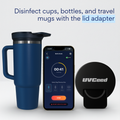
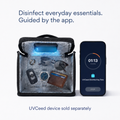
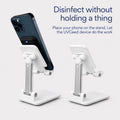
UVCeed is a handheld 254 nm UV-C device built for exactly this kind of targeted, staff-operated use, not for replacing your existing cleaning contract or your infection preventionist's protocols. In practice, facilities deploy a portable unit like this in a few specific spots where staff time is tightest and touch frequency is highest:
- Resident room turnover. Bed rails, call buttons, remote controls, and nightstands during the gap between discharge and the next admission, as a documented supplement after the EPA-registered disinfectant wipe-down, not instead of it.
- Shared mobility and medical equipment. Wheelchairs, walkers, gait belts, blood pressure cuffs, and glucometers that move room to room throughout a shift, where a quick pass with UVCeed between uses adds a layer of coverage without pulling the item out of rotation.
- Nurses' stations and med carts. High-contact surfaces touched by multiple staff members across a shift, aimed directly with the unit held steady until the app confirms the section is complete, then moved to the next section.
- Dining hall surfaces between seatings. Tabletops and shared condiment stations between resident meal groups, when time between seatings is too short for a full chemical clean-and-dwell cycle. Note: 254 nm UV-C inactivates bacteria on food-contact surfaces, but FDA rules prevent us from citing a specific reduction percentage on food, so we do not.
Because UVCeed is portable and battery-powered, staff can carry it room to room during rounds instead of scheduling a separate disinfection pass, which matters when your infection preventionist is already stretched across surveillance, training, and outbreak response. It will not pass a survey for you and it is not a substitute for your written IPCP, but as a documented, repeatable supplement on the surfaces that get touched the most between full cleanings, it closes a real gap in the schedule.
FAQ
Does UV-C disinfection count toward CMS infection control compliance? No single device satisfies 42 CFR 483.80 on its own. Compliance requires a documented IPCP, a qualified infection preventionist, and use of EPA-registered disinfectants per CMS guidance (CMS QSO-20-03-NH). UV-C can support that program as a supplemental step, and documenting its use can strengthen your record during a survey.
Is it safe to run a 254 nm UV-C device around residents? Direct 254 nm exposure can irritate skin and eyes, so these devices are meant for unoccupied surfaces or targeted, staff-operated use with the unit aimed directly at a surface, not as ambient room lighting while residents or staff are present (PMC).
How often do norovirus outbreaks actually hit long-term care facilities? Over half of all norovirus outbreaks reported nationally occur in long-term care settings, and outbreaks in these facilities can last months once introduced (CDC).
What happens if we fail an infection control survey tag? Depending on severity, CMS can impose civil money penalties, deny payment for new admissions, or move toward termination from Medicare/Medicaid participation (CMS).
Who should be responsible for running a portable UV-C device in the building? Any trained staff member can operate it, but your infection preventionist should own the protocol: which areas get treated, how often, and how it is logged alongside your standard disinfectant schedule.
The bottom line
Infection control in senior living is not a checkbox exercise anymore, if it ever was. It is a regulatory mandate with real financial teeth, a genuine clinical risk to a vulnerable population, and, as recent litigation shows, a liability exposure that can follow an operator for years. None of that gets solved by a single device. But closing the gap between scheduled disinfectant rounds on the surfaces and equipment your residents and staff touch most often is a concrete, low-effort step your team can start this week.
Want More Articles Like This?
Get research on UV-C treatment and product updates delivered to your inbox.