TL;DR
On July 30, 2026, the USDA's Food Safety and Inspection Service issued a public health alert for Mary's Harvest Curry Chicken Salad over possible Listeria monocytogenes contamination. No recall was issued because the product was already past its use-by date and off shelves, but FSIS is specifically worried it is still sitting in refrigerators. Listeria is different from most foodborne bacteria in one important way: it keeps growing at refrigerator temperatures. This piece covers what the alert says, who is actually at risk, and how to clear both the product and the cross-contamination it may have left behind out of your kitchen.
What Actually Happened
FSIS issued the alert after the Curry Chicken Salad, produced on July 22, 2026, tested positive for possible Listeria monocytogenes contamination. From the FSIS public health alert:
- Product: 8-oz. plastic packages labeled "CURRY CHICKEN SALAD"
- Use-by date: 07/30/2026
- Establishment number: P-39928 inside the USDA mark of inspection
- Distribution: retail locations in Oregon and Washington
- No illnesses confirmed as of the alert date
Because the use-by date had already passed by the time the alert went out, FSIS did not request a formal recall, but explicitly flagged the risk that product could still be in someone's refrigerator, per Food Safety News coverage. If you have it, the guidance is simple: throw it out, or return it for a refund, and do not taste it to check.
Why Listeria Is the One Bacteria Your Fridge Doesn't Stop
Most foodborne bacteria need warmth to multiply. Listeria monocytogenes does not follow that rule. It is one of the only common foodborne pathogens that can grow slowly even at standard refrigerator temperatures (36-40°F), which is exactly why ready-to-eat deli items like chicken salad, sliced meats, and soft cheeses are recurring sources of outbreaks.
The people at real risk are a defined group, per CDC's page on who is at increased risk:
- Adults 65 and older
- People with weakened immune systems
- Pregnant women, where infection can cause miscarriage, stillbirth, preterm labor, or a severe infection in the newborn - the CDC notes 1 in 4 pregnant women who get listeriosis lose the pregnancy or the baby shortly after birth
For everyone else, symptoms are usually limited to fever, muscle aches, and fatigue, but the CDC's clinical overview notes that severe cases can progress to headache, stiff neck, confusion, and convulsions when the infection spreads to the nervous system. Incubation can take up to 70 days, which makes it one of the hardest foodborne illnesses to trace back to a specific meal.
What to Actually Do in Your Kitchen
- Check for the product. Curry Chicken Salad, 8-oz packages, use-by 07/30/2026, establishment P-39928. If you have it, discard it in a sealed bag so it does not touch other food, or return it unopened.
- Clean the refrigerator shelf and drawer it sat in. Listeria spreads by cross-contamination inside the fridge more easily than most bacteria because it survives cold storage. Wipe down the shelf, any bins nearby, and the fridge door handle.
- Wash anything the container touched, including reusable bags, other food packaging on the same shelf, and any utensils used to serve from it.
- If you are pregnant, 65+, or immunocompromised and ate the product, contact your doctor even without symptoms, per FDA guidance on listeria.
- Disinfect high-touch kitchen points you handled while dealing with the product: the fridge handle, the trash can lid, and the counter where you set it down.
Where UV-C Fits (and Where It Does Not)
UV-C at 254 nm inactivates Listeria and other bacteria on hard, non-porous surfaces by damaging the DNA that lets them reproduce. It is well suited to the fridge handle, the shelf edge, and the counter, none of which should ever see a chemical spray near food-adjacent surfaces if you can avoid it.
Where UV-C does not help: it cannot reach bacteria that has soaked into a porous cutting board, a sponge, or fabric, and it will not disinfect food that is still sealed in its packaging or already contaminated inside a container you have not opened. 254 nm UV-C does inactivate bacteria on food surfaces themselves when there is direct line of sight, but FDA rules prevent us from citing a specific reduction percentage on food, so we do not. For anything you plan to eat, washing and proper cook temperatures remain the controls that matter most.
Where UVCeed Fits
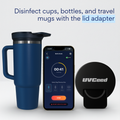
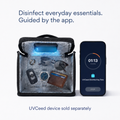
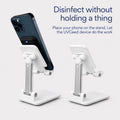
UVCeed is a 254 nm UV-C device that pairs with your phone camera and app to guide a session across the exact surface you are treating. You aim UVCeed at one section, hold it steady while the app confirms that section is complete, then move to the next section if the surface is larger than the coverage area.
After a recall scare, the realistic session list is short: the fridge shelf and handle, the counter, and the trash lid. No chemical residue near food-storage surfaces, no wipes to throw away, and a tilt-safety shutoff that turns the lamp off if the device rotates away from the target.
FAQ
Do I need to throw away everything else in my fridge? No. Focus on the shelf and any surfaces the product directly touched. FSIS has not indicated broader contamination beyond the specific product and its immediate contact surfaces, per the FSIS alert.
How do I know if I got sick from this? Listeriosis symptoms can take up to 70 days to appear, per the CDC clinical overview, which is much longer than most foodborne illness. Watch for fever, muscle aches, and fatigue, or in severe cases headache, stiff neck, and confusion, and mention the product name to your doctor if symptoms appear.
Is Listeria only a risk from this one product? No. Listeria shows up recurrently in deli meats, soft cheeses, smoked seafood, and pre-made salads because it survives refrigeration. The CDC has tracked a separate ongoing outbreak linked to deli-sliced meats as a reminder that this is a category-wide risk, not a one-time event.
Can UV-C replace washing my hands after handling recalled food? No. Hand hygiene is still the first control. UV-C is a supplement for the hard surfaces around food handling, like the fridge handle and counter, not a replacement for washing your hands with soap and water.
Why wasn't this a full recall? FSIS explained the product's use-by date had already passed and it was no longer available for retail purchase by the time the alert went out, so a formal recall was not applicable, but the health alert stands because product may still be in consumers' homes, per FSIS.
The Bottom Line
Listeria's ability to grow in a cold refrigerator is what makes this alert worth acting on even after the product's official shelf life ended. Check for it, clear it out, and treat the surfaces it sat near, not just the product itself.
Want More Articles Like This?
Get research on UV-C treatment and product updates delivered to your inbox.