TL;DR
Los Angeles County health officials confirmed in June 2026 that a measles-infected traveler moved through LAX and stayed at the Hilton Los Angeles Airport Hotel while infectious (Fox News, June 2026; LA County Public Health advisory). Measles is the most contagious respiratory virus known - 9 out of 10 unvaccinated people exposed will get infected, and the virus hangs in the air for up to 2 hours after the infectious person has left the room (CDC Measles Transmission). The U.S. is having its worst measles year since 1992, with more than 1,300 confirmed cases across 39 states as of late July (CDC Measles Cases and Outbreaks). If you fly, you need a travel disinfection routine.
What happened at LAX
An infected traveler passed through LAX and stayed at the Hilton on June 11. LA County Department of Public Health issued exposure alerts covering specific gate areas, the terminal, and hotel common areas. Because measles is airborne and lingers, anyone unvaccinated who was in those spaces during the exposure window - or who arrived within two hours of the traveler's departure - is at risk.
This is the third airport-linked measles exposure alert of 2026. LAX in June follows exposure warnings at Newark (EWR) in April and Dulles (IAD) in May (CDC Measles Travel Alerts).
Why airports and airline travel are the perfect measles vector
- Measles has an R0 of 12-18 - the highest of any well-characterized human pathogen. One infected person infects 12-18 unvaccinated people on average (NIH PMC - Measles R0 review).
- Airborne particles remain infectious in enclosed spaces for up to 2 hours after the infected person leaves (CDC Measles Transmission).
- Airport HVAC filtration is not designed for measles particle sizes at the concentrations produced by a symptomatic traveler.
- Terminal seating, jet bridges, boarding areas, and gate touchpoints see thousands of hands per day between deep cleans.
The 2026 outbreak year is being driven by declining MMR coverage among school-age children - the CDC reported kindergarten MMR coverage at 92.7%, well below the 95% herd-immunity threshold (CDC MMWR - School Vaccination Coverage).
The surfaces you actually touch when you travel
- Airport check-in kiosk touchscreen - direct hand-to-face pathway.
- Security bins - hundreds of hands per hour, no disinfection cycle between passengers.
- Gate seat armrests and USB charging ports - one of the highest-contact surfaces in the terminal.
- Airline tray table - a 2015 Auburn University study found MRSA can survive on tray tables for up to 168 hours (7 days) (Auburn University Aviation Research).
- Hotel room remote control - a University of Houston study cited it as the single dirtiest object in the average hotel room (University of Houston Hospitality Research).
- Hotel bathroom light switch, faucet handle, and phone.
- Airbnb kitchen surfaces - shorter turnover than hotels, less standardized cleaning.
The airline tray table and hotel remote are the two objects that get the least disinfection relative to how often they are touched. UV-C is not the answer to airborne measles inside the cabin (vaccination is), but it directly addresses the surface-to-hand-to-face transmission chain that carries norovirus, RSV, influenza, and every other travel bug you can pick up on the same trip.
What to actually do
- Confirm your MMR status before you fly. If you were born after 1957 and are unsure, two doses of MMR is the single most important thing you can do. Ask your doctor. This is not something UV-C can substitute for.
- Session your tray table on the plane. Aim, hold steady until the app confirms the section is complete, move to the next section. Do the armrest and seatbelt buckle while you are at it.
- Session the hotel remote, light switches, faucet handle, and door handle on arrival. These are the surfaces the previous guest touched most, and the ones housekeeping deep-cleans least.
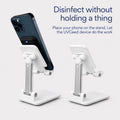
- Session your phone twice a day when traveling. Your phone is the courier for everything you touch on the trip.
- Wash your hands with soap and water after every terminal transit, restroom trip, and dining venue. 20 seconds. Hand sanitizer is a supplement, not a replacement (CDC Handwashing).
- Check the CDC travel notice list before you book. Measles exposure alerts and destination-specific outbreak notices are updated at CDC Travel Health Notices.
Where UVCeed fits
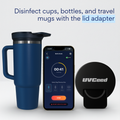
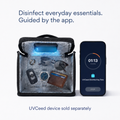
UVCeed is a 254 nm UV-C device with an app that guides you through sessions: aim at one section (like a tray table or hotel remote), hold steady while the app confirms the section is complete, then move to the next section for surfaces larger than the coverage area.
Airport and hotel surfaces are exactly the use case UVCeed is designed for: hard, non-porous, high-touch, and rarely disinfected between users. 254 nm UV-C is documented to inactivate influenza, RSV, coronaviruses, and norovirus surrogates on hard surfaces (EPA UV Disinfection Guidance; NIH PMC - UV inactivation of respiratory viruses).
UVCeed is USB-C, TSA-friendly, and fits in a carry-on. Unlike bleach or alcohol wipes, it does not leak, does not stain, and does not run out.
FAQ
Does UV-C kill measles? 254 nm UV-C is documented to inactivate enveloped RNA viruses (measles falls in this category) on hard surfaces at standard germicidal doses (NIH PMC review). UV-C on surfaces is not a substitute for MMR vaccination against airborne measles - the two address different transmission routes.
Is UV-C safe in a hotel room? Yes, when used correctly. Aim at surfaces, not at skin or eyes. UVCeed has a tilt-based safety shutoff.
Do I need to sanitize the plane's tray table if the airline says they clean it? Airline turnaround cleaning is variable and largely cosmetic between flights. Auburn University research found MRSA can persist on tray tables for up to 168 hours (Auburn University). A 30-second session removes that variable.
Can UVCeed disinfect food I buy in-flight? 254 nm UV-C inactivates bacteria on food surfaces. FDA rules prevent us from citing a specific reduction percentage on food. On the wrapper, container, and tray, UV-C is straightforward hard-surface disinfection.
Will TSA allow UVCeed through security? Yes. Personal UV-C sanitizing devices are permitted in carry-on and checked baggage per current TSA guidance for lithium-battery consumer electronics (TSA Special Items List).
The bottom line
Measles is airborne and requires vaccination. Everything else you pick up in an airport terminal or hotel room - norovirus, RSV, influenza, staph - travels on surfaces. Your airline and hotel do not deep-disinfect between users. Your phone is the courier that brings all of it to your face.
Vaccinate for the airborne risks. Session the surfaces for everything else.
Want More Articles Like This?
Get research on UV-C treatment and product updates delivered to your inbox.