TL;DR
A peer-reviewed study published in July 2026 in the journal Pathogens collected 180 surface samples across 12 gym devices, three times a day, over five consecutive weekdays, and built device-specific contamination profiles. The findings confirm what gym-goers have suspected for years: bacterial load is not evenly distributed. Some equipment is a genuine Staphylococcus hotspot, and contamination climbs measurably as the day goes on. This piece breaks down what the study actually found and where a quick disinfection habit does the most good.
What the Study Actually Found
The study, published in Pathogens (DOI: 10.3390/pathogens15070707), was designed to answer a more specific question than "is the gym dirty." Researchers tracked how contamination changes by device, by time of day, and by day of the week, then built a device-level risk index instead of a single blanket number.
Key patterns from the study:
- Contamination was not uniform across equipment - some devices consistently ranked as Staphylococcus hotspots while others stayed comparatively low
- Bacterial load increased across the day, from morning to noon to evening sampling, tracking cumulative hand contact
- The study identified device-level risk indices, meaning some machines warrant more frequent disinfection than a facility's blanket cleaning schedule assumes
This adds precision to earlier findings. Older research already established that gym equipment can carry substantially more bacteria than a toilet seat, and a broader review in The Conversation has documented E. coli and Staphylococcus aureus on treadmills, weights, and mats. The 2026 study's contribution is showing which equipment and which time of day actually carry the most risk, rather than treating "the gym" as one undifferentiated surface.
Why Staphylococcus on Gym Equipment Matters
Staphylococcus aureus lives on the skin and in the noses of a large share of the population without causing illness, but it spreads readily by direct contact and can cause skin infections, and in more serious cases, more invasive infections, particularly through cuts or abrasions, which are common in a gym setting. Shared free weights, cable handles, and mats that see continuous bare-hand contact with minimal disinfection between users are exactly the conditions that let it persist and transfer.
Most gyms rely on member-applied wipes at a station, which only work if members actually use them, use them long enough, and hit every contact point, not just the obvious ones like handlebars.
What You Can Actually Control
- Wipe equipment before and after use, not just after. Pre-use wiping protects you from the person before you; post-use protects the person after.
- Prioritize high-hotspot equipment: free weights, cable machine handles, and shared mats saw the strongest contamination signals across gym hygiene research. Treat these with more attention than, say, a stationary bike seat.
- Bring your own mat for floor work rather than relying on shared studio mats, which are harder for staff to disinfect between every single class.
- Avoid touching your face during a workout, and wash or disinfect your hands before you do afterward.
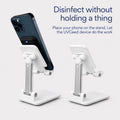
- Disinfect what leaves the gym with you: your phone (frequently set on equipment or benches), water bottle, and gym bag straps.
Where UV-C Fits (and Where It Does Not)
UV-C at 254 nm inactivates Staphylococcus aureus and other bacteria on hard, non-porous surfaces by damaging their DNA, which is well documented in disinfection literature for gym-relevant pathogens. It works well on dumbbell handles, cable attachments, and phone screens because these are hard surfaces with direct line of sight.
Where it does not help: UV-C cannot penetrate the fabric of a yoga mat, gym towel, or upholstered bench pad, since the light only disinfects what it can directly reach. For those, laundering or a facility-grade sanitizing cycle is still the right tool.
Where UVCeed Fits
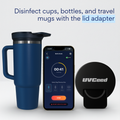
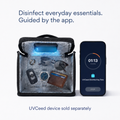
UVCeed is a portable 254 nm UV-C device that uses your phone camera and app to guide a session across a surface. You aim UVCeed at one section, hold it steady while the app confirms the section is complete, then move to the next section if the equipment surface is larger than the coverage area.
For a gym bag, the realistic routine is short: your phone after it sat on a bench or machine console, your water bottle spout, and your keys. A tilt-safety shutoff turns the lamp off automatically if the device rotates away from the target.
FAQ
Which gym equipment should I worry about most? The 2026 Pathogens study found Staphylococcus hotspots concentrated on specific high-touch devices rather than spread evenly, with free weights and shared handles consistently ranking higher than equipment with less direct skin contact.
Does time of day matter? Yes. The study found contamination increased from morning to evening sampling as more members touched the same equipment without a deep clean in between, so an evening workout carries more residual bacterial load than an early morning one, all else equal.
Are gym-provided wipes enough? They help when used correctly and for long enough contact time, but member compliance is inconsistent, and wipes cannot disinfect equipment between the moment the last person used it and the moment you touch it if no one wiped it down.
Can UV-C be used mid-workout between sets? It is designed for quick, targeted sessions rather than continuous use, so it fits best before you start on a specific piece of equipment or on your own gear (phone, bottle, mat handles) rather than as a running background treatment.
Is my own equipment (mat, gloves, wraps) also a risk? Yes. Personal gear that never gets washed becomes its own bacterial reservoir over time. Launder mats, gloves, and wraps regularly, and disinfect hard-surfaced personal items like your phone and water bottle with a UV-C session after each session.
The Bottom Line
The 2026 device-level data confirms gym bacteria is not an abstract risk, it is concentrated on specific equipment at specific times. Wipe before and after, prioritize the known hotspots, and treat what you carry out with you.
Want More Articles Like This?
Get research on UV-C treatment and product updates delivered to your inbox.