TL;DR
A study published in the Journal of Hospital Infection (Volume 174, 2026) found that a norovirus surrogate survives up to 14 days on hard surfaces like steel, glass, tile, and plastic, and up to 21 days on terry cloth, the fabric used in most bathroom and kitchen towels. The same research also measured aerosolization from toilet flushing and found mixed, inconsistent results when household cleaners were tested against the virus on real surfaces. If you have ever assumed a wipe-down and a few days of airing out a bathroom was enough after a stomach bug moved through the house, this study is the reason that assumption deserves a second look.
What the study actually found
Researchers tested how long a norovirus surrogate remained viable and infectious on common household and healthcare surfaces under realistic conditions rather than idealized lab settings. On hard, non-porous surfaces, steel, glass, tile, and plastic, the virus remained viable for up to 14 days. On terry cloth, the absorbent, looped fabric used in nearly every bath towel and many kitchen towels, viability extended to 21 days, a full week longer than on hard surfaces. Fabric's porous structure appears to shelter the virus from the drying and UV exposure that would otherwise degrade it faster on a flat, non-absorbent surface.
The study also examined toilet-flushing aerosolization, confirming what smaller studies have suggested before: flushing with the lid up can aerosolize norovirus particles into the surrounding air, which then settle on nearby surfaces, toothbrush holders, towel bars, light switches, well beyond the toilet bowl itself. Perhaps most useful for households trying to actually respond to a stomach bug: the researchers tested common household cleaners against the virus on these surfaces and found mixed, inconsistent results. Not every cleaner performed reliably, and performance varied by surface type and contact time, meaning the wipe-and-hope approach many households default to during a norovirus scare is genuinely unreliable, not just imperfect.
Why researchers use a surrogate virus, and why that's actually standard practice
Human norovirus cannot be reliably grown in standard laboratory cell cultures, which has historically made it difficult to study directly. To get around that, researchers commonly use murine norovirus, a related virus that infects mice, as a surrogate that behaves similarly to human norovirus in terms of environmental persistence and resistance to disinfection, while being safe and practical to culture in a lab setting. This is a well-established and widely accepted method in norovirus research, used in numerous peer-reviewed studies over the past two decades, not a shortcut that undermines the findings. When a study like this one reports 14-day survival on hard surfaces and 21-day survival on fabric, that data is considered a reasonable proxy for how human norovirus behaves in the same conditions, which is exactly why public health guidance on norovirus cleaning protocols has leaned on surrogate studies like this one for years.
Why this matters more than a typical hygiene study
Norovirus is already the leading cause of acute gastroenteritis outbreaks in the US, spreading through cruise ships, schools, daycares, and households with brutal efficiency because it takes an extremely small viral dose to cause infection. What this study adds is a concrete timeline: an infected household member's illness might resolve in 24 to 48 hours, but the towel they used, the doorknob they touched, and the surfaces near the toilet can remain a live transmission risk for up to three weeks afterward if cleaning is inconsistent. That gap between "the person feels better" and "the environment is actually safe" is where a lot of household outbreaks quietly re-trigger, especially in families with young kids who are less careful about hand-to-mouth contact.
What to actually do after a stomach bug moves through your house
- Wash all towels, bath mats, and any fabric the sick person used in hot water on the longest cycle, and do not assume a quick rinse is sufficient given the 21-day survival window on fabric.
- Close the toilet lid before flushing, every time, for at least a few days after anyone in the household has norovirus symptoms.
- Disinfect hard surfaces near the toilet, light switches, towel bars, faucet handles, doorknobs, not just visibly soiled areas, since aerosolized particles settle broadly.
- Do not rely on a single wipe-down with any one household cleaner and assume the job is done, given this study's finding of inconsistent cleaner performance across surface types.
- Wash hands with soap for at least 20 seconds, especially after bathroom use and before eating, since hand-to-mouth transmission remains norovirus's primary spread route.
Where UVCeed fits
This study is a direct argument for a disinfection method that does not depend on which cleaner you happened to grab or how long you left it sitting on the surface. UV-C works by physically damaging the virus's genetic material on contact, rather than relying on a chemical formulation that this study found performs inconsistently. UVCeed is built for the hard, non-porous surfaces this research specifically measured, steel, glass, tile, and plastic, all of which are common around bathrooms and kitchens: the counter, the toilet handle, the light switch, the faucet.
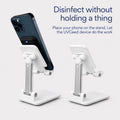
With UVCeed, you aim the device at one surface, the counter, the toilet handle, the light switch, and hold steady until the app confirms that section is complete, then move to the next section. No guessing whether the cleaner you used actually worked against the virus on that particular surface.
FAQ
How long can norovirus actually survive outside the body? Per this study, up to 14 days on hard surfaces like steel, glass, tile, and plastic, and up to 21 days on terry cloth fabric like bath towels.
Do household cleaners reliably kill norovirus? This study found mixed, inconsistent results across different cleaners and surface types, which means a single wipe-down should not be assumed to fully eliminate the virus.
Can flushing the toilet actually spread norovirus into the air? Yes. The study confirmed that flushing, especially with the lid up, can aerosolize norovirus particles that settle on nearby surfaces well beyond the toilet bowl itself.
Why does norovirus survive longer on towels than on hard surfaces? Porous, absorbent fabric appears to shelter the virus from the drying and degradation that happens faster on flat, non-absorbent surfaces, extending viability by about a week compared to hard surfaces.
Does UV-C disinfection work on fabric surfaces like towels? UVCeed is designed for hard, non-porous surfaces with direct line of sight. For fabric, washing in hot water on a long cycle is the more reliable method, per this study's findings.
Why is norovirus so much more contagious than most other stomach viruses? Norovirus requires an extremely small viral dose, as few as 10 to 100 particles, to cause infection, compared to much higher thresholds for many other pathogens. Combined with the extended surface survival times this study documents, that low infectious dose is a major reason norovirus spreads so efficiently through households, schools, and cruise ships.
Is it true that alcohol-based hand sanitizer does not work well against norovirus? Yes, this is a well-documented limitation. Norovirus lacks a lipid envelope, which is the structure alcohol-based sanitizers are most effective at disrupting, making soap and water handwashing significantly more effective than sanitizer alone for norovirus specifically.
Want More Articles Like This?
Get research on UV-C treatment and product updates delivered to your inbox.