WastewaterSCAN Alert: RSV detected at high levels in western San Francisco, Corte Madera and Novato - and at moderate levels across San Jose, Sunnyvale, Redwood City, Napa, Sacramento and Davis - in May 2026. RSV season historically ends in March.
Something is deeply wrong with the calendar of illness in Northern California, and the doctors monitoring it aren't mincing words. It is May. Summer is days away. And RSV - the respiratory syncytial virus long understood to peak in December and retreat by March - is still surging through Bay Area wastewater at levels that would have been alarming in the middle of winter.
"There's no season anymore," Dr. Monica Gandhi, an infectious disease specialist at UC San Francisco, told SFGate this week. "We're so off." Gandhi, one of the region's most closely followed voices on infectious disease, says the breakdown of traditional seasonal viral patterns became apparent immediately after the COVID-19 pandemic. She doesn't expect them to stabilize anytime soon.
For Bay Area parents, grandparents, caregivers and anyone with someone vulnerable in their life, this is not abstract public health language. It is a direct statement from one of the country's leading infectious disease clinicians: the mental model most families have built for when to be careful - the winter months, the flu season window - no longer reflects reality. The threat is now year-round. And most families are completely unprepared for it.
Where RSV Is Hitting Hardest in the Bay Area Right Now
The data coming out of WastewaterSCAN - the infectious disease surveillance network run by researchers at Stanford and Emory University that monitors pathogens in municipal wastewater across the country - tells a precise story about where the virus is concentrated right now. Wastewater surveillance is considered one of the most reliable leading indicators of community-level infection because it captures viral shedding from the entire population, not just those who seek medical care.
As of this week, WastewaterSCAN shows RSV at its highest levels in the western section of San Francisco and parts of Marin County, including Corte Madera and Novato. Moderate levels are spreading across a far wider swath of Northern California:
Highest RSV Levels:
- Western San Francisco
- Corte Madera (Marin County)
- Novato (Marin County)
Moderate RSV Levels:
- San Jose
- Sunnyvale
- Redwood City
- Southeastern San Francisco
- Napa
- Sacramento
- Davis
Dr. Gandhi speculates that Northern California appears to bear a disproportionate burden compared to Southern California not because the virus is necessarily more prevalent there, but because the Bay Area operates more sophisticated wastewater surveillance infrastructure - meaning the data is capturing something that is almost certainly happening across a much wider geographic footprint but going undetected elsewhere.
The Numbers That Put This in Perspective
| Stat | Detail |
|---|---|
| Up to 24 hours | How long RSV survives on hard, non-porous surfaces |
| 58,000 | Children under 5 hospitalized by RSV annually (CDC) |
| #1 | RSV is the most common cause of infant hospitalization in the US |
| 3-8 days | How long a person with RSV remains contagious |
| 4-10 minutes | The required wet contact time for disinfectant wipes to actually kill RSV at their advertised rate |
The Immunity Debt: Why COVID Changed Everything
To understand why "there's no season anymore," you have to understand immunity debt - and why many infectious disease experts now believe the Bay Area, and the country at large, is still paying it down years after lockdowns ended.
The immune system is not a static shield. It is a dynamic, adaptive system calibrated by continuous exposure to pathogens. Every winter, pre-pandemic, millions of Americans were exposed to RSV, rhinoviruses, parainfluenza, human metapneumovirus and dozens of other common respiratory pathogens. Those exposures - even when they caused only mild illness - were maintaining and refreshing a population-wide reservoir of immune memory.
When COVID-19 lockdowns began in March 2020, that continuous calibration stopped almost overnight. Schools closed, offices emptied, social contact collapsed. The pathogens that had circulated freely for generations suddenly had no hosts. They retreated. And during those years of isolation, hundreds of millions of people - particularly children born during the pandemic years - were never exposed to the viruses their immune systems would normally have encountered in infancy.
When restrictions lifted, those viruses found a population that was dramatically more immunologically naive than any prior generation. The result has been exactly what epidemiologists predicted: unusual, out-of-season, more intense outbreaks. Dr. Gandhi told SFGate that starting in March 2021, "we've had these offseason RSV waves" - and the pattern shows no sign of correcting itself.
"There's no season anymore. We're so off."
- Dr. Monica Gandhi, Infectious Disease Specialist, UC San Francisco
Beyond RSV, Northern California has simultaneously been dealing with surges in human metapneumovirus (HMPV) - a closely related Pneumoviridae family virus with no available vaccine and no specific treatment. WastewaterSCAN data showed high HMPV levels in Sacramento, Davis, Vallejo and San Francisco as recently as March 2026. Both viruses are now circulating simultaneously, months outside their historical seasonal windows.
The Surface Problem Nobody Is Talking About
When most people think about how RSV spreads, they picture a sick child coughing in a classroom. They think about airborne droplets. And while that mode of transmission is absolutely real, there is a second, less-discussed pathway responsible for a significant portion of RSV infections - one that the standard advice of "wash your hands and stay home when sick" does almost nothing to address.
RSV is one of the most surface-persistent common respiratory viruses known to science. Published research in peer-reviewed literature - including studies appearing in the Journal of Infectious Diseases - has established the following survival times with high confidence:
| Surface Type | Examples | RSV Survival Time | Transmission Risk |
|---|---|---|---|
| Non-porous hard surfaces | Countertops, doorknobs, crib rails, phone screens, plastic toys | 6-30 hours | HIGH |
| Non-porous hard surfaces (clinical) | Hospital bed rails, stainless steel | Up to 12 hours documented | HIGH |
| Porous / soft surfaces | Fabric, clothing, cardboard, paper tissue | 30 min - 2 hours | MODERATE |
| Rubber / gloves | Exam gloves, rubber toys | Up to 90 minutes | MODERATE |
| Human skin / hands | Palms, fingers | 15-30 minutes | LOWER (but rapid transfer) |
Now look at that table again and picture a normal Tuesday. A child with a runny nose touches a doorknob at 8 AM. That doorknob may still be capable of transmitting RSV at 6 PM - ten hours later. A person who doesn't yet know they're infected handles the remote control, the kitchen counter, the baby's pacifier. Every one of those surfaces becomes a vector.
Critically: landmark published research (Hall et al., Journal of Infectious Diseases) demonstrated that RSV on a contaminated surface successfully transfers to any hand that touches it, and from that hand the virus remains viable for up to 25 additional minutes - more than enough time to touch your eyes, nose or mouth.
This is why the California Department of Public Health explicitly lists "disinfecting frequently touched surfaces" as one of the primary prevention strategies for RSV. Not just handwashing. Not just masks. Surface disinfection.
Why Your Current Cleaning Routine Is Failing
Here is an uncomfortable truth that disinfectant wipe manufacturers would prefer you not examine too carefully: the label on those EPA-registered disinfecting wipes requires the surface to remain visibly wet for the full contact time printed on the label - typically 4 to 10 minutes - for the product to kill pathogens at its advertised efficacy rate. In practice, most people wipe a surface and consider it done. It dries in seconds. The virus isn't dead.
The same limitation applies to spray disinfectants. Contact time is everything, and virtually nobody applies them correctly on the surfaces that matter most - phones, remote controls, keys, keyboards, children's toys, pacifiers. These objects are handled dozens of times a day by every person in a household, including sick family members. They are almost never properly chemically disinfected. And they are precisely the objects that anchor the fomite transmission chain driving household RSV spread.
What conventional cleaning misses:
- Dries in seconds - nowhere near the required 4-10 minute wet contact time
- Chemical residues on baby items, pacifiers and food-prep surfaces
- Toxic ingredients harmful to children and pets with repeated exposure
- Completely ineffective on screen crevices, keyboard gaps, phone ports
- No confirmation of coverage - pure guesswork
- Degrades electronics, screens and soft materials over time
The Science Behind UV-C: What Hospitals Have Known Since the 1920s
Germicidal ultraviolet light - UV-C - is not a new technology or a consumer health fad. It is a well-characterized physical phenomenon with over a century of documented use in healthcare settings. UV-C light at germicidal wavelengths (primarily 254-265nm) penetrates the outer envelope of microorganisms and directly attacks the molecular bonds in their DNA and RNA. Once those bonds are disrupted, the pathogen cannot replicate. It is rendered biologically inert. Not suppressed. Not slowed. Destroyed.
Hospitals have used UV-C irradiation systems for operating room decontamination, whole-room disinfection and water purification since the 1920s. The technology was historically confined to fixed institutional installations - large, expensive systems requiring trained operators and strict protocols to prevent UV exposure to humans and animals.
What changed in the last several years is the miniaturization of UV-C LED technology, which has made it possible to deliver the same germicidal wavelengths in handheld, portable, consumer-accessible devices - without sacrificing the efficacy that made the technology a hospital standard for a hundred years.
Critically: UV-C efficacy against RSV and related Pneumoviridae family viruses - including human metapneumovirus - is well-supported. These viruses, like most enveloped RNA viruses, are considered among the most UV-C sensitive pathogens known. They require lower doses and shorter exposure times to reach inactivation than many bacterial pathogens. This makes UV-C particularly well-suited to the current Northern California respiratory virus landscape.
Meet UVCeed: Hospital-Grade Protection, Now in Your Pocket
<!-- FLOATING PRODUCT CARD TRIGGER: Insert scroll-triggered product card component here (recommend triggering at ~35-40% scroll depth) -->
UVCeed was developed by Dr. Peter Bonutti with a straightforward premise: the UV-C technology trusted in hospital disinfection systems should be accessible to every family, everywhere they go - not confined to operating rooms.
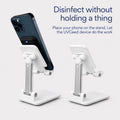
The result is the world's first smart, app-guided UV-C disinfection device that combines medical-grade germicidal technology with real-time AI safety monitoring and visual confirmation of every treatment session. Unlike generic consumer UV wands that emit unmeasured doses with no guidance, no safety monitoring, and no confirmation of coverage, UVCeed integrates directly with your smartphone via MagSafe and uses your camera, machine vision, and a purpose-built app to guide every disinfection session in real time.
You see exactly what you've treated. You know when you're done. And the device's patented sensor array automatically disables the UV-C emitter the instant it detects a person or pet - the same safety logic used in institutional UV disinfection systems.
What sets UVCeed apart:
- Medical-grade 265nm UV-C LED - the same wavelength used in hospital systems
- Eliminates 99.9% of pathogens in 30 seconds - lab-tested and verified
- App-guided real-time visual coverage - you see exactly what's been treated
- Patented AI safety monitoring - automatic shutoff when person or pet detected
- Machine-vision 3D surface mapping - ensures complete, even coverage
- MagSafe compatible - attaches instantly to any iPhone 12+
- Zero chemicals, zero residue - safe for baby items, pacifiers, food surfaces, electronics
- Compact and rechargeable - pocket-sized, no batteries, no ongoing purchase costs
Currently deployed at Sarah Bush Lincoln Healthcare for professional-grade surface disinfection - the same UV-C technology and identical wavelength, now available for your home.
Six Surfaces You Should Be Disinfecting Every Day (And Probably Aren't)
Understanding which surfaces carry the highest RSV transmission risk is the first step to building a disinfection routine that actually works. The following six objects share two critical characteristics: they are touched by multiple people repeatedly throughout the day, and they are almost never properly disinfected.
1. Your Phone Screen
The average smartphone is touched over 2,600 times daily and rarely if ever disinfected with the correct contact time. RSV can survive on glass and metal surfaces for up to 30 hours. A 30-second UVCeed treatment eliminates pathogens with zero chemical damage to your screen coating.
2. Keys and Keychains
Metal keys are touched after every external outing - groceries, the pediatrician's waiting room, public transit - and placed directly into pockets and bags alongside other items. They are virtually never disinfected. A quick UVCeed pass every evening takes under a minute and costs nothing.
3. Remote Controls
The average television remote is handled by every family member, including symptomatic children, and almost never cleaned. Irregular surfaces, button gaps and crevices make chemical wipes ineffective even when used - UV-C light reaches every contour without the guesswork.
4. Baby Items and Pacifiers
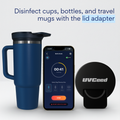
Chemical disinfectants are inappropriate for items that go directly in a child's mouth. UVCeed's chemical-free UV-C approach provides hospital-grade sanitization with zero toxic residue - it is specifically designed for parents sanitizing pacifiers, sippy cups, baby bottles and toys.
5. Keyboards and Trackpads
Published research has found keyboards harbor hundreds of times more bacteria per square inch than a toilet seat. Chemical sprays damage electronics and leave residue. UVCeed's guided disinfection sweeps across keyboard surfaces in seconds with no liquid, no residue, no damage.
6. Car Interior Surfaces
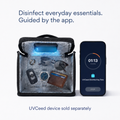
Steering wheels, door handles, seatbelt buckles and center consoles are touched by every occupant on every trip. With the UVCeed Disinfecting Tote accessory, UV-C protection extends to enclosed bags, gym bags, diaper bags and any space where high-touch items are stored together.
What Real Users Are Saying
5/5 "With two kids in daycare during this RSV surge, we were terrified. UVCeed has become part of our daily routine - phones, keys, the remote, the kids' tablets. It's the first time I've actually felt like we're doing something real about surface transmission."
- Sarah M., San Jose, CA
5/5 "I'm an ICU nurse and I was skeptical of consumer UV devices - I've seen the cheap ones that do nothing. UVCeed is genuinely different. The app guidance, the safety shutoff, the 265nm wavelength. This is the real deal, designed by someone who actually understands infection control."
- Jennifer K., San Francisco, CA
5/5 "My 84-year-old mother lives with us and RSV could put her in the hospital. I use UVCeed every day on the surfaces she touches most. Since we started, not a single respiratory illness in the household through a winter that hospitalized people in our neighborhood."
- David R., Marin County, CA
The Year-Round Threat Demands a Year-Round Solution
The core message from Dr. Gandhi and WastewaterSCAN data is not subtle: the framework most Bay Area families are operating under - "stay careful during cold and flu season, relax in spring and summer" - is no longer valid. The post-pandemic immunity debt, the disrupted seasonal patterns, the simultaneous circulation of RSV and HMPV months outside their historical windows - all of it points to the same conclusion. Respiratory virus risk in Northern California is now a permanent, year-round management problem.
That changes the calculation for how you approach protection. A seasonal mindset produces seasonal behavior - pulling out the hand sanitizer in November, putting it away in April. A year-round threat requires year-round infrastructure.
A device you use once a day, for 30 seconds on the surfaces that matter most, that delivers consistent hospital-grade disinfection with zero ongoing purchase cost, zero chemicals, zero guesswork, and real-time confirmation that the job is done.
That is precisely what UVCeed was designed to be. Not a crisis product. Not a pandemic panic purchase. A permanent tool in how thoughtful families manage the microbial reality of daily life - a reality that Dr. Gandhi and the UCSF infectious disease community have now confirmed is not going back to the way it was.
Protect Your Family Today - Use Code SAFECLEAN for 10% Off
RSV is surging in the Bay Area right now - in May, when it has no business being here. Your phone, your keys, your child's pacifier and your remote control are all potential vectors sitting in your home right now.
Get UVCeed at UVCeed.com - Free Shipping
Use code SAFECLEAN at checkout for 10% off. Free shipping. Satisfaction guaranteed.
Frequently Asked Questions
How long does RSV actually survive on surfaces in my home? On non-porous hard surfaces - countertops, doorknobs, phone screens, crib rails, plastic toys - RSV can remain viable and infectious for anywhere from 6 to 30 hours, depending on environmental conditions. Landmark peer-reviewed research (Hall et al., Journal of Infectious Diseases) documented recovery of infectious RSV from countertops for up to 6 hours from infant nasal secretions. That same research demonstrated the virus transferred successfully to hands touching contaminated surfaces and remained recoverable from those hands for up to 25 minutes afterward - more than enough time for self-inoculation via eyes, nose or mouth.
Why is RSV still surging in May in Northern California? According to Dr. Monica Gandhi at UCSF, the post-COVID immunity debt has fundamentally disrupted the seasonal patterns that previously governed respiratory virus circulation. Before the pandemic, consistent population-wide exposure to circulating pathogens maintained collective immune memory that helped limit out-of-season spread. Two-plus years of suppressed viral circulation created a population that is, in aggregate, more immunologically naive to common respiratory viruses than any comparable period in recent history. Gandhi says this pattern began in March 2021 and has continued without interruption. WastewaterSCAN data confirms RSV is actively surging in multiple Northern California communities as of May 2026 - two full months past the historical end of RSV season.
Does UV-C light actually kill RSV? What's the evidence? Yes, and RSV is considered among the most UV-C sensitive pathogens known. Enveloped RNA viruses - the category that includes RSV, HMPV, influenza and SARS-CoV-2 - have lipid envelopes that make them highly susceptible to UV-C irradiation at germicidal wavelengths. UV-C light at 254-265nm disrupts the nucleic acid bonds in the virus's RNA, rendering it incapable of replication. UVCeed uses a medical-grade 265nm UV-C LED - the same wavelength used in hospital disinfection systems - and is lab-tested to eliminate 99.9% of bacteria and viruses in 30 seconds of proper exposure. The device is currently deployed at Sarah Bush Lincoln Healthcare for professional surface disinfection.
Who is most at risk from the current RSV surge in the Bay Area? RSV is the most common cause of infant hospitalization in the United States. Highest-risk groups include: infants under 12 months (especially premature infants), children under 2 with heart or lung disease, adults over 65, people with weakened immune systems (including cancer patients and organ transplant recipients), and people with chronic lung conditions like COPD or asthma. In any household with these individuals, surface disinfection is a direct infection control intervention with potentially significant health consequences.
Is UVCeed safe to use around children and pets? UVCeed incorporates patented machine vision technology that uses your smartphone's camera to continuously monitor the treatment area. If a person or pet is detected, the UV-C light automatically and immediately disables - the same safety logic used in institutional UV disinfection systems. The device is designed for surface disinfection of objects only and should never be directed at people, animals or plants. It is specifically recommended for parents sanitizing baby items, pacifiers, sippy cups and toys - applications where chemical disinfectants are entirely inappropriate.
How is UVCeed different from cheap UV wands sold elsewhere? The differences are fundamental. Most low-cost UV wands emit UV-A or UV-B light with minimal germicidal efficacy, or emit UV-C at insufficient dosage with no measurement, no guidance on proper distance or speed, and no confirmation of coverage. Germicidal efficacy requires specific wavelengths (254-265nm), specific dosage, and the correct exposure time at the correct distance. Without app guidance, there is no way to know whether an effective dose was delivered. UVCeed provides: medical-grade 265nm UV-C LED technology; app-guided real-time visual coverage confirmation; patented AI safety monitoring with automatic shutoff; machine-vision 3D surface mapping for complete coverage; and active deployment validation in a functioning healthcare facility. It is protected by multiple U.S. patents that competitors cannot legally replicate.
Sources: WastewaterSCAN (Stanford/Emory University); California Department of Public Health Respiratory Virus Dashboard; CDC National Respiratory and Enteric Virus Surveillance System; Hall et al., "Possible Transmission by Fomites of Respiratory Syncytial Virus," Journal of Infectious Diseases (PubMed PMID: 7365274); UC Davis Health HMPV Advisory (March 2026); SFGate reporting by Ariana Bindman (May 18, 2026); UVCeed product specifications and lab testing documentation.
This article contains affiliate product information. UVCeed product claims are based on manufacturer laboratory testing and published UV-C efficacy literature. UV-C disinfection complements but does not replace vaccination, handwashing, and other recommended public health measures. Use code SAFECLEAN for 10% off at UVCeed.com.
Want More Articles Like This?
Get research on UV-C treatment and product updates delivered to your inbox.