TL;DR
Quinnipiac University's Ledges Residence Hall, home to more than 350 freshmen, dealt with a norovirus outbreak that prompted the university's medical director to send campus-wide guidance on symptoms and prevention, according to WFSB. The university's own advisory included a detail a lot of students don't know: hand sanitizer does not work well against norovirus. For anyone moving into a dorm, a share house, or any high-turnover living space this fall, that gap matters.
What actually happened
Shortly after students returned to Ledges Residence Hall, cases of viral gastroenteritis began spreading through the building, per Western Mass News. The university didn't release an exact case count because not every affected student visited the campus health center, a common pattern with norovirus outbreaks since symptoms often resolve within 24 to 72 hours and many people ride it out without seeking care.
The school's prevention guidance, covered by NBC Connecticut, emphasized frequent handwashing with soap and water, staying hydrated, avoiding close contact while symptomatic, and explicitly noted that hand sanitizer does not work well against norovirus. That's not a minor caveat, it's the single most important thing to understand about why norovirus spreads so efficiently through dorms, dining halls, and any shared living space.
Why hand sanitizer fails against norovirus
Most alcohol-based hand sanitizers work by disrupting the lipid envelope that surrounds many viruses and bacteria. Norovirus doesn't have that vulnerability. It's a non-enveloped virus with a tough protein shell, which makes it substantially more resistant to alcohol than viruses like the flu or common cold coronaviruses. The CDC's own guidance on norovirus prevention specifically recommends handwashing with soap and water over sanitizer for this reason, since the mechanical action of washing physically removes the virus rather than relying on chemical disruption that doesn't reliably work against it.
Norovirus is also extraordinarily contagious. It takes as few as 10 to 100 viral particles to cause infection, an amount too small to see or feel on your hands, and it can survive on hard surfaces, door handles, shared bathroom fixtures, communal kitchen counters, for days to weeks if not properly disinfected.
What to actually do
- Wash hands with soap and water for at least 20 seconds, especially before eating and after using shared bathrooms. Don't substitute sanitizer for this in a norovirus-active environment.
- Disinfect shared high-touch surfaces regularly: door handles, light switches, shared bathroom fixtures, microwave and fridge handles in common kitchens.
- If you or a roommate develop symptoms (sudden vomiting, diarrhea, stomach cramps), isolate as much as the living situation allows and avoid preparing shared food for at least 48 hours after symptoms resolve, since norovirus remains shed in stool for days after you feel better.
- Wash bedding and any soiled laundry in hot water separately if someone in the room has been sick.
- Don't rely on hand sanitizer stations alone as your prevention plan. They help with many pathogens, but norovirus specifically requires soap, water, and surface disinfection.
Where UV-C fits
Shared living spaces, dorm rooms, common bathrooms, communal kitchens, have a structural problem: high-touch surfaces get used by many people between cleanings, and cleaning schedules in shared spaces are rarely as frequent as they'd be in a private home.
254 nm UV-C light inactivates norovirus and other pathogens on hard, line-of-sight surfaces through DNA and RNA damage, a mechanism that doesn't rely on the same lipid-envelope vulnerability alcohol sanitizer needs. That's a meaningful distinction for a virus specifically known to shrug off alcohol-based products.
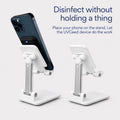
A UVCeed session is built around aiming at one section, a desk, a door handle zone, a shared bathroom counter, and holding until the app confirms that section's dose is complete before moving to the next. For a dorm room or shared space, running a session over frequently touched surfaces adds a layer of protection that doesn't depend on remembering to carry (or correctly use) sanitizer that wasn't going to work against this virus anyway.
FAQ
Why doesn't hand sanitizer work on norovirus? Norovirus lacks the lipid envelope that alcohol-based sanitizers are designed to break down, which makes it substantially more resistant than many other common viruses. The CDC recommends soap and water instead, for the mechanical removal, not just chemical disruption.
How long does norovirus survive on surfaces? It can persist on hard surfaces for days, and in some conditions weeks, if not properly disinfected, which is part of why outbreaks in shared living spaces can drag on even after the first wave of cases resolves.
How contagious is norovirus really? Extremely. It takes as few as 10 to 100 viral particles to cause infection, an amount far smaller than what most other common illnesses require, which is why it spreads so efficiently through shared bathrooms and dining spaces.
Can UV-C be used on soft surfaces like bedding? UVCeed is designed for hard, line-of-sight surfaces. For bedding and laundry, hot-water washing remains the better tool; use UV-C for the hard surfaces around the bed and room, not as a laundry replacement.
If my roommate is sick, how long should I keep disinfecting after they recover? Norovirus continues shedding in stool for up to two weeks after symptoms resolve in some cases, so continuing surface disinfection for at least a week past recovery is a reasonable precaution.
Want More Articles Like This?
Get research on UV-C treatment and product updates delivered to your inbox.