TL;DR
One of our team members just got back from 7 nights on Icon of the Seas. They got sick on night one, a headache showed up every single day of the trip, and the actual flu symptoms did not hit until the last day, which means they spent almost a full week touching buffet tongs, handrails, elevator buttons, salt and pepper shakers, the stateroom phone, and the TV remote while contagious and not knowing it. That space between feeling off and knowing you are actually sick is the whole problem with cruise ship illness, and it is longer than most people think.
What Actually Happened
Night one of a 7-night cruise, they had diarrhea. Not fun, but they chalked it up to travel food and figured it would pass. Thankfully it was not norovirus, which is the outbreak everyone worries about on cruise ships and can knock out a meaningful share of a sailing when it spreads. But starting that same night, they had a headache every single day of the trip. Every day. They assumed it was the sun, the drinks, the recycled air, dehydration, anything but what it actually was.
The real flu symptoms, the fever, the body aches, the feeling like they got hit by a truck, did not show up until the last day of the trip. By then they had already spent 6 full days in the Windjammer buffet line, riding elevators multiple times a day, holding handrails on every staircase, reaching for salt and pepper shakers at nearly every meal, and touching the phone and TV remote in their stateroom every night.
That is the part nobody tells you about getting sick on a cruise. You do not get a warning shot. Influenza has an incubation period that typically runs 1 to 4 days before symptoms appear, and during at least part of that window a person can already be shedding virus, according to the CDC. A headache and mild GI symptoms on night one, with the real illness not landing until day 7, fits that window. It also means our team member was a contagious person touching shared surfaces for the better part of a week while thinking they just had a headache from the sun.
What Is Actually On Those Surfaces
They did not make up the touchpoints. Here is what the ship actually put in front of every passenger, repeatedly, all week:
- Windjammer buffet tongs and serving utensils. Every dish has one set of tongs, touched by hundreds of hands a day. Health and travel experts consistently flag shared buffet serving utensils and condiment stations as high-touch hotspots precisely because hundreds to thousands of passengers cycle through them daily, per Yahoo Travel.
- Salt and pepper shakers. Restaurant hygiene research consistently ranks salt and pepper shakers among the dirtiest tableside items, right behind the menu, because they get handled by every table before any cleaning happens between uses, per Yahoo Travel.
- Handrails and elevator buttons. Nonporous, frequently touched, rarely wiped between uses on a ship carrying thousands of passengers a day.
- The stateroom phone and TV remote. A University of Houston study with researchers from Purdue and the University of South Carolina tested hotel room surfaces across three states and found the TV remote among the most contaminated items in the room, with mean bacterial contamination rivaling or exceeding the bathroom sink, and lab testing on one remote turning up E. coli, indicating fecal contamination, per NBC News. Cruise staterooms get the same nightly turnover cleaning as hotel rooms, and the remote and phone are exactly the kind of hard, frequently-touched, easily-missed items that fall through the cracks.
On top of the surfaces, the flu virus itself is durable. Research on influenza A and B shows both survive 24 to 48 hours on hard, nonporous surfaces like stainless steel and plastic, which describes almost every high-touch point on a ship, according to the CDC and coverage of the underlying research at Norton Healthcare. That is a full window where the virus stays viable on a handrail or a shaker between the time an infected passenger touches it and the time the next passenger does.
To be fair to the science, surface contact is not considered the primary way flu spreads. Respiratory droplets and aerosols from close contact do most of the work, and researchers at the University of Minnesota's Center for Infectious Disease Research and Policy have concluded the odds of catching flu from a dried surface alone are low. But a cruise ship is not a low-contact environment. It is thousands of people in enclosed spaces, shared dining, shared elevators, and shared air for a week straight, which stacks both the droplet risk and the surface risk on top of each other rather than replacing one with the other.
None of this is specific to Icon of the Seas. The CDC's Vessel Sanitation Program has logged multiple gastrointestinal outbreaks across different ships and cruise lines in 2026 alone, several confirmed as norovirus and others as E. coli, each one triggered once 3% or more of passengers or crew report symptoms to the ship's medical staff, per the CDC Vessel Sanitation Program. That 3% threshold is a real number worth sitting with. On a ship carrying several thousand people, you do not need many contagious passengers moving through the buffet line before enough surfaces are seeded to matter.
What They Would Do Differently
- Do not wait for a fever to treat a headache and GI symptoms as contagious. If something is off in the first 24 hours of a trip, assume you might be shedding virus during the days that follow, not just on the day you feel worst.
- Treat the shakers and buffet tongs as shared risk, not seasoning. Use hand sanitizer immediately after the buffet line, before you eat, not after.
- Wipe or treat the stateroom phone and remote on arrival. Housekeeping turnover between passengers does not reliably reach these two items, based on the hotel research above, and a cruise stateroom sees the same turnover pressure a hotel room does.
- Use the handrail, but wash or sanitize right after, especially before your next meal or before touching your face.
- Pack something that treats surfaces without needing a sink or wipes, since a stateroom bathroom and a pack of sanitizing wipes do not cover a phone, remote, or the tray table at dinner.
Where UV-C Fits (and Where It Does Not)
254 nm UV-C inactivates bacteria and, at sufficient dose, damages viral genetic material on hard, non-porous surfaces by disrupting the DNA or RNA that lets a pathogen replicate. That covers the stateroom phone, the TV remote, the tray table, and the bathroom fixtures in a cabin, exactly the items housekeeping turnover is least likely to reach thoroughly between passengers. It does not stop droplet or airborne transmission in a crowded dining room or elevator, and it is not a substitute for hand hygiene at the buffet line, where your hands are the actual transfer point between the tongs and your face.
Where UVCeed Fits
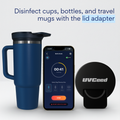
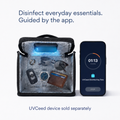
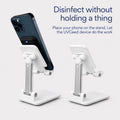
UVCeed is a 254 nm UV-C device that pairs with your phone camera and app to guide a session across a surface. In a stateroom, that means aiming it at the phone, then holding it steady while the app confirms that section is complete, then moving to the remote, then the tray table, rather than guessing whether a wipe actually covered the whole thing. It runs on USB-C, so it charges with everything else already in your carry-on, and a tilt-safety shutoff turns the lamp off if the device rotates away from the target, which matters in a stateroom bathroom the size of a closet.
It will not fix the buffet line or the elevator button in the moment, that is what hand sanitizer and hand-washing are for, but it covers the surfaces that come back to your cabin with you every night for the length of the cruise.
FAQ
How do I know if I have norovirus or the flu on a cruise? Norovirus tends to hit fast and hard with vomiting and diarrhea as the dominant symptoms and usually resolves within 1 to 3 days. Flu more commonly presents with fever, body aches, headache, and fatigue, and can take longer to fully clear. If GI symptoms show up on night one and headache or body aches persist for days afterward, as happened on our team member's trip, it is worth treating both possibilities seriously rather than assuming it is only one or the other.
Why does the CDC only step in when 3% of a ship reports symptoms? That threshold is the Vessel Sanitation Program's operational trigger for posting a gastrointestinal outbreak, not a claim that illness below 3% does not matter. Individual cases, including the one described here, do not show up in that data at all, per the CDC Vessel Sanitation Program.
Is the buffet actually riskier than the sit-down dining rooms? Shared serving utensils and condiment stations create more contact points per item than a server-plated meal does, which is why buffets are flagged more often in cruise hygiene coverage, per Yahoo Travel. That does not make sit-down dining risk-free, it just spreads fewer hands across the same shaker or bread basket.
Can UV-C be used on the food itself, like bread or the buffet plate? 254 nm UV-C does inactivate bacteria on food surfaces where there is direct line of sight, but FDA rules prevent us from citing a specific reduction percentage on food, so we do not. On a cruise, the more practical use is the tongs handle, the tray table, and your own plate rim before you sit down, not the food itself.
Does getting a flu shot before a cruise actually help? Yes. Vaccination reduces the likelihood and severity of flu illness and is one of the few pre-trip steps that addresses the droplet and aerosol transmission route that surface disinfection cannot touch, per the CDC.
The Bottom Line
Our team member felt "off" on night one and did not feel actually sick until the last day of a 7-night cruise. In between, they touched every shared surface on that ship the way every other passenger does, tongs, handrails, elevator buttons, shakers, and they carried the stateroom phone and remote back to their own cabin every night without a second thought. The lesson is not that cruises are uniquely dangerous. It is that the gap between being contagious and clearly feeling sick is longer than it feels in the moment, and the surfaces you touch during that gap do not know the difference.
Want More Articles Like This?
Get research on UV-C treatment and product updates delivered to your inbox.