TL;DR
- Nail salon pedicure infections and unlicensed med spa procedures are documented, recurring public health events, not rare anecdotes, and they show up in CDC reports, court records, and city investigations. NEJM, CBS News
- State cosmetology boards mandate specific tool and pedicure basin disinfection protocols, and inspectors do cite salons for skipping them. California Board of Barbering and Cosmetology, Virginia Administrative Code
- A 2025 NYC Council and state investigation found violations at every single med spa it inspected, including sanitation and licensure failures. NYC Council
- 254nm UV-C is a legitimate supplement for surfaces, tool handles, and treatment areas, but it does not replace liquid disinfectant immersion or autoclave sterilization for anything that penetrates skin.
Why this is a licensing and news story, not just a hygiene tip
If you run a nail salon, hair salon, or med spa, you already know inspectors show up unannounced and clients Google your name before they book. What you may not know is how well documented the failure cases are.
The foundational case study is an outbreak investigated by public health researchers and published in the New England Journal of Medicine: more than 110 patrons of a single California nail salon developed furunculosis (painful boil-like skin lesions) traced to whirlpool pedicure footbaths contaminated with rapidly growing mycobacteria, with leg shaving before the pedicure identified as a major risk factor because it created micro-abrasions for bacteria to enter through NEJM. A follow-up CDC-affiliated study of 18 California nail salons found mycobacteria in 29 of 30 footbaths tested, thriving in organic debris trapped behind the footspa recirculation screens, a design and cleaning issue, not a one-off accident CDC Emerging Infectious Diseases. Clinical literature has continued documenting pedicure-associated mycobacterial infection clusters since then, describing it as an "endemic disease" tied to footbath maintenance Clinical Infectious Diseases, Oxford Academic.
Med spas carry a sharper version of the same risk because procedures break the skin. In April 2024, the CDC published its first documented case of HIV transmission linked to nonsterile cosmetic injection services: three women were infected after "vampire facial" microneedling and platelet-rich plasma treatments at an unlicensed spa in Albuquerque, New Mexico, where investigators found unlabeled tubes of blood on a kitchen counter and injectable products stored alongside food in a refrigerator CBS News. The owner was later convicted of practicing medicine without a license, and the case is now a standard reference point in state and local med spa investigations.
Those investigations are still happening. In late 2025, a joint New York City Council and state investigation inspected 15 medical spas across the five boroughs and found a violation at every single one: 100% were performing medical procedures without required licensure, 60% carried no liability insurance, and 53% had documented sanitation or hygiene issues NYC Council press release. Four of those businesses have already lost their licenses. The message for owners: sanitation and licensing are now treated as the same enforcement problem.
What the rules actually require, and what happens if you skip them
State cosmetology boards do not leave "clean" to interpretation. California's Board of Barbering and Cosmetology requires that non-electrical tools have all visible debris removed, be washed with soap and water, dried, and then fully immersed in an EPA-registered disinfectant proven bactericidal, fungicidal, and virucidal before reuse; containers must be labeled, covered, and changed per the manufacturer's instructions or whenever they turn cloudy California Board of Barbering and Cosmetology. Virginia's cosmetology code goes further on pedicure units, requiring that after draining and scrubbing the basin, operators disinfect it with an EPA-registered, bactericidal, virucidal, and fungicidal product per the manufacturer's contact-time directions Virginia Administrative Code 18VAC41-20-270. These are the specific line items an inspector checks during a walkthrough, not general suggestions.
Enforcement is active at the state level too. In Washington State, more than 100 salons were cited by the Department of Licensing for license, sanitation, or safety violations in a single sweep, and individual salons have separately been fined for using improperly disinfected tools and storing dirty instruments alongside clean ones KHQ Spokane. Violations for improper disinfection or banned chemicals commonly draw fines in the $500 to $5,000 range per citation, and repeat findings can escalate to suspension.
For med spa owners, the stakes compound because liability sits on top of the same sanitation rules. Anything that penetrates skin, needles, cannulas, microneedling tips, laser handpieces contacting broken skin, falls under sharps handling and sterilization requirements stricter than standard salon tool disinfection, and a breach can trigger a malpractice claim, a medical board complaint, and a licensing board complaint at once. That is the exposure a single unsterilized needle created in the Albuquerque case, and it is what regulators are now actively hunting for in inspection sweeps.
There's also a client trust dimension that shows up directly in revenue. Surveys of beauty salon customers consistently find that cleanliness and visible hygiene of equipment rank among the top factors clients judge within seconds of walking in, and that cleanliness is one of the most frequently mentioned themes in online reviews, for better or worse Service Quality and Customer Satisfaction among Beauty Salons. In an industry where "nail salon infection" and "med spa outbreak" are now real, searchable news categories, a visibly clean, documented sanitation routine isn't just about passing inspection. It's a retention and reputation tool.
A practical compliance checklist
- Immerse, don't just wipe, multi-use tools. Follow your state's exact protocol (remove debris, wash, dry, then fully submerge in an EPA-registered disinfectant for the labeled contact time) rather than a quick spray-and-go California Board of Barbering and Cosmetology.
- Treat pedicure basins as a distinct risk category. Drain, scrub, and disinfect with an EPA-registered bactericidal/virucidal/fungicidal product after every client, given that footbath biofilm is the documented source of past mycobacterial outbreaks CDC Emerging Infectious Diseases.
- Never skip skin-penetrating sterilization for speed. Needles, lancets, microneedling cartridges, and anything that draws blood require single-use disposal or true sterilization (autoclave), not surface wiping, the exact failure point in the CDC's Albuquerque HIV case CBS News.
- Confirm licensure and insurance are current and displayed, since the 2025 NYC investigation found licensure display failures at 93% of inspected med spas NYC Council.
- Log your disinfection routine, with time-stamped records for tool immersion, basin cleaning, and treatment bed turnover, so documentation is ready if a board inspector or client's attorney asks.
- Make sanitation visible to clients, not just compliant on paper: label containers per code, post your protocol, and let clients see tools coming out of sealed, sterilized packaging.
Where UV-C fits, and where it doesn't
254nm UV-C light is a genuine, well-established germicidal tool, but it works within a narrow set of physical rules that matter for how you deploy it in a salon or med spa.
UV-C only disinfects what it directly reaches. It has no effect on surfaces in shadow, underneath an object, or covered by debris, hair, or product residue, which is why the FDA is explicit that UV-C cannot inactivate pathogens it does not physically strike FDA. That makes it well suited to exposed surfaces like a treatment bed, chair armrest, tool handles, or the exterior of a pedicure basin, and poorly suited to hinges, crevices, or porous material where debris can hide.
UV-C is also not a substitute for state-mandated liquid disinfection or sterilization. Nothing in cosmetology board rules, and nothing in med spa regulation, treats UV-C light as an approved alternative to full immersion in an EPA-registered disinfectant for reusable tools, or to autoclave sterilization for needles, cannulas, and anything that penetrates skin. For those items, the board-required liquid or heat protocol is still mandatory.
And UV-C at 254nm carries a real, documented direct-exposure hazard. Skin and eye contact with germicidal UV-C can cause painful burns and eye injury, which is exactly why safety guidance calls for using exposed-lamp UV-C only in unoccupied areas, or with a device engineered specifically for safe operation around people FDA. Any UV-C device used in a working salon or spa needs to be handled the same way you'd handle any other occupational hazard: aimed deliberately, used when the area is clear, and never pointed at skin or eyes.
Used correctly within those limits, UV-C is a genuinely useful supplement to your existing sanitation program, not a replacement for it.
Where UVCeed fits
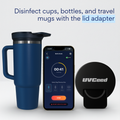
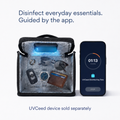
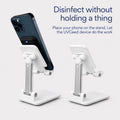
UVCeed is a portable 254nm UV-C device built for exactly this kind of supplemental, surface-level disinfection between clients, in the gaps where liquid disinfectant protocols aren't practical or aren't required.
In a hair or nail salon, that means running UVCeed over the treatment chair, armrest, and tray surface between clients while tools go through their required liquid immersion cycle separately. It's a fast way to hit surfaces that never get submerged in disinfectant but still get touched constantly: chair arms, checkout tablets, doorknobs, and reception counters.
In a med spa, the deployment follows the same logic in a higher-stakes setting: aim the device at the treatment bed and adjustable headrest between clients, hold steady until the app confirms the section is complete, then move to the next section, covering the tray surface holding non-invasive tools (never needles or cannulas, which still require mandated sterilization) and waiting-area touchpoints like door handles and consultation tablets. None of that replaces your autoclave or EPA-registered disinfectant log. It closes the gap on everything those protocols don't cover, and gives you something concrete to show a client who asks what you do between appointments.
FAQ
Does UV-C disinfection satisfy my state cosmetology board's sanitation requirements? No. Boards like California's and Virginia's specify liquid immersion in an EPA-registered disinfectant for multi-use tools and pedicure basins. UV-C is a supplement for surfaces, not a substitute for the required protocol California Board of Barbering and Cosmetology.
Can I use UV-C on needles or injectable equipment? No. Anything that penetrates skin requires single-use disposal or true sterilization (autoclave), the same standard implicated in the CDC's documented HIV transmission case at an unlicensed med spa CBS News. UV-C should never be used as a stand-in for that requirement.
Is it safe to run a UV-C device while clients are in the room? Direct UV-C exposure to skin and eyes can cause burns and eye injury, so exposed-lamp devices are meant for unoccupied areas or need to be engineered specifically for safe operation around people FDA. Always follow the device's stated safety guidance and never aim it at skin or eyes.
Are pedicure footbaths really a documented infection risk, or is that overstated? It's documented and recurring, not overstated. A California outbreak affected more than 110 pedicure clients and was published in the New England Journal of Medicine, and a follow-up study found mycobacteria in 29 of 30 footbaths tested across 18 salons NEJM, CDC Emerging Infectious Diseases.
Does visible sanitation actually affect client retention, or is it just an inspection issue? Both. Cleanliness is one of the most frequently cited factors in salon customer satisfaction and online reviews, meaning your sanitation routine functions as marketing whether or not you treat it that way Service Quality and Customer Satisfaction among Beauty Salons.
The bottom line
Salon and med spa sanitation sits at the intersection of three things owners can't afford to get wrong: license, liability, and whether clients book again after reading the news. The documented cases above, from footbath outbreaks to an unlicensed med spa's HIV transmission case to a city investigation that found violations everywhere it looked, aren't outliers meant to scare you. They're why the rules exist, and what inspectors and prospective clients are now primed to ask about. Keep your required liquid disinfection and sterilization protocols exactly as your board mandates, and use a fast, visible supplement like UVCeed to cover the surfaces in between.
Want More Articles Like This?
Get research on UV-C treatment and product updates delivered to your inbox.