TL;DR
Scientists at Eurac Research just published findings in the journal Microbiome showing that living microbes, including cold-adapted yeasts and ancient gut bacteria, are still alive inside Ötzi the Iceman, a mummy who died around 3300 B.C. and was preserved in an Alpine glacier for 5,300 years. If bacteria can survive five millennia frozen in ice, the "I wiped it down this morning" strategy on your kitchen counter is not the disinfection plan you think it is. 254 nm UV-C, delivered in an app-guided session, inactivates bacteria and viruses on hard surfaces in seconds.
What the researchers actually found
Ötzi was discovered in 1991, melted out of an Alpine glacier by hikers. He was between 25 and 35 when he died, 5'2", with an arrowhead in his shoulder. He has been studied for more than three decades. Everyone assumed that after 5,300 years and after 30 years in a museum climate-controlled cell at the South Tyrol Museum of Archaeology in Bolzano, whatever microbes had once lived on and in him were long dead.
They were wrong.
A team led by Frank Maixner at Eurac Research's Institute for Mummy Studies analyzed tissue samples, swabs, the ice surface, meltwater, intestinal tissue, and stomach contents. They found:
- Cold-adapted yeast species from glacial environments still alive on the body
- Ancient gut bacteria not present in any modern human intestine
- A mixed community of ancient and modern microorganisms coexisting inside the mummy
Frank Maixner's quote, on the record: "These yeasts have accompanied Ötzi on his long journey through the millennia."
Why this matters for the surfaces in your home
The Ötzi finding is not just a fun archaeology story. It is a warning about how underestimated microbial survival is in the general public.
Consider the conditions bacteria and yeast survived on Ötzi:
- 5,300 years frozen at high altitude
- Repeated freeze-thaw cycles as the glacier shifted
- Three decades of controlled museum preservation
Now consider the conditions on your kitchen sponge, your phone screen, your child's water bottle:
- Warm
- Damp
- Rich in organic material (food particles, skin cells, saliva)
- Touched dozens of times a day
The CDC has been clear for years that cleaning (removing visible dirt) is not the same as disinfecting (killing pathogens). See the CDC's guidance: Cleaning and Disinfecting Your Home - CDC.
A wet paper towel spreads bacteria around. Alcohol wipes evaporate before they can do the full 30-second wet-contact time the label requires. Bleach damages electronics, laminate, and skin.
What actually kills bacteria that resilient
254 nm UV-C light. It's the wavelength that damages microbial DNA and RNA so pathogens cannot replicate. It has been used in hospitals, water treatment plants, and municipal sanitation systems for decades. The EPA and FDA both recognize UV-C as an established disinfection technology. See: Ultraviolet Radiation - U.S. FDA.
UV-C works because it doesn't care whether bacteria are "resilient." It doesn't matter if the organism has survived glacial ice for 5,000 years. Direct-line-of-sight UV-C photons at 254 nm break the molecular bonds in nucleic acids. Full stop.
Where UVCeed fits
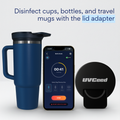
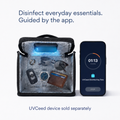
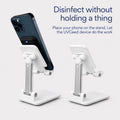
UVCeed is a smartphone-mounted 254 nm UV-C device that guides you through a session using the built-in app. You point it at the surface you want to disinfect, hold it steady, and the app tells you when that section is complete. If the surface is larger than the beam's coverage area, you move to the next section and repeat.
Not a sweep. A session. Aim, hold, confirm, next.
Built-in features:
- 254 nm UV-C (the germicidal wavelength)
- App-guided coverage so you know when a section is truly done
- Tilt-safety shutoff so it will not fire if it's pointed at you or a pet
- USB-C charging
- Pocket-sized, safe for phones, laptops, keyboards, remotes, doorknobs, faucet handles, and yes, kitchen counters
Practical checklist: the surfaces in your home that deserve a session this week
- Kitchen sponge (run a session on both sides, top and bottom, holding until the app confirms each section)
- Fridge handle
- Faucet handles (hot and cold, both sides)
- Cutting board (after washing, run a session across each quadrant)
- Phone (front, back, sides)
- TV remote (buttons, edges, back)
- Doorknobs (interior and exterior, front and back)
- Light switches in the kitchen and bathroom
- Toothbrush handle and holder base
FAQ
How is UV-C different from a UV nail lamp or a black light? Different wavelengths, different purposes. UV-C is 200-280 nm and is germicidal. UV-A (used in nail lamps and black lights) is 315-400 nm and is not effective for disinfection. UVCeed uses 254 nm specifically because that is the wavelength most effective against microbial DNA.
Is UV-C safe around kids and pets? UVCeed's tilt-safety shutoff means the device stops emitting if the beam is pointed anywhere except at the intended surface. Never look directly at the light while it's active. Do a session on your child's toys and their room while they're not in it.
How long does a session take? Each section takes 30 to 60 seconds depending on distance from the surface, and the app tells you exactly when the section is complete. You don't guess.
Can I use UVCeed on food? 254 nm UV-C inactivates bacteria on food surfaces. FDA regulations prevent us from citing a specific reduction percentage on food, so we don't. UV-C is a supplement, not a substitute for washing and proper cooking temperatures.
Does it work through glass or plastic packaging? No. UV-C is a line-of-sight technology. It disinfects what the light directly touches.
The bottom line
If 5,300 years of glacial ice can't kill microbes, a spray-and-swipe with a damp cloth is not the standard of care. UV-C at 254 nm is what actually works, and UVCeed puts that technology in your pocket with app-guided sessions so you know each section is done, not guessed.
Want More Articles Like This?
Get research on UV-C treatment and product updates delivered to your inbox.