TL;DR
Doctors are warning that gastrointestinal illnesses are surging among summer travelers, with 30 to 70 percent of people getting sick during a two-week trip depending on destination and season. The recommended travel kit is well known: rehydration salts, loperamide, bismuth subsalicylate, hand sanitizer with at least 60 percent alcohol. What most people don't pack, and what actually protects the shared surfaces you touch every 90 seconds on a trip, is a 254 nm UV-C device. UVCeed runs an app-guided session on hotel remotes, airplane tray tables, cruise cabin door handles, and rental car steering wheels in about a minute per section.
What the doctors are actually saying
Chad D. Neilsen, Director of Infection Prevention and Control at Nemours Children's Health in Florida, and Bethany Doerfler, Senior Clinical Research Dietitian at the Digestive Health Institute of Northwestern Medicine, both told Fox News Digital in July 2026 that gastrointestinal illness in travelers is spiking, and that dehydration alone can escalate a "routine" stomach bug into an ER visit.
The stat that should get your attention: travelers' diarrhea affects an estimated 30 to 70 percent of travelers during a two-week trip.
Source: Stomach bugs surging: Doctors say travel essentials could save your trip - Fox News, July 19, 2026
The CDC's Yellow Book, the official travel medicine reference, backs the same numbers and pushes hand hygiene, safe food and water choices, and prophylactic bismuth in high-risk regions. See: Travelers' Diarrhea - CDC Yellow Book.
What the standard travel kit gets right
The doctors quoted in the Fox News piece and the CDC agree on the basics:
- Oral rehydration salts or electrolyte packets (the single most important item)
- Loperamide (Imodium) for mild cases
- Bismuth subsalicylate (Pepto-Bismol)
- Hand sanitizer with at least 60 percent alcohol for situations where soap and water are not available
- Food strategy: peelable produce (bananas, avocados, melons) over leafy greens; cook higher-risk vegetables to over 160°F
That's a solid kit. It handles what goes into your mouth and what's on your hands.
It does not handle what's on the surfaces between the two.
The gap in the standard travel kit
Here is a hygiene reality check on the surfaces you touch on a normal trip, from research the industry doesn't like to publicize:
- Airplane tray tables were found to have more bacteria than the lavatory flush button in the widely-cited Auburn University study on airplane cabin surface microbial survival. See the study coverage: Auburn study on airplane surfaces.
- Hotel TV remotes and light switches are two of the most contaminated items in a standard hotel room per the University of Houston hospitality microbiology work. Housekeeping cleans surfaces you'd expect (bathroom, sheets) but rarely wipes the remote or the switch.
- Cruise cabin door handles are a well-documented norovirus vector, which is why the CDC's Vessel Sanitation Program specifically tracks these. See: CDC Vessel Sanitation Program.
- Rideshare and rental car steering wheels are handed off between drivers without a wipe-down between users.
Hand sanitizer works for the last two inches. It doesn't work for the surface your hands touched three seconds ago.
Where UVCeed fits in your travel bag
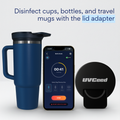
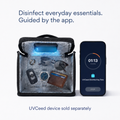
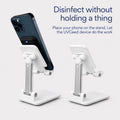
UVCeed is a smartphone-mounted 254 nm UV-C device that runs an app-guided session. You aim it at a surface, hold it steady, and the app confirms when that section is complete. If the surface is larger than the beam's coverage area (a hotel desk, say, or a cruise cabin nightstand), you move to the next section and run another session.
Built for travel:
- Pocket-sized, USB-C charging, fits in a carry-on
- 254 nm UV-C, the germicidal wavelength recognized for disinfection by the FDA and EPA
- Tilt-safety shutoff so it will not fire if the beam is pointed at your face or a kid
- App-guided sessions so you don't guess whether a section is done
- Compatible with iPhone and Android
The travel session checklist
Run a session on these surfaces the moment you enter a new space:
On the plane:
- Tray table (top and underside)
- Seat belt buckle
- Armrest
- Air vent knob
- Touchscreen (if the seatback has one)
At the hotel or Airbnb:
- TV remote (front, back, buttons)
- Light switches (bedroom, bathroom, entry)
- Doorknobs (interior and exterior)
- Thermostat
- Bedside table surface
- Bathroom faucet handles
On a cruise:
- Cabin door handle (interior and exterior)
- Muster station handrail seat
- Elevator buttons before you press
- Buffet tongs and drink dispenser levers (or use them, then session your hand's follow-up surface, or session the tong handles when the line is thin)
In a rideshare, rental car, or e-scooter:
- Steering wheel
- Gear shifter
- Door handle (interior)
- Radio and AC touch controls
- Scooter handlebar grips
FAQ
How long does a session take? 30 to 60 seconds per section, depending on distance. The app tells you when the section is complete. No guessing.
Is it TSA compliant? Yes. UVCeed is a small USB-C-charged personal electronic device, categorized like any small charger or hairdryer accessory. Pack it in your carry-on.
Does UV-C kill norovirus? 254 nm UV-C is effective against norovirus on hard, non-porous surfaces in direct line of sight. See: Norovirus Environmental Cleaning - CDC.
Should I still use hand sanitizer? Yes. UV-C on the surfaces, alcohol on your hands. They work together. Norovirus specifically is not well-inactivated by standard alcohol sanitizers, which is why surface disinfection matters even more when norovirus is circulating.
Can I use it on my kids' stuff on the trip? Yes. Run a session on their tablet, headphones, water bottle exterior, and stroller handle. Tilt-safety keeps the beam pointed at the surface, not at them.
The bottom line
The CDC and every travel doctor agree: rehydration, loperamide, bismuth, hand sanitizer. Pack all of it. But the hand-sanitizer-only strategy leaves the surfaces you touch every 90 seconds on a trip completely unaddressed. UVCeed closes that gap with app-guided 254 nm UV-C sessions in about a minute per section.
Sick days on a trip you paid for are the worst kind of sick days.
Want More Articles Like This?
Get research on UV-C treatment and product updates delivered to your inbox.