TL;DR
The cyclospora outbreak linked to Taylor Farms de Mexico iceberg lettuce, first tied to Taco Bell restaurants over the summer, has grown into one of the largest foodborne illness events in recent U.S. history: 11,458 illnesses across 20 states and 2 deaths, both in Michigan patients with underlying health conditions. The FDA just expanded the outbreak states list to include Georgia, Tennessee, and Texas. If your family still buys bagged or chopped lettuce, this is worth five minutes of your attention.
What actually happened
Cyclospora cayetanensis is a single-celled parasite that causes watery diarrhea, cramping, nausea, fatigue, and weight loss, sometimes for a month or longer, with symptoms that can relapse. The FDA's outbreak investigation traced the source to iceberg lettuce supplied by Taylor Farms de Mexico, which moved through Taco Bell's supply chain before spreading into retail channels.
As of the FDA's August 28, 2026 update, the case count sits at 11,458 confirmed illnesses across 20 states, with hundreds of hospitalizations and 2 deaths, both in Michigan among people with underlying health conditions, according to Fox Business's coverage of the expansion. Georgia, Tennessee, and Texas were the three newest states added to the list.
The ripple effect has hit grocery shelves too. Dave Ciesinski, president and CEO of The Marzetti Company, told investors that leafy green sales fell as much as 30% at the start of the outbreak, with broader vegetable sales down 16-17% and fruit sales also declining, a sign of how quickly consumer trust erodes once a produce category gets tied to a national outbreak.
Why lettuce is such a hard problem
Cyclospora oocysts have a thick protective wall that makes them notoriously resistant to standard kitchen washing. The CDC is direct about this: rinsing produce under running water reduces but does not eliminate contamination, because the parasite can be embedded in leaf folds and crevices that water simply doesn't reach. Chlorine-based sanitizers, which work well against many bacteria, are not effective against cyclospora's resistant oocyst wall either.
That's part of why bagged and pre-chopped lettuce is a recurring outbreak vector: once contamination happens upstream at the farm or processing facility, no amount of home washing fully undoes it.
What to actually do this week
- Check any bagged, chopped, or pre-washed iceberg lettuce in your fridge against the FDA's current recall list before using it.
- Rinse whole-head lettuce under running water and separate the outer leaves, which carry more surface contamination than the inner core.
- Keep raw produce away from cooked or ready-to-eat foods on cutting boards and in the fridge.
- Run a UV-C session over the produce drawer, cutting board, and colander after prepping greens, since these are the surfaces that carry contamination forward to the next meal even after the lettuce itself is gone.
Where UVCeed fits
254 nm UV-C inactivates bacteria and protozoa on food surfaces, including leafy greens, by damaging their DNA so they can't reproduce or cause infection. FDA rules prevent us from citing a specific reduction percentage on food, so we don't, but UV-C is a genuine supplement to washing, not a replacement for it. Rinse first, then run a session on the produce and the surrounding prep zone.
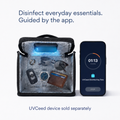
With UVCeed, you aim the device at one section, the produce, the cutting board, the colander, and hold it steady until the app confirms that section is complete. If the surface is larger than the coverage area, like a full cutting board or the inside of your crisper drawer, move to the next section and repeat until you've covered the whole area. No wiping, no chemical residue near food.
FAQ
Is the recalled lettuce still on shelves? Check the FDA's current recall notice for specific lot numbers and retailers; the situation is still active as of this writing.
Can I use UVCeed directly on produce? Yes. 254 nm UV-C inactivates bacteria and protozoa on food surfaces including leafy greens. FDA rules prevent us from citing a specific reduction percentage on food, so we don't. Wash first, then run a session on the produce itself.
Does washing lettuce remove cyclospora? Rinsing reduces contamination but does not reliably eliminate cyclospora oocysts, according to the CDC, because the parasite resists standard washing and chlorine-based sanitizing.
How long do cyclospora symptoms last? The CDC notes symptoms typically begin about a week after infection and can last from days to a month, sometimes reappearing.
What surfaces should I disinfect after prepping greens? Cutting boards, colanders, the produce drawer, and any counter space the lettuce touched, since these can carry contamination forward even after the lettuce is gone.
Want More Articles Like This?
Get research on UV-C treatment and product updates delivered to your inbox.