TL;DR
The CDC has recorded more than 21 cruise ship norovirus outbreaks in the 2025-2026 season, with the most recent reported incident sickening nearly 100 people. Norovirus accounts for over 90% of diarrheal disease outbreaks on cruise ships, and the CDC's Vessel Sanitation Program tracks every one of them publicly. This piece covers what the current outbreak data shows, why cruise ships are a persistent hotspot, and the cabin-level habits that actually reduce your exposure.
What Actually Happened
The CDC reported its 21st cruise ship norovirus outbreak of the 2025-2026 season, with nearly 100 passengers and crew affected. It follows a string of recent incidents tracked by the CDC's Vessel Sanitation Program, including the Westerdam in March with 76 ill and the Rotterdam in January with 89 ill.
The scale of the pattern, not just a single ship, is what stands out in the underlying data:
- Since 2019, 81% of cruise ship acute gastroenteritis outbreaks posted to the Vessel Sanitation Program's public log were attributed to norovirus
- Norovirus causes over 90% of diarrheal disease outbreaks on cruise ships specifically, per CDC data
- Cruise-associated outbreaks are still a small share (about 1%) of all reported norovirus outbreaks nationally, meaning most norovirus spread happens on land, but cruise ships concentrate cases in a way that makes headlines
Why Cruise Ships Keep Reappearing in Outbreak Data
Norovirus needs very little to spread: as few as 10 viral particles can cause infection, and an infected person can shed billions of particles. A cruise ship compresses thousands of people into shared dining rooms, buffet lines, elevators, and cabin corridors for days at a time, which is close to ideal conditions for a virus that spreads through contaminated food, surfaces, and person-to-person contact.
The CDC's twice-yearly sanitation inspections and public outbreak logging exist precisely because this risk is structural to the cruise environment, not a sign that any individual ship is poorly run. When an outbreak is suspected, affected passengers are asked to provide stool or vomitus samples so the causative agent can be confirmed, which is how the Vessel Sanitation Program builds its public dataset.
What You Can Actually Control in Your Cabin
- Wash hands with soap and water, not just hand sanitizer, before eating and after using shared spaces. Norovirus is notably resistant to alcohol-based sanitizers, per CDC guidance, which is why handwashing matters more here than for many other pathogens.
- Disinfect high-touch cabin surfaces on arrival: the TV remote, phone, door handle, and bathroom fixtures, all of which are cleaned between passengers but not necessarily to a norovirus-specific standard before you board.
- Avoid self-serve buffet stations during any announced outbreak, and prefer served or plated options if the ship shifts protocols mid-cruise.
- Report symptoms immediately to the ship's medical staff rather than waiting them out; early reporting is how ships contain outbreaks before they spread further.
- Disinfect what comes home with you: your phone, luggage handles, and anything you set down in common areas during the trip.
Where UV-C Fits (and Where It Does Not)
UV-C at 254 nm is documented as effective against norovirus surrogates on hard, non-porous surfaces, damaging the virus's genetic material so it can no longer infect a host cell. This makes it a reasonable tool for cabin surfaces you control directly: the remote, the door handle, your phone, and bathroom fixtures.
Where it does not help: UV-C cannot disinfect food at a buffet line, and it will not reach norovirus embedded in carpet, upholstery, or bedding, which require standard laundering or facility-grade cleaning. It is also not a substitute for handwashing, which remains the single highest-yield control against norovirus specifically because the virus resists alcohol-based sanitizers.
Where UVCeed Fits
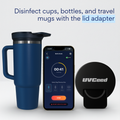
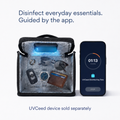
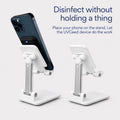
UVCeed is a compact 254 nm UV-C device built for exactly this kind of travel use case. It pairs with your phone camera and app to guide a session across a surface: you aim UVCeed at one section, hold it steady while the app confirms the section is complete, then move to the next section if the surface is larger than the coverage area.
On a cruise, a practical arrival routine covers the remote, door handle, bathroom fixtures, and your phone, all in a few short sessions with no chemical smell in a small cabin and no wipes to pack out. The tilt-safety shutoff turns the lamp off automatically if the device rotates away from the target.
FAQ
Are cruise ships actually riskier than land vacations? Cruise-associated outbreaks make up a small share of all reported norovirus outbreaks nationally, but the shared-space, high-density nature of a ship makes any single outbreak spread faster and become more visible, which is why the CDC tracks and publishes cruise data separately.
Does hand sanitizer protect me from norovirus? Not reliably. Norovirus is notably resistant to alcohol-based hand sanitizers, which is why cruise lines and the CDC both emphasize soap-and-water handwashing over sanitizer stations.
Can UV-C disinfect buffet food or utensils? No. 254 nm UV-C inactivates bacteria on food surfaces when there is direct line of sight, but FDA rules prevent us from citing a specific reduction percentage on food, so we do not, and utensils in active food service are outside the realistic use case for a personal UV-C device. Buffet-line risk is a food-service control issue, not something a passenger device addresses.
How would I know if my cruise has an active outbreak? The CDC's Vessel Sanitation Program publishes outbreak reports by ship and date. Cruise lines are also required to notify passengers and adjust onboard protocols during a confirmed outbreak.
What should I do if I get sick on board? Report symptoms to the ship's medical center immediately rather than self-isolating without notifying staff. Early reporting helps the ship contain the outbreak and gets you appropriate care faster.
The Bottom Line
Norovirus on cruise ships is a structural risk, not a random one, and the CDC's own data shows it recurs predictably every season. Handwashing is your first line of defense; disinfecting the cabin surfaces you actually control is the second.
Want More Articles Like This?
Get research on UV-C treatment and product updates delivered to your inbox.