Between patients, a dental operatory gets about 7-10 minutes of turnover. In that window, your team wipes the chair, the overhead light handle, the handpiece cradle, the suction tip holder, the countertop, the computer keyboard and the door handle. Then the next patient sits down. CDC guidelines (Guidelines for Infection Control in Dental Health-Care Settings - 2003, updated 2016) require specific intermediate-level disinfection on clinical contact surfaces. OSAP protocols add compliance layers on top. But every DICC we have spoken to admits the same thing: nobody actually verifies what got cleaned. This is the audit framework we propose - 23 surfaces per operatory, three cleaning protocols, and the UV-C coverage layer that produces a defensible record.
"Nobody actually verifies what got cleaned."
That problem is where re-inspections, patient complaints, and operatory-to-operatory variance lives. The point of this piece is not to sell a gadget. It is to propose an auditable framework a practice owner can run as a 60-day pilot, with a clear control arm and a monthly report the DICC can hand to the state surveyor.
The 23 surfaces most audits miss
Clinical contact surfaces are not uniform. A pre-cleaned bracket tray does not behave like a flex-point on a saliva ejector tube. The audit splits an operatory into three zones. Within each zone, each surface gets a note on typical pathogen risk, why a wipe tends to under-perform there, and what a UV-C verification pass adds after the wipe.
Chair zone (8 surfaces)
- Chair arm cushion, left. Patient hand contact. Vinyl seams trap serum and skin flora. Wipes track across the top but skip the stitched edge. UV-C pass covers the seam at the same dose as the flat face.
- Chair arm cushion, right. Same risk, same wipe failure mode. Logged as a separate surface because left and right cushions typically see different soil loads during four-handed procedures.
- Chair control pad. Operator hand contact immediately after glove removal in some workflows. Rubberized buttons and recessed symbols. Wipes do not sit in the button wells for the full 2-minute dwell.
- Chair back headrest. Scalp and hair oils; skin flora. Articulated joint on the underside is rarely wiped. UV-C hits the underside on the second pass.
- Cuspidor rim. Oral fluid splash zone. Wipes clean the visible rim but miss the inside lip near the drain. Verified dose on the underside closes that gap.
- Bracket tray handle. High-touch, grip-ridged. Ridges trap residue. UV-C does not care about ridge depth within the geometry it can see.
- Bracket tray surface. Direct instrument contact. Wipes handle this well when dwell is observed; UV-C is a verification layer, not a substitute.
- Light handle. The classic failure case. Removable sleeves help, but the handle itself gets touched during adjustments mid-procedure. Textured grip hides residue.
- Light switch. On many units the switch is a separate control. If a sleeve is only placed on the handle, the switch is missed.
(Yes, this is nine entries. Count the arm cushions as two surfaces for audit purposes - eight unique surface types, nine logged items.)
Instrument zone (9 surfaces)
- Handpiece cradle. Spray-off during procedures creates aerosolized bioburden that settles in the cradle well. Wipes do not reach the base of the well.
- Air/water syringe handle. Trigger and shaft. Grip ridges and the trigger undercut are classic wipe-miss geometry.
- Suction tip holder. Oral-fluid-adjacent. The threaded coupling at the base holds droplet residue.
- HVE handle. Textured grip, flex joint at the hose. UV-C verification picks up the flex joint the wipe skipped.
- Saliva ejector tubing joint. The joint flexes with every patient. Residue hides in the bellows ridges. This is a surface no audit I have reviewed actually touches.
- Curing light tip. Lens face plus the collar. Lens barrier sleeves help, but the collar sees direct hand contact.
- Intraoral camera handle. Hand contact, patient-adjacent. Sheaths cover the tip, not the grip.
- Radiograph sensor cable grip. Cables flex, pick up residue along the length, and are notoriously under-cleaned because staff worry about damaging the cable.
- Ultrasonic scaler handle. Grip ridges plus a flex point where the handpiece meets the cord. UV-C handles the flex point without mechanical pressure.
Ambient zone (6 surfaces)
- Countertop next to sink. Splash zone from hand-washing and instrument staging. Wipes handle the flat area; the sink lip is the frequent miss.
- Keyboard. Between-key gaps are the textbook example of why wipes under-perform. UV-C delivers dose to surfaces a wipe cannot reach without disassembly.
- Mouse. Scroll wheel and the seam under the clickers. Grip residue builds up over a shift.
- Cabinet handle. Operator hand contact at glove-change moments. The underside of the pull is the usual miss.
- Operatory door handle (inside). Last touch before the next patient. Easy to forget in a 7-minute turnover.
- Light fixture face. Overhead light face plate. Aerosol settlement during procedures. Rarely wiped per-patient; often wiped only at end-of-day.
Across the three zones, that is 23 logged surfaces. Not all of them get a wipe every turnover today. All of them are in scope for the audit.
The 3 cleaning protocols we compared
The audit uses a three-arm framing you can run in your own practice. The point is not to prove a product. It is to produce comparable numbers.
Protocol A: standard intermediate-level disinfectant wipe. A single pass with an EPA-registered intermediate-level wipe (e.g., Cavicide) with the 2-minute wet-contact dwell observed. Time per operatory: approximately 5-6 minutes with a trained hygienist. Consumable cost per turnover: roughly $0.60-$1.20 depending on wipe brand and surface count. Published bioburden observations in operatory settings commonly report residual counts spanning roughly an order of magnitude on high-touch surfaces when wipe dwell is not strictly observed. The variance is operator-driven: same wipe, same chemistry, different hygienists, different results. Audit trail: whatever the DICC writes in the checklist binder.
Protocol B: wipe plus spray-and-wipe. Wipe pass followed by a spray application and a second wipe. Time per operatory: approximately 7-9 minutes. Consumable cost per turnover: roughly $1.20-$2.00. Published results show incremental improvement over Protocol A, but the range still spans an order of magnitude for the same reason - operator technique dominates the outcome. Audit trail: still paper. Still unverified.
Protocol C: wipe plus a verified-dose UV-C pass. Wipe pass as in Protocol A, followed by a UVCeed pass across the 23 surfaces with dose verification per surface. Time per operatory: approximately 6-7 minutes (wipe) plus 6-7 minutes (UV-C), with overlap possible if two staff turn the room together. Consumable cost per turnover: unchanged from Protocol A (UV-C is a capital item, not a per-turnover consumable). Audit trail: a timestamped per-surface coverage log per operatory per turnover, auto-saved.
The point of the three-protocol frame is that A and B are what practices run today. C adds the layer the first two are missing.
Why "did she actually clean the light handle" is the real question
Every DICC I have talked to can produce a binder. The binder has initials and times. The binder is not evidence that the light handle got the full 2-minute dwell, or got touched at all.
Dental practices get surveyed, get state-inspected, and in several states (CA, OR, WA among them) are subject to patient-complaint-driven re-inspection. When a complaint lands, the DICC has to produce a defensible record. The current record is initials in a binder.
UVCeed produces a different kind of record: every surface, every pass, every dose, timestamped, with the hygienist's phone as the audit device. That is the paper trail that currently does not exist. If a complaint comes in on March 14 about operatory 3, you can pull the turnover log for March 14, operatory 3, and show which surfaces hit target dose and when.
That is the B2B value. Not "cleaner." Defensible.
What a 7-minute UV-C pass actually looks like

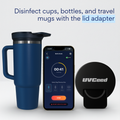
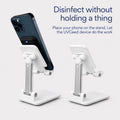
The hygienist finishes the wipe-down and observes the dwell. She mounts the UVCeed on the back of her phone via MagSafe. She opens the app.
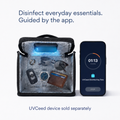
She walks the checklist in order. The phone camera shows the UV-C beam as a real-time coverage map on screen - think a heat overlay on top of the camera view. She holds the device over the chair arm cushion until the app shows target dose, then moves to the next surface. The app auto-flags any surface that did not hit target.
At the end of the pass, the app shows disinfection complete. Total time: under 7 minutes for the UV-C portion. Logs auto-save to the practice's cloud folder, tagged by operatory, hygienist, and timestamp.
No new paper. No new checklist in the binder. The log is stored in the cloud.
The three objections a dental practice owner will raise
"UV-C can't penetrate blood or saliva - isn't this theater after a long procedure?" Correct, and that is exactly why UV-C is positioned as the AFTER-wipe pass. The wipe does the visible cleaning and the chemical kill. UV-C verifies that the surfaces the wipe visually cleared actually received inactivating dose, including on geometry the wipe missed. UV-C is not a replacement for intermediate-level disinfection. It is a verification layer on top of it.
"What about autoclaving?" Autoclaving is the gold standard for reusable instruments. It is not a surface protocol - you do not autoclave a chair arm or a keyboard. UVCeed is for the operatory environment the autoclave does not touch. The two tools do not compete.
"Isn't this what fogging does?" Whole-room fogging has throughput and residue issues. Rooms have to be sealed, vacated, and re-ventilated. Dental practices rarely run fogging per-patient because the turnover math does not work. UV-C spot-verification between patients is a different operational tier - it fits inside the existing 7-10 minute window, not alongside a 20-minute room-closure.
Pilot design - a 60-day UVCeed trial in your practice
The pilot is designed to produce comparable before/after numbers in your actual operatory, not a vendor's demo room.
- Week 1 - baseline. Your DICC runs the current-protocol turnover. UVCeed is deployed in audit-only mode: the device logs coverage data without changing workflow. The staff keeps doing what they do today. You get a baseline reading on which of the 23 surfaces are consistently reached and which are not.
- Weeks 2-4 - split arm. UVCeed goes active on 50% of operatories. The other 50% continue on current protocol as the internal control. Monthly audit-trail reports show the delta.
- Weeks 5-8 - full rollout. UVCeed deploys to all operatories. The vendor delivers a 30-minute live training session for hygienists and the DICC. The DICC receives a monthly audit-trail report formatted for state-survey use.
- End state. The DICC has a defensible compliance log. The owner has a patient-facing differentiator - a post-UVCeed audit badge in the waiting room signaling verified-dose turnover. Clinical workflow is unchanged. Consumable cost per turnover is unchanged.
The pilot ends with a go/no-go decision supported by your own numbers, not a vendor's.
Running this pilot
If you run a private practice or a DSO, the 60-day framing above is designed to be executed with your existing DICC and your existing wipe protocol. The audit arm is additive, not disruptive. The output is a defensible per-turnover record you can hand to a state surveyor or produce in response to a patient complaint.
We publish updates to the framework in public rather than silently revising it. When operator-technique data shifts the recommended protocol, the change appears here with a dated note.
Sources
- Centers for Disease Control and Prevention. Guidelines for Infection Control in Dental Health-Care Settings - 2003 (reaffirmed 2016).
- Organization for Safety, Asepsis and Prevention (OSAP). Dental Infection Prevention and Control resources.
- Rutala WA, Weber DJ. Guideline for Disinfection and Sterilization in Healthcare Facilities, 2008 (CDC/HICPAC, updated May 2019). The authoritative framework for intermediate-level disinfection on clinical contact surfaces, including the "operator technique dominates outcome" finding.
Want More Articles Like This?
Get research on UV-C treatment and product updates delivered to your inbox.