TL;DR
Two decades of airport hygiene research keep landing in the same place: the gray plastic bins at TSA are dirtier than the toilet, self-check-in screens average over a quarter-million CFU (colony-forming units), and the lavatory flush button and tray table on your flight are also in the top five. The good news is that the surfaces that pose the highest risk to you personally, once you get through security, are not the terminal's. They are yours: your phone, your passport case, your water bottle, and your hands. 254 nm UV-C is a practical, chemical-free way to reset those between the terminal and your hotel room.
What the Studies Actually Show
The most-cited data comes from a University of Nottingham and Finnish Institute for Health and Welfare study published in BMC Infectious Diseases, which sampled surfaces in the Helsinki-Vantaa airport during flu season. The findings, still driving airport policy:
- 50% of security tray samples were positive for at least one respiratory virus
- Luggage trays at security carried the highest viral load of any surface tested, higher than toilet seats, elevator buttons, or handrails
- Rhinovirus, influenza A, adenovirus, and coronavirus were all detected on tested airport surfaces
A separate audit reported by CityScene and Corporate Travel Safety using ATP swab testing found:
- Self-check-in touchscreen: 253,857 CFU (average per screen)
- Airline gate bench armrests: 21,630 CFU
- Water fountain buttons: 19,181 CFU
- Onboard lavatory flush button: 95,145 CFU
- Onboard tray table: 11,595 CFU
- Onboard seat belt buckle: about 1,000 CFU
A 2025 study from the Reader's Digest travel science roundup added a fresh angle: suitcase wheels carry up to 58 times more bacteria than a public toilet seat, because they roll through sidewalks, airport floors, and bathroom stalls before ending up on your hotel bed.
Why the TSA Tray Keeps Winning the Dirty-Surface Contest
Three factors converge:
- Volume of contact. Hundreds of hands per hour, including everything those hands were touching seconds earlier: phones, wallets, boarding passes, belts.
- No disinfection cycle. Unlike a bathroom, which has a documented cleaning cadence, TSA trays typically get wiped only during scheduled overnight maintenance.
- Plastic surface + damp hands = ideal transfer. Non-porous plastic is where viruses persist the longest and transfer most readily to the next hand.
The CDC has documented that influenza viruses can survive 24-48 hours on hard, non-porous surfaces. Rhinovirus (the common cold) survives even longer.
The Real Risk Is What You Carry Onward
You do not need to disinfect the airport. You need to disinfect what you pulled out of the airport and now carry into a hotel room, an Airbnb, a rideshare, or home.
The travel-hygiene checklist that actually matters:
- Right after security, use hand sanitizer or wash before touching food, your eyes, or your face
- Wipe your phone when you get to the gate, before you eat, and before bed at your hotel
- Wipe your passport, wallet, and boarding pass sleeve at the end of the travel day
- Do not put your suitcase on the hotel bed; use the luggage rack, and do a UV-C session on the wheels before it goes in your closet at home
- Wipe your water bottle spout and threads after refill; airport water fountains are on the high-touch list
- In-flight: wipe your tray table, seat belt buckle, and armrest before use; run a UV-C session on your phone before you land
Where UV-C Fits (and Where It Does Not)
UV-C at 254 nm is well-documented against airport-relevant pathogens including influenza A, rhinovirus, adenovirus, and coronavirus families. A 2020 review in the Journal of Hospital Infection confirmed UV-C's efficacy against SARS-CoV-2 on surfaces, and prior CDC-cited literature supports UV-C use as an adjunct for hard, non-porous surface disinfection.
Where UV-C helps for the traveler:
- Your phone (case removed), your passport, your keys, your boarding pass
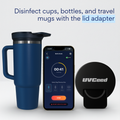
- Your reusable water bottle spout and threads
- Your suitcase wheels and handle (before storing at home)
- Hotel room high-touch spots: TV remote, door handle, faucet handle, alarm clock (which a Purdue study identified as one of the least-cleaned hotel surfaces)
- Your reusable coffee mug or wrapper
Where UV-C does not help:
- Inside your body once a virus has already entered your respiratory tract
- On fabric with folds and creases (line-of-sight limit)
- Through a phone case (remove it first)
- On the airport surfaces themselves; UV-C is not a public-space tool
Where UVCeed Fits
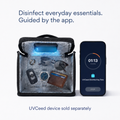
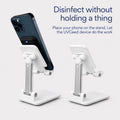
UVCeed is a 254 nm UV-C device that pairs with your phone and uses your camera plus the app to guide you through a session on the exact surface you are treating. You aim UVCeed at one section (phone screen, then phone back, then edges), hold it steady while the app confirms the section is complete, then move to the next section. For a hotel remote or a suitcase handle you cover the full surface one section at a time. The tilt-safety shutoff kills the lamp automatically if it rotates away from the target.
For a traveler, the practical routine is 90 seconds total: phone at the gate, water bottle after refill, passport and boarding pass at the hotel, TV remote and door handle when you check in. USB-C charging means it lives in your carry-on and always has power.
FAQ
Are TSA trays actually dirtier than the toilet? Yes, in terms of respiratory virus load. The BMC Infectious Diseases study found 50% of tested trays were positive for respiratory viruses, higher than any other surface in the terminal including bathroom surfaces.
Should I wipe the airline tray table before I use it? Yes. ATP swab data from the audits cited above puts the tray table around 11,600 CFU, and CDC influenza persistence data shows flu virus survives 24-48 hours on hard surfaces. A wipe or a UV-C session before you eat off it is warranted.
Do the airplane HEPA filters make cabin air safe? Yes, for airborne particles. HEPA filters do not disinfect the surface you touch on your armrest or tray. The FAA acknowledges this distinction in its cabin air guidance.
Is my phone the dirtiest thing on my trip? It is one of them. Multiple studies have found phones with more bacteria than a toilet seat, and airport travel amplifies that because your phone is on the tray at security, on the counter at the gate coffee shop, in your hand at the restroom sink, and out again for boarding. A UV-C session at the gate is the highest-leverage 30 seconds of your trip.
Is UV-C safer than a chemical wipe for travel? Wipes work but leave residue, run out, and generate trash. Quaternary ammonium residues were found in the blood of 80% of tested adults in a 2021 study in Environmental Science and Technology. UV-C leaves no residue, works on line-of-sight surfaces, and is reusable. Combine both if you want to hit fabric (wipes) and hard surfaces (UV-C).
The Bottom Line
Airports are dirty because they concentrate hundreds of thousands of hands per day onto a small set of plastic surfaces that never get disinfected between users. You cannot fix the airport. You can fix what leaves it with you. UVCeed handles the phone, the passport, the water bottle, and the suitcase handle in under two minutes, and it is chemical-free enough to use every leg of the trip.
Want More Articles Like This?
Get research on UV-C treatment and product updates delivered to your inbox.