President Trump said Monday he was concerned the Ebola outbreak in the Democratic Republic of Congo could have a "breakout" beyond its current geographic footprint. The same day, WHO Director-General Tedros Adhanom Ghebreyesus told attendees of the World Health Assembly in Geneva that he was "deeply concerned about the scale and speed of the epidemic." An American physician, Dr. Peter Stafford, had already been evacuated to receive specialized treatment after contracting Ebola while treating patients at Nyankunde Hospital in eastern Congo.
Three separate figures - the President of the United States, the head of the World Health Organization, and the infection control logs of a U.S. hospital preparing to treat an Ebola patient - all converged on the same word in the same week: concern.
For most Americans, Ebola registers as a remote threat, something that happens in central Africa and occasionally generates headlines before fading from view. The 2014-2016 West Africa outbreak was the worst in recorded history - over 11,000 deaths - and even then, the U.S. case count reached only eleven, with two deaths. The statistical argument for complacency is real.
But the statistical argument is not the only argument that matters. The current outbreak involves a strain that existing vaccines do not cover. The outbreak went undetected for weeks because the local laboratory was not equipped to test for the correct strain. It has already crossed an international border into Uganda. One American has already been infected. And the surface survival data for Ebola - most of it published by the NIH and CDC and largely unknown outside clinical settings - tells a story about this virus that has direct implications for healthcare workers, international travelers, and anyone operating in or near clinical environments where an infected patient could theoretically present.
What Makes This Outbreak Different from Everything That Came Before
The Ebola outbreaks most people remember - the 2014-2016 West Africa disaster, the Kivu outbreaks of 2018-2020 - were driven by the Zaire strain. Zaire is the most studied, most feared, and most prepared-for Ebola virus. The two approved vaccines that exist - rVSV-ZEBOV (Ervebo) and Ad26.ZEBOV/MVA-BN-Filo (Zabdeno/Mvabea) - were both developed specifically to target Ebola Zaire. Ring vaccination campaigns using these vaccines were central to the containment strategy in every recent Zaire outbreak.
The current outbreak is not Zaire.
It is the Bundibugyo strain, first identified in Uganda in 2007. Bundibugyo is rarer, less extensively studied, and critically, not covered by either of the approved vaccines currently in international stockpiles. When the WHO or the DRC government deploys its standard Ebola response toolkit - including ring vaccination of contacts and healthcare workers - those vaccines provide no protection against the strain that is actually killing people in Ituri province right now.
The Congolese Health Minister confirmed this week that the outbreak spread undetected at first precisely because local laboratories were only equipped to test for Ebola Zaire. The Bundibugyo strain was not identified until samples were shipped over 620 miles to the capital of Kinshasa for analysis. By that point, the outbreak had already been underway for weeks. Jean-Jacques Muyembe, the virologist who first identified Ebola in 1976, called the situation "catastrophic" and said the surveillance system "didn't work."
"There were deaths, and nothing was being said," Muyembe told the Associated Press.
The Outbreak by the Numbers
| Stat | Detail |
|---|---|
| 131 | Confirmed deaths as of May 19, 2026 |
| 500+ | Suspected cases as of May 19, 2026 |
| 25-40% | Estimated case fatality rate for Ebola Bundibugyo |
| 3 weeks | How long the outbreak spread undetected before WHO was notified |
| 2 | Cases confirmed across the border in Uganda - one fatal |
| 1 | Confirmed American infection - Dr. Peter Stafford, now evacuated |
| 0 | Approved vaccines for the Bundibugyo strain |
| 0 | Approved antiviral treatments for Ebola Bundibugyo |
That last row carries the same weight it did in the hantavirus analysis. When there is no vaccine and no treatment, the entire burden of managing the disease falls on a single intervention: preventing exposure in the first place. The WHO's own position on this is clear. "The disease is transmitted through contact with bodily fluids," Muyembe said. "If you avoid this contact, you break the chain of transmission and the epidemic stops."
Avoiding contact with bodily fluids is partly a behavioral question. It is also, in ways that most people have not thought carefully about, a surface disinfection question.
What the NIH and CDC Surface Survival Data Actually Shows
The dominant mental model most people hold for Ebola - that it requires direct, wet contact with infected bodily fluids and dies almost immediately outside the body - is incomplete.
Ebola on dry surfaces such as doorknobs and countertops can survive for several hours, according to CDC guidance. That is the figure most commonly cited because it describes the typical scenario under normal temperatures. But the peer-reviewed literature, including a landmark NIH study conducted during the 2014 outbreak and published in the journal Emerging Infectious Diseases, paints a more detailed picture that matters considerably for anyone working in or near clinical settings:
| Surface Type | Environmental Conditions | Ebola Survival Time |
|---|---|---|
| Plastic (non-porous) | Hospital conditions (21C, 40% humidity) | Up to 8 days |
| Stainless steel | Hospital conditions (21C, 40% humidity) | Up to 4 days |
| Tyvek (PPE material) | Hospital conditions (21C, 40% humidity) | Up to 11 days |
| Dry surfaces (general) | Room temperature | Several hours |
| Bodily fluids (blood) on surfaces | Room temperature | Up to several days |
| Dried blood on glass | Low temperature storage | Up to 50 days (DSTL study) |
| Water | Room temperature | Up to 6 days |
Sources: NIH/NIAID Rocky Mountain Laboratories; CDC Ebola FAQ; UK Defence Science and Technology Laboratory; Emerging Infectious Diseases vol. 21 no. 7
The NIH study's lead researcher, Vincent Munster of the Virus Ecology Unit at the National Institute of Allergy and Infectious Diseases, stated explicitly: "We found that the Ebola virus can persist on surfaces in hospitals, so it is very important that workers follow protocols for thoroughly disinfecting and removing protective gear when leaving an Ebola treatment unit."
The hospital environment is not incidental to this finding. The cool, low-humidity, climate-controlled conditions typical of American hospitals and clinical facilities - 21 degrees Celsius, 40 percent relative humidity - are precisely the conditions under which Ebola survives longest on surfaces. A stainless steel surface in a hospital procedure room is not an inhospitable environment for this virus. It is one of the most favorable.
"We found that the Ebola virus can persist on surfaces in hospitals, so it is very important that workers follow protocols for thoroughly disinfecting."
- Vincent Munster, Chief, Virus Ecology Unit, National Institute of Allergy and Infectious Diseases
Why Healthcare Workers Bear the Highest Burden - and Why Surface Decontamination Is Central to Their Protection
In every major Ebola outbreak on record, healthcare workers have been disproportionately represented among the infected. During the 2014-2016 West Africa outbreak, healthcare workers accounted for approximately 3-4% of all confirmed cases despite representing a tiny fraction of the exposed population. The 2018-2020 Kivu outbreak saw repeated healthcare worker infections that contributed to the duration and difficulty of containment.
Dr. Peter Stafford's infection this week is consistent with this pattern. He contracted Ebola while treating patients at Nyankunde Hospital. Two other medical workers - his wife Dr. Rebekah Stafford and a physician named Dr. Patrick LaRochelle - were exposed during patient care and are currently under quarantine.
The mechanism behind healthcare worker vulnerability is not primarily behavioral failure. Skilled, experienced clinicians follow protocols. The mechanism is environmental: clinical spaces where Ebola patients are treated become contaminated with viable virus on the surfaces that healthcare workers touch, sit on, rest equipment against, and inadvertently contact in the course of delivering care. PPE provides a barrier during active patient contact. It does not protect against a contaminated doorknob on the way out of a treatment room, a surface that was handled during a procedure and not yet decontaminated, or any of the dozens of minor surface contacts that occur in a clinical environment over the course of a working shift.
Decontamination of clinical surfaces - using disinfectants with established Ebola efficacy, applied with correct contact time, covering all potentially contaminated surfaces - is the primary environmental control measure for Ebola in clinical settings. It is also, the NIH data makes clear, an ongoing requirement rather than a one-time event, because Ebola on hospital surfaces does not die quickly.
UV-C: The Decontamination Standard Already in Use in Ebola Treatment Units
UV-C irradiation at germicidal wavelengths is not new to Ebola containment. It has been used in Ebola treatment unit decontamination since at least the 2014 outbreak, both for room-level decontamination and for the treatment of equipment and PPE that cannot be bleach-washed without damage. WHO and Medecins Sans Frontieres treatment unit protocols both incorporate UV-C irradiation as a component of their environmental decontamination procedures.
The scientific basis for UV-C efficacy against Ebola is strong. Ebola is a filovirus with an outer lipid envelope - the same structural characteristic that makes RSV, influenza, SARS-CoV-2 and other enveloped viruses among the most UV-C sensitive pathogens known. The lipid envelope is highly vulnerable to UV-C irradiation at 265nm. UV-C light at germicidal wavelengths penetrates the envelope, destroys the viral RNA, and renders the pathogen non-infectious. Unlike chemical disinfectants, UV-C requires no contact time in the traditional sense - it works at the speed of light on surfaces within its field of irradiation.
For Ebola specifically, this matters for a reason that is not always appreciated: the NIH surface survival data was generated precisely because researchers needed to understand the risk posed by surfaces in Ebola treatment units - environments where liquid disinfectants are in use but where complete, verified surface coverage is difficult to achieve in practice. UV-C provides coverage confirmation that chemical disinfection cannot. You can see, in real time, what has and has not been treated.
Meet UVCeed: The Hospital-Grade UV-C Device Now Available to the Professionals Who Need It Most
UVCeed was developed by Dr. Peter Bonutti to bring the UV-C surface decontamination technology used in hospital infection control into the hands of the people who most directly face pathogen risk - healthcare workers, clinical staff, and informed families who understand that prevention is not passive.
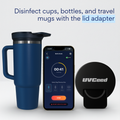
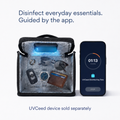
The device combines a medical-grade 265nm UV-C LED with machine vision, AI-powered safety monitoring, and real-time app-guided coverage confirmation. It is the same wavelength used in institutional UV decontamination systems - including those deployed in Ebola treatment units - in a compact, portable, rechargeable form that goes wherever the risk is.
For healthcare workers operating in clinical environments where international patient presentations are possible, or in any facility treating patients who may have traveled from active outbreak regions, UVCeed offers a practical, portable UV-C pre-treatment capability for high-contact surfaces: workstation counters, procedure carts, equipment handles, doorknobs, and any surface that warrants a rapid decontamination pass between contacts.
What UVCeed delivers:
- Medical-grade 265nm UV-C LED - the same wavelength used in Ebola treatment unit decontamination systems
- 99.9% elimination of viruses and bacteria including enveloped RNA viruses in 30 seconds of proper exposure
- App-guided real-time visual coverage confirmation - no guessing about what was missed
- Patented AI safety monitoring - automatic shutoff if a person or pet is detected
- Machine-vision 3D surface mapping - verifiable, complete coverage
- Zero chemicals, zero residue, zero contact time delay
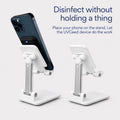
- MagSafe compatible - pocket-sized, rechargeable, deployable in any setting
Currently deployed at Sarah Bush Lincoln Healthcare for professional-grade surface disinfection - the same UV-C technology and identical wavelength used in clinical Ebola decontamination protocols, now available for healthcare professionals and informed families.
The Scenarios That Matter Most Right Now
Healthcare Professionals in Clinical Settings
Any healthcare worker treating patients in an emergency department, urgent care, or clinical setting where international travelers may present has an elevated interest in rapid, verifiable surface decontamination of high-touch areas. The NIH data on Ebola surface survival under hospital conditions - up to 8 days on plastic, 4 days on stainless steel - establishes why chemical disinfection alone, applied inconsistently or without verified contact time, is insufficient as a sole environmental control measure.
International Aid Workers and Medical Missionaries
Dr. Stafford's case is a direct illustration of the exposure scenario for medical workers operating in or near outbreak regions. Aid workers, medical missionaries, and NGO clinical staff working in sub-Saharan Africa or who have recently returned from outbreak-adjacent regions face the most direct exposure risk outside the DRC itself. UV-C pre-treatment of equipment, personal items, and work surfaces is a practical first-line risk-reduction step.
International Travelers Transiting Through Affected Regions
Two Ebola cases have now been confirmed in Uganda - both travelers from the DRC. Airport transit through Entebbe, Nairobi, Addis Ababa and other East African hubs brings travelers into environments shared with passengers from active outbreak regions. High-touch surfaces - tray tables, armrests, lavatory surfaces, gate seating - cannot be reliably evaluated for contamination status. A portable UV-C device provides a practical pre-contact treatment option for travelers who take these risks seriously.
Preparedness-Minded Households with Healthcare Workers
In the household of a nurse, physician, paramedic or emergency responder, the risk calculus for surface decontamination is different than in a household with no clinical exposure. The surfaces that matter are the ones that bridge between the clinical environment and the home: bags, phones, keys, and the surfaces of the car and entry areas where work clothing and equipment make contact before decontamination. UVCeed provides a systematic, verifiable treatment of those surfaces.
Veterinary and Laboratory Professionals
Laboratory settings handling biological samples - including reference labs that may receive samples from international sources or that process samples from clinical facilities - operate in environments where surface contamination with unknown pathogens is a documented occupational risk. UV-C pre-treatment of sample handling surfaces, biosafety cabinet exteriors, and equipment surfaces is consistent with standard biosafety practices.
Why "Low Risk to the General Public" Is the Beginning of the Conversation, Not the End
Every major Ebola outbreak in history has been accompanied by the same official messaging: "The risk to the general public remains low." That statement has always been epidemiologically accurate. And it has always been somewhat beside the point for the people whose actual exposure risk is not "the general public" - it is the specific subset of people with clinical exposure, occupational risk, or travel history that places them in proximity to outbreak-linked cases.
The 2014 outbreak arrived in the United States via a single patient in Dallas. Before the chain of transmission was identified and contained, two healthcare workers who treated that patient were infected - both in a fully equipped American hospital, following established protocols, in a city of 1.3 million people with world-class medical infrastructure. The surface survival data published by the NIH in direct response to those healthcare worker infections explained the mechanism: Ebola persisted on hospital surfaces far longer than the prevailing guidance had suggested, and the decontamination protocols in place were not consistently achieving complete coverage.
What changed after Dallas was that hospital infection control took UV-C whole-room decontamination far more seriously as a complement to chemical cleaning protocols. The portable, app-guided UV-C capability that UVCeed provides represents the same logic applied at the individual level - for the healthcare worker, the aid organization, the clinical facility that wants verified surface decontamination rather than approximate chemical coverage.
"Low risk to the general public" is a true statement. It is also a statement about population averages. For the people whose work, travel, or circumstances place them outside that average, the conversation about surface decontamination is a different one.
Protect Yourself and Your Team - Use Code SAFECLEAN for 10% Off
An Ebola outbreak with 131 confirmed deaths, no effective vaccine, no approved treatment, and a confirmed American case is not a distant abstraction. It is an active event, currently the subject of emergency response by the WHO, the U.S. State Department, and the governments of two African nations. Healthcare workers, aid organizations, international travelers, and clinical professionals who take these risks seriously have the same tool available to them that hospital decontamination systems have used for decades.
Get UVCeed at UVCeed.com - Free Shipping
Use code SAFECLEAN at checkout for 10% off. Free shipping. Satisfaction guaranteed.
Frequently Asked Questions
What strain of Ebola is causing the current outbreak, and why does it matter? The current outbreak in the DRC is caused by the Bundibugyo strain, first identified in Uganda in 2007. This is distinct from Ebola Zaire, which caused the 2014-2016 West Africa outbreak and which the two approved vaccines - Ervebo and the Zabdeno/Mvabea regimen - were designed to target. Neither approved vaccine provides protection against Bundibugyo, which means the standard ring vaccination strategy used in recent Zaire outbreaks cannot be directly applied here. The outbreak went undetected for weeks because local laboratories were only equipped to test for Zaire, not Bundibugyo. The case fatality rate for Bundibugyo is estimated at 25-40%, lower than Zaire's historical 50-90% but still among the highest of any circulating pathogen.
How does Ebola spread and what role do surfaces play? The primary transmission route for Ebola is direct contact with bodily fluids - blood, vomit, urine, feces, saliva - of a person who has symptoms of infection. Ebola does not spread through casual contact or airborne transmission in the way respiratory viruses do. However, surfaces contaminated with bodily fluids carry viable virus and represent a documented transmission pathway, particularly in clinical settings. On dry surfaces, Ebola survives for several hours. On surfaces in hospital conditions - plastic, stainless steel - the NIH has documented survival times of 4 to 8 days. In bodily fluids on surfaces, survival can extend to several days at room temperature. Healthcare workers who come into contact with contaminated clinical surfaces account for a disproportionate share of Ebola infections in every outbreak on record.
Does UV-C light kill Ebola virus? Yes. Ebola is a filovirus with a lipid outer envelope, placing it in the class of enveloped RNA viruses that are among the most UV-C sensitive pathogens known. UV-C irradiation at germicidal wavelengths - 254-265nm - penetrates the lipid envelope and destroys the viral RNA, rendering the virus incapable of replication. UV-C decontamination is used in Ebola treatment unit protocols by the WHO and international treatment organizations and was specifically adopted more broadly in clinical settings following the NIH's findings about Ebola surface persistence during the 2014 outbreak. UVCeed operates at 265nm - the same wavelength used in these institutional systems - and eliminates 99.9% of viruses and bacteria in 30 seconds of proper surface exposure.
Who is at genuine risk from this outbreak within the United States? The CDC and WHO agree that the risk of widespread community transmission in the United States is very low based on current data. The elevated-risk categories are: healthcare workers and emergency responders who may treat patients with recent travel history from affected regions; international aid workers, medical missionaries, and NGO clinical staff working in or near the DRC and Uganda; laboratory professionals handling samples from clinical facilities or international sources; international travelers transiting through East African airports with connections from outbreak-affected areas; and household contacts of the above. "Low risk to the general public" describes population averages and does not apply uniformly to people in these categories.
Why have healthcare workers been disproportionately infected in every Ebola outbreak? Healthcare workers represent roughly 3-4% of confirmed Ebola cases in major outbreaks despite being a small fraction of the exposed population. The mechanism is environmental: clinical spaces where Ebola patients are treated become contaminated with viable virus on the surfaces that healthcare workers routinely contact - procedure carts, doorknobs, equipment handles, workstation surfaces. PPE provides protection during active patient contact but not against incidental surface contact outside designated care zones. The NIH surface survival study was conducted specifically because researchers needed to understand how Ebola persisted on surfaces in treatment units after the 2014 Dallas healthcare worker infections. The answer - up to 8 days on plastic, 4 days on stainless steel under clinical conditions - established why standard chemical decontamination protocols were insufficient and drove adoption of UV-C room decontamination systems in high-risk clinical settings.
What is the difference between this outbreak and the 2014 West Africa outbreak? The 2014-2016 outbreak was the largest in recorded history, with over 28,600 cases and 11,325 deaths concentrated in Guinea, Sierra Leone and Liberia. It was driven by the Zaire strain, which has a higher case fatality rate (50-90% untreated) than Bundibugyo (25-40%). The current outbreak is smaller by comparison but differs in several important respects: it involves a strain not covered by approved vaccines; it was significantly delayed in detection due to laboratory limitations; it is occurring in a conflict-affected region where containment operations are complicated by security conditions; and the outbreak in Goma - a rebel-held city - raises particular containment concerns given the difficulty of implementing surveillance and contact tracing in that environment.
Sources: Breitbart News / AP reporting (May 19, 2026); WHO World Health Assembly briefing, Tedros Adhanom Ghebreyesus (May 19, 2026); Colorado Department of Public Health statement (May 19, 2026); Munster et al., "Stability of Ebola Virus under Hospital and Environmental Conditions," Emerging Infectious Diseases Vol. 21 No. 7 (NIH/NIAID Rocky Mountain Laboratories); UK Defence Science and Technology Laboratory Ebola persistence study (2010); CDC Ebola surface survival guidance; Serge missionary organization statement (May 19, 2026); U.S. State Department DRC response statement (May 19, 2026); UVCeed product specifications and laboratory testing documentation.
This article contains affiliate product information. UVCeed product claims are based on manufacturer laboratory testing and published UV-C efficacy literature. UV-C disinfection is one component of a comprehensive infection control approach and does not replace established Ebola exposure prevention protocols including PPE, contact precautions, and facility-level decontamination procedures. Individuals with suspected Ebola exposure should contact their local public health authority immediately. Use code SAFECLEAN for 10% off at UVCeed.com.
Want More Articles Like This?
Get research on UV-C treatment and product updates delivered to your inbox.